“… users can carry [a] backpack keeping adverse effects lower.”
” … I would never, never have the patience …”
Glad someone has alerted packers to the long term adverse effects of conventional backpacks.
As for patience, note that the video clips are somewhat repetitious, and the OP is making his own hip belts and shoulder straps. Contoured belts and straps can be purchased ready made, and for me, have worked just as well, maybe better than home-made. And after all, this is MYOG, and often involves major investments of time.
In his video clips, the OP shows diagrams of the belt resting on the Iliac crests; so understands the anatomy. However, he may not see the importance of using the Iliac crests to support a platform on which ALL of the load rests. Thus making the ‘weight plate’ irrelevant, because there is no weight to put on the plate. There are no ‘adverse effects’ on the back when none of the weight rests on the back. But should note that the center of the pack’s gravity must be kept on the low side to avoid its becoming overly top heavy
Can almost hear the moaning when odes to the late Jack Stepenson are raised again; but he did forsee how, with the use of sidearms, a hip belt did not have to always be tied over the tummy. Sidearms fell by the wayside, however, because most moved the pack’s center of gravity too far backwards, which has ill effects just as damaging as a ‘weight plate.’ I followed a hiker wearing one of Jack’s packs on a very gradual climb up to the tableland below “the window” in the Weminuche Wilderness in the Colorado San Juans, and saw the difficulty he was having without tightening the partial hip belt around his waist.
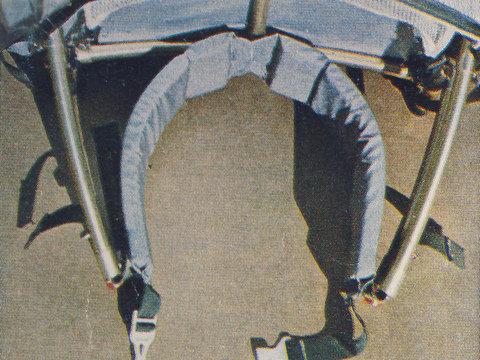
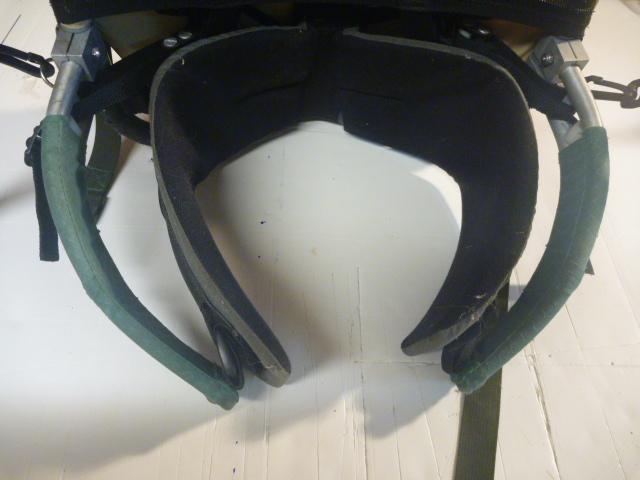
But Jack conceived a three point suspension. Point 1 being the center of the hip belt, attached to the pack at the small of the back, but not touching the back. Points 2 and 3 being the projections of the Iliac crests. To keep the hip belt resting on the crests, sidearms were used to suspend the sides of the hip belt over the crests:

What was missing was an adjustable way to hold the belt FIRMLY over the crests, and that required a cinching device that closes the sidearms just enough to keep the belt over the crests and wrap it against the body; but with the sidearms remaining partially open in the front, and not touching the body:
As with Jack’s pack, the length of the belt is tightened by buckles just behind the points of the sidearms; so that when the sidearms are tightened by the cinching device, the belt never touches the sidearms. The weight falls between the Iliac crests and the small of the back, and close enough to the back to avoid moving the center of gravity uncomfortably backward. Note that while the belt appears roughly circular in the photos, it becomes oval when the pack is worn.
This arrangement was used for several decades during which I developed newer models with improved suspensions. During this time, back pain was never an issue simply because the back was not carrying any weight. Later however, when conventional suspensions were used, represented by the ‘weight plate” in the OP’s diagrams, back pain soon developed.
The next MYOG project will be an ultralight version of the pack, and when it is eventually completed, I’ll share the details with readers of this forum. Maybe someone will market it, and we can post one on the Gear forum. Imagine, backpacking into old age without causing back problems.