Topic

Adding Down to Garments

Viewing 6 posts - 1 through 6 (of 6 total)
PostedFeb 25, 2026 at 2:02 pm

Several times I have had reason to add down to down jackets, sleeping bags and parkas. The job is a bit messy with down plumules floating around but they represent only a tiny amount of lost down.

I un-stitch the compartment to be filled and make a funnel of sorts to help get the always uncooperative down to go into the garment. A short wood dowel rod or sometimes a much smaller item like a pencil eraser end will work to push the down into the garment, depending on the compartment opening size.

I buy DWR treated loose down only B/C it is so much better at moisture resistance. My next project is adding down to two bottom compartments of my -20 F. winter mummy bag where I’ve noticed some lack of loft.

Once I had a tailor make a V shaped nylon fabric pocket to expand the waist of my otherwise very nice Nature Hike down pants. The pocket was centered at the back. He thought I was nuts but when I showed him the down filled area he understood.

Anybody else add down to their gear?

Jerry Adams BPL Member
PostedFeb 25, 2026 at 3:38 pm

I weigh the down in a plastic container.  Then I grasp the down between thumb and finger(s).  Stoff that into the baffle.  Takes several times to get it all in.

Then push down with a stick or whatever like you said

Then sew it closed.

Then fluff it up to distribute down evenly.

Roger Caffin BPL Member
PostedFeb 26, 2026 at 12:14 am

I have filled two MYOG down quilt shells and one MYOG down over-quilt so far.

I start with a large plas bag – washing machine size, plus a collection of discarded cardboard toilet paper rolls.
Put down and TP rolls into plas bag and seal end except for two arm holes – tight ones. Add scale if you want.
Insert arms into bag – like a glove box.
Open down container – yeah, fluff everywhere – INSIDE the plas bag.
By hand, stuff as much down as I can into a number of toilet rolls. Once they are stuffed fairly tight the down does not escape. Very nice. Option here to weigh each full tube with little electronic scale inside the plas bag.
Remove one full toilet roll and insert into opening in quilt (tube), push contents out into quilt with stick or wooden ruler. Repeat.
Yes, a few bits of down escape, but very little. Close end of quilt tube (fold end over first) with bulldog clip
Sew.
Um … then gather all errant bits of down before SWMBO comments.
This method even lets me put the same known wt of down into each tube.

Cheers

PostedFeb 26, 2026 at 2:39 am

I used a vacuum cleaner to fill the compartments. A video of the technique.(Same as Roger)

Youtube video

Tipi Walter BPL Member
PostedMar 26, 2026 at 8:49 am

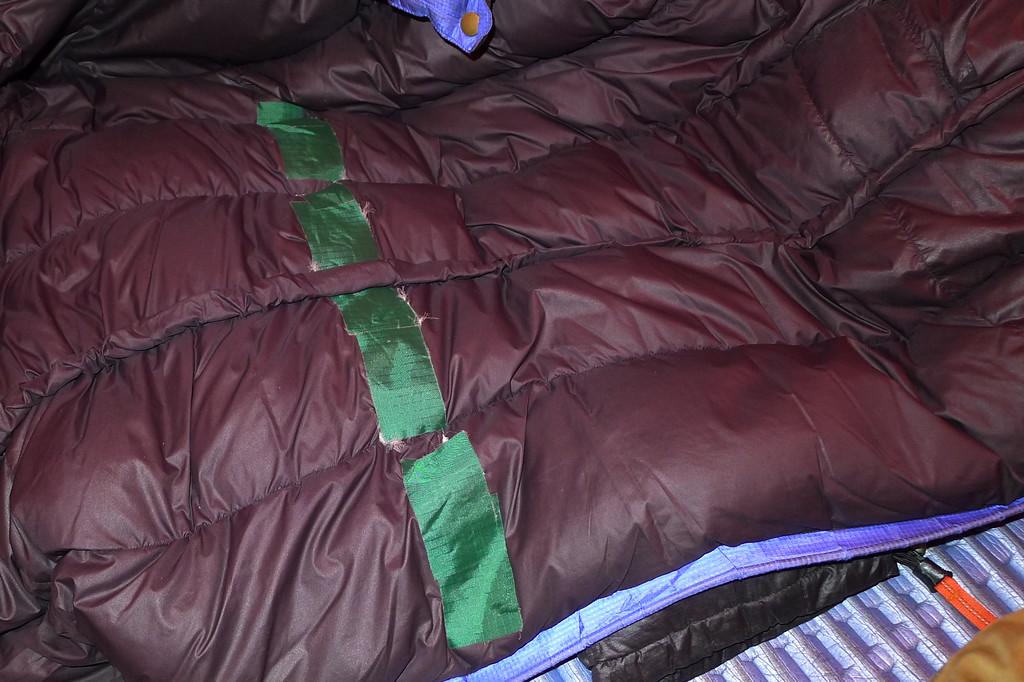
I have an excellent FF Icefall parka which needed an upgrade so I tore apart a defunct Exped Downmat with high quality geese and stuffed about 5 ozs into four of my parka’s baffles the easy way—by cutting slits and closing with ripstop tape ergo no seam splitting and no sewing or needle and thread.  I did all of the work inside one of my zipped up Hilleberg tents in the backyard to contain all the swirling down.  It’s been keeping me warm on 3 winter trips over a course of 38 days.

Mina Loomis BPL Member
PostedMar 29, 2026 at 8:50 am

In spring 1972, using savings from working during a leave from college, I went to the just-opened Whole Earth Provision Company and bought my first actual backpacking equipment, including a down sleeping bag by Gerry.  I don’t remember the temperature rating but it was pretty standard I’m sure.  However I am a cold sleeper and after a few trips, in 1977 or so I wanted to make it warmer and ordered a pound of down from Frostline.  It arrived sewn into two half-pound pillows encased in a light porous fabric.  Following Frostline’s recommendation, I thoroughly soaked the down pillows in water until the down was fully saturated.  I opened the sleeping bag baffles one by one along the outer seam and, portioning by the approximate handful (not being an engineering type) I was able to stuff the down in.  Being all wet, it did not fluff around the room, so it was all pretty easy.  Also not having a sewing machine at the time, I would have stitched the baffles back together by hand.  I used that sleeping bag for over 20 years, for backpacking, car camping, and even as a quilt at home.  It had patches from mishaps and a chewing puppy.  I only replaced it after it started to fall apart completely.

Viewing 6 posts - 1 through 6 (of 6 total)
Loading...