Topic

About TRIPS

Viewing 9 posts - 1 through 9 (of 9 total)
PostedMar 19, 2026 at 3:04 pm

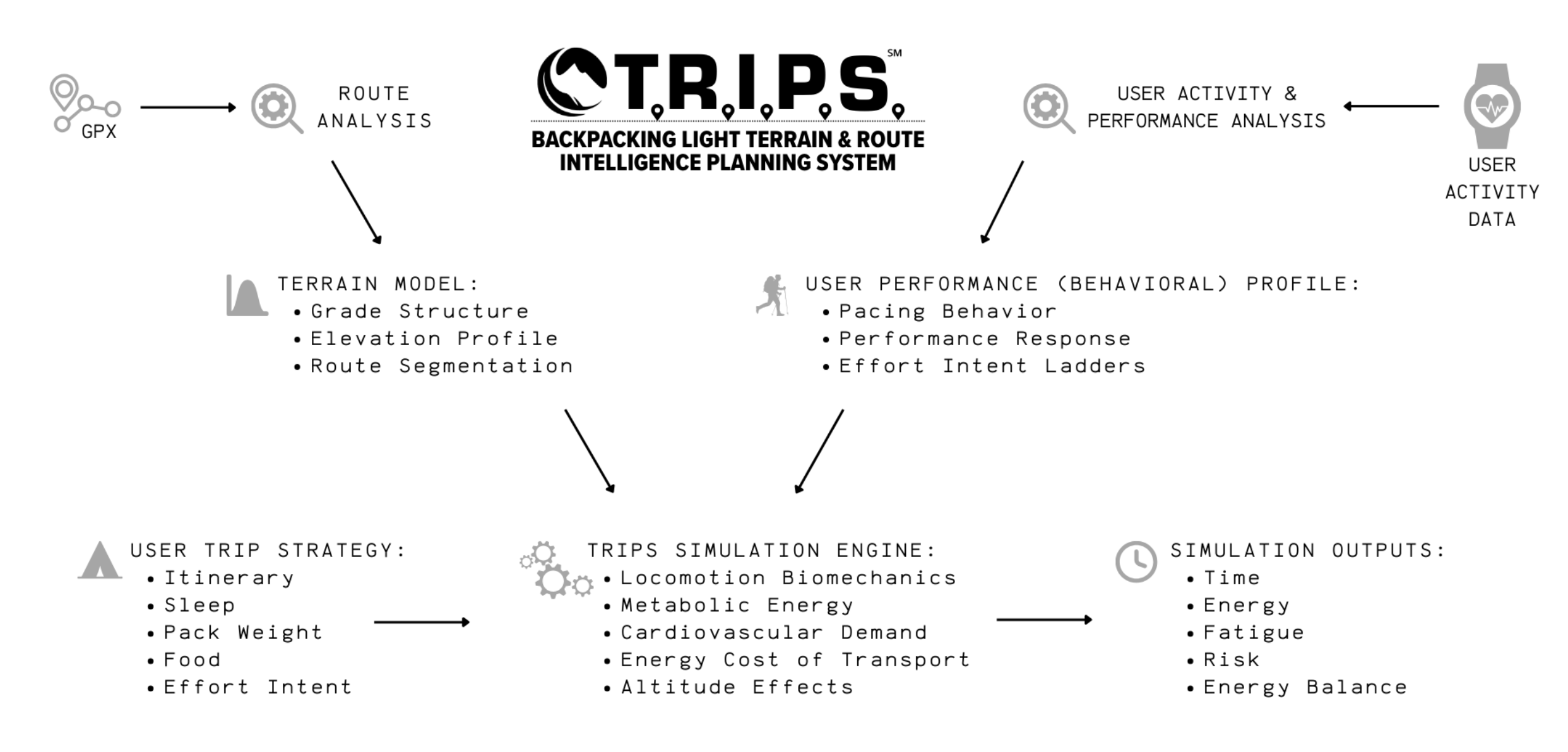
TRIPS is a cloud-based software platform for terrain-based route analysis, predictive simulation, and performance modeling for wilderness travel, expeditions, long-distance hiking, and fastest-known-time (FKT) planning for hikers, guides, athletes, coaches, and physiology researchers.

  • Expected Beta Release Date: April 30, 2026 (to be included with Backpacking Light Unlimited Membership)
  • Expected Public Release Date: June 30, 2026


Learn more: backpackinglight.com/trips

PostedMar 30, 2026 at 8:45 pm

Release update: TRIPS is scheduled for public consumer and enterprise release on June 30, 2026. The production beta version will be available (free) to Backpacking Light Unlimited Members on April 15, 2026. All subsequent production versions will be included for free as part of Backpacking Light Unlimited Membership.

Terran BPL Member
PostedMar 31, 2026 at 8:28 am

Sounds like a good way to complicate a relaxing hike.

David D BPL Member
PostedMar 31, 2026 at 10:41 am

To loosely paraphrase Conan the Barbarian, time enough to relax in the grave!

I listened to the podcast and like the idea of the concept for when pushing big days.  But I’m an engineering geek.  Only a really small subset of hikers would think this way.

To be worth the effort beyond easy existing rules of thumb (energy mile concept etc) it’ll make or break on that little top-right input, the individual calibration.

Exercise literature points to a lot of variance in outcomes between individuals.   I’m not sure it’s possible to make a metabolic model that has broad utility for everyone when the model was designed using data collected from only one individual (Ryan), regardless of the duration of the data set and even if it’s calibrated with individual data.   Usually a base model structure requires data collected from a broad population representing many factors like bmi, age, sex, pre-existing historical injuries, etc.  Guess we’ll see.

PostedMar 31, 2026 at 12:32 pm

A few notes:

1. TRIPS is not intended for all backpacking scenarios.

For low-consequence trips where conditions are familiar and decisions can be made using experience or simple heuristics (e.g., Naismith’s rule, energy mile concepts), TRIPS is unlikely to add meaningful value. In those contexts, added complexity is not justified.

The intended use case is narrower:

  • High-effort days where pacing errors compound over time.
  • Routes with complex terrain or limited bailout options.
  • Situations where energy expenditure, time, and environmental constraints interact in non-linear ways.
  • Trips where small planning errors have larger consequences (e.g., winter travel, load-intensive travel, remote routes, FKTs).

In these cases, heuristic approaches tend to break down because they do not account for interactions between variables such as terrain geometry, load, fatigue accumulation, and individual capacity.

2. On the concern about individual variability and model generalizability:

This is a valid point and aligns with findings in exercise physiology literature – inter-individual variability in metabolic response and performance is substantial.

TRIPS is not positioned as a universal predictive model with high absolute accuracy across all users. Instead, it is structured as a parameterized and calibratable framework:

  • The base model defines relationships between terrain, effort, and movement.
  • Individual calibration is required to meaningfully align outputs with a specific user’s physiology. Without calibration, outputs should be interpreted as directional estimates rather than precise predictions.

In other words, the utility of the system depends less on the generalizability of a single-subject dataset and more on whether the framework can be tuned to improve decision-making at the individual level.

3. On complexity vs. value:

The tool is not intended to replace experience or simplify inherently simple decisions. It is intended to provide additional structure in scenarios where decision-making is already complex and where existing rules of thumb may not be sufficient.

4. Simulation vs. predication. vs. scenario planning

In summary – TRIPS is best understood as a simulation-based planning tool rather than a deterministic predictive system. Its primary value is in allowing users to explore “what-if” scenarios (e.g., changes in pace, load, terrain, campsite locations, or route options) and evaluate their implications for time, effort, fatigue, fatigue-driven risk, and feasibility. The outputs are not intended to be interpreted as precise forecasts, but as structured estimates that support better planning decisions under uncertainty. That said, personal calibration goes a long ways towards allowing TRIPS to provide believable forecasting ranges for outcome metrics (e.g., hiking times, calories expended, etc.).

5. Feasibility analysis

This is where TRIPS can provide a lot of value:

A core application is evaluating whether a proposed route plan is feasible given a user’s capacity and constraints. This includes identifying where plans may be overly optimistic, where fatigue accumulation may create downstream risk, and where adjustments to pacing, load, or itinerary may be required to maintain reasonable safety margins.

If you already know that your route is feasible and relaxing and low-risk and simple and you’re confident at being able to execute it with plenty of time and energy and fatigue margin, then the value of TRIPS is more limited – still valuable as a sanity check, though, because when calibrated with your historical user data, it’s quite good at predicting hiking time and actual active calorie (energy) expenditure along a route.

David D BPL Member
PostedMar 31, 2026 at 1:32 pm

Nice overview, thanks for explaining the context.   A “what if” tool sounds like best use.

My point was different though.  It’s not a criticism but a risk/complexity factor to consider.

When making models predicting human response to external factors (I used to work in audition doing just this), two factors need consideration:

  1. a broad sampling data set across a varied user base to create the base model.  Broad sampling may (usually does) capture a multitude of interdependencies between independent variables that sampling from one user will miss
  2. sometimes (often, depending), calibration data to seed the model

TRIPS accounts for #2, but uses only your data to create #1.  It’s very possible that this narrow sampling used to create the model framework will make it’s application limited to a narrow set of individuals, even in what if scenarios.

I’m not saying it will, just that in my professional work, single person sampling to create the model carries this real (and often significant) risk


PostedMar 31, 2026 at 1:37 pm

I see what you’re asking about. To clarify, TRIPS was not developed with my data – all of its models were derived and validated against various population-level datasets from research studies, as well as hikers, backpackers, ultrarunners, long-distance hikers, and FKT athletes.

David D BPL Member
PostedMar 31, 2026 at 1:49 pm

Ah, big difference and important qualifier.  Thanks for clearing that up.  In your podcast and from what I read the impression was that the model relied on your watch data from over the years.

PostedMar 31, 2026 at 1:55 pm

Studying my data allowed me to come up with some of TRIPS’ original modeling hypotheses, but obviously those can’t be validated without much broader datasets. In addition, my data is limited by my own biased trip types and physiological responses and behaviors, so extending TRIPS’ models absolutely requires other populations.

Viewing 9 posts - 1 through 9 (of 9 total)
Loading...