


Anybody have a DIY method of "seasoning" the inside and outside of an Imusa mug to "seal" the pores somewhat?
Topic
Become a member to post in the forums.
Anybody have a DIY method of "seasoning" the inside and outside of an Imusa mug to "seal" the pores somewhat?
Dan,
I was thinking about that just the other day as I wss looking over.some new IMUSA pots
I had two interesting experiences if the lastt few years with the Imusa 12CM and Walmarts new takl 1.5 qt IMUSA made grease pot.
I noticed after boiling several pots of good strong "Cowboy Coffee" in them, they aquired a bronze color on the inside. Could not wash it out. It was IN the metal.
After that, curious things happened. We have very hard water and the lime deposits in pots show quickly after a few boils. Its bad enough I have to use a Vinegar solutuon to keep it at bay. Also, food cooked in them never stuck and as long I washed the pots well after each Coffee boiling session, I have never had a "coffee taste" imparted to other food or water, either.
The only thing I can think of is the open pored Alumnium + Coffee Bean oils = seasoning the pot.
As far as the outside of the pots go, Rustleum 2,000 degree flat black engine paint shoukd work well for that.
Thanks jimmer. I also was thinking about hard anodized aluminum pots being talked about recently. Way back when, I worked for a company that screen printed on anodized, unsealed aluminum sheet and then after the ink dried, the sheets were sealed one by one in a tank of boiling water that contained nickel acetate solution. The sheets were then processed into name plates that were eventually fasten to NASA satellites and probes etc. The ink was permanently sealed and protected from the harshest atmospheric conditions. The ink used was special for unsealed anodized alum.
I suspect the boiling water in your pot used for cowboy coffee had something to do with sealing the aluminum and the coffee color into the aluminum. what's really interesting is the interior surface of your pot was not affected by washing it with vinegar aka acetic acid(weak) and did not affect the sealed in coffee color.
After a little googling I found this info:
We currently warm seal anodized aluminium extrusions in water at approx. 100 C (212 degrees Fahrenheit). I understand that appropriate quantities of nickel acetate will help the sealing process. Could someone explain how it works? How much nickel acetate should we add? How can we check the concentration of nickel acetate?
Thanks
Sanjay A. Bulchandani
– Bombay, India
________________________________________
—-
Nickel sealing is often used for dyed anodic oxides, since it is colorless. The corrosion resistance afforded by the process is generally not as good as boiling water or steam seal, unless the nickel acetate process is done at boiling temp. Cobalt acetate may also be used. A practice [mix] found in The Surface Treatment & Finishing of Aluminum and its Alloys by S. Wernick, R. Pinner, P.G. Sheasby is:
5 g/l nickel acetate, 1 g/l cobalt acetate, 8 g/l boric acid (in distilled water) for 15-20 min at 70-90 C and pH 5-6.
Gary A. Nitowski
Alcoa Center, Pennsylvania
________________________________________
—-
You might want to review the following two references which explain what occurs during sealing and provide information on seal bath make-up:
1. "Sealing of Aluminum and its Alloys," Roy C. Spooner, Metal Finishing, December 1968, page 44.
2. "Sealing of Anodized Aluminum — A Review," Benjamin Yaffe, Metal Finishing, May 1990, page 41.
In order to determine the nickel acetate concentration in a solution, we use the following method:
Reagents:
EDTA (21.4 g/l = 0.0575 M)
Ammonium Hydroxide
Murexide (0.2 g Murexide to 100 g NaCl)
Procedure:
Take a 2 ml sample in a 250 ml Erlenmeyer flask and 50-75 ml of water. Add 10 ml ammonium hydroxide. Add a pinch of murexide and titrate with 0.0575 M EDTA to a blue-purple endpoint.
Calculation:
oz/gal Ni Acetate = mls EDTA x .678
Blair Smith
aerospace – Windsor Locks, Connecticut
________________________________________
—-
Nickel acetate works as as catalyst in the sealing process. Also, the nickel ions are incorporated into the pores on your coating, which is why the nickel acetate bath can seal anodized aluminum more quickly than water alone. The nickel ion basically blocks or fills up the opening to the pore.
Also, nickel acetate will not leach the color out of your dyed parts, which makes it very effective in dyeing operations.
Jerry Janssen
– Streamwood, Illinois
________________________________________
________________________________________
August 1, 2012
Q. We are currently using a Nickel Acetate Seal Bath. It is only nickel acetate and a desmut agent in the bath. I see that you say to use cobalt acetate as well as boric acid. Could you explain the advantages of using these chemicals in addition to nickel acetate?
It says in The Surface Treatment and Finishing of Aluminum and Its Alloys, on page 894 that there is little or no difference between the nickel and cobalt salts, but are frequently used together.
Also when controlling the concentration of nickel acetate in the bath, are you trying to control the amount of Nickel Ion in the bath? Or are you trying to control the amount of Nickel Acetate in the bath.
Thanks, any help is appreciated.
John Renbarger
– Boulder, Colorado, USA
1. Description
High purity Nickel Acetate is used widely to seal anodic coatings on aluminum. The sealing process
consists of immersing the anodized aluminum in a boiling nickel acetate solution. When sealing with
nickel acetate alone, a smutty deposit will form on the work. This can be prevented by the addition of
a wetting agent such as Specialty Dispersant. Nickel acetate is suitable for sealing dyed or clear
anodized aluminum. Nickel acetate offers the advantage of increased weather and light fastness on
coatings dyed with organic dyes.
2. Suggest formulation
Nickel Acetate: 4-5 g/l
Specialty Dispersant: 2-3 g/l
Benzoic Acid: 1-2 g/l
3. Application instructions
pH: 5.2 – 5.9
Temperature: 200-210°F
Seal time: 10-25 minutes
4. Conditions for using Nickel Acetate
Tank: Stainless steel or other acid resistant material that that can withstand a
constant operating temperature of 210F.
Separate seal tanks for clear and dyed work.
Water quality: Deionized
pH adjustments: Lower with acetic acid.
Raise with dilute ammonium hydroxide.
pH should be checked once per shift with a calibrated meter.
Rinse: Before sealing, a thorough rinse is necessary to remove any foreign substances.
After sealing, the work load should be thoroughly rinsed at once before it is dried.
Filtration: Field experience has shown that continuous filtration through a 5-35 micron filter is
beneficial. Do not use a carbon filter.
Sealing time: 2-3 minutes per 0.10 mil. oxide coating
Become a member to post in the forums.
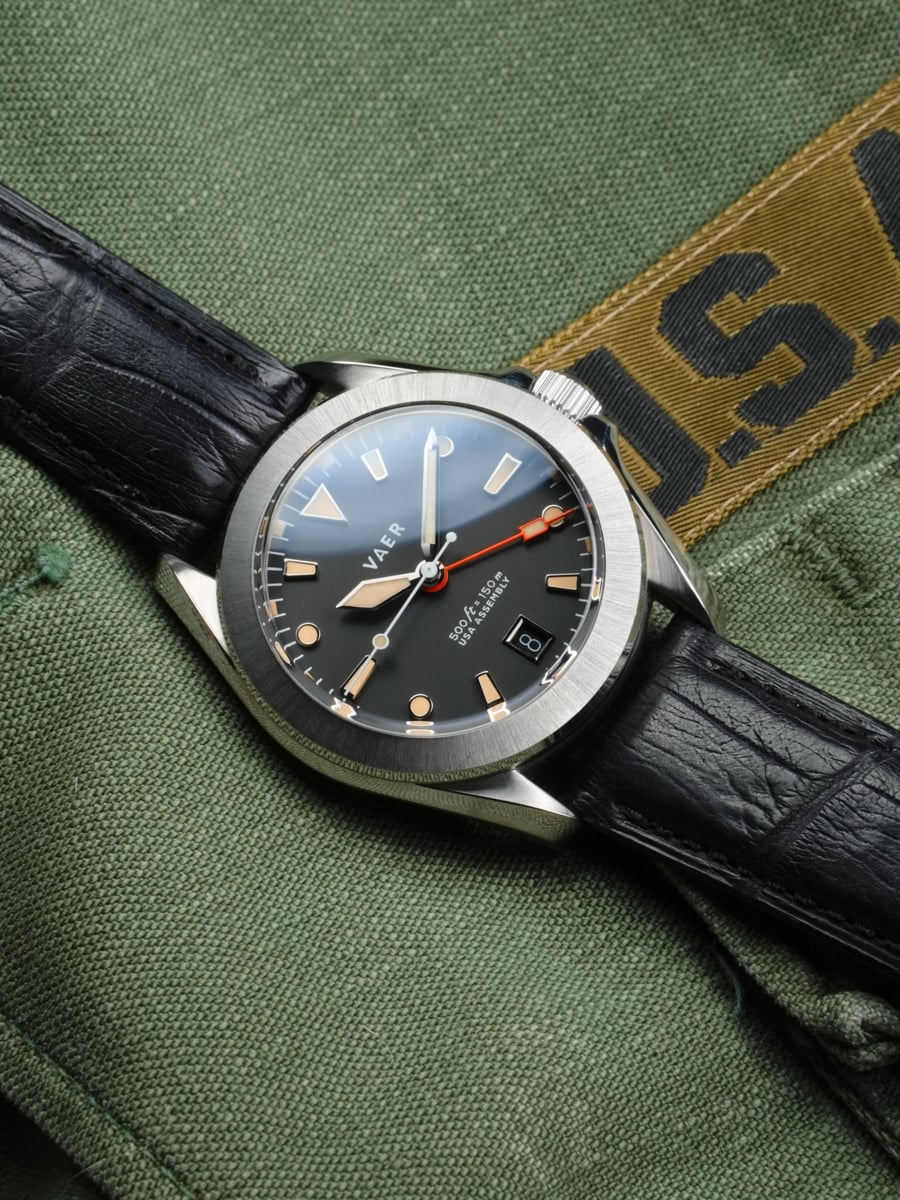 A Cult-Classic GMT Reimagined for Everyday WearInspired by the famously bezel-stripped Rolex GMT-Master worn by Marlon Brando in Apocalypse Now, the G2 Apocalypse turns a piece of 1970s film and watch history into a practical everyday GMT. Its restrained 39mm design pairs a Swiss Ronda quartz GMT movement with sapphire crystal, 150 meters of water resistance, strong BGW9 lume, and USA assembly. The result is an accurate, low-maintenance travel watch with a story collectors will immediately recognize.
 © Beartooth Media Group Inc.
 Loading...