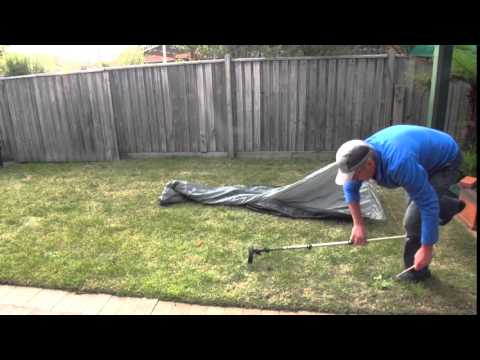
So I've now got my Protrail, most excellent service from Tarptent, as usual, and such prompt replies to small questions. I've erected mine in garden to just get familiar with it, how to pitch, and coming from a Notch which I really like, I can see where some differences are apparent. TO use pros/cons isn't what I'm thinking just a different set of emphasis and features. I've read that "I'll never use a front entrance again" well I can see the benefits of two entrances, most so for 2+ people tents and a secondary advantage to cook away from the wind in the porch facing away as wind moves around, but as for entrance/exit, to be honest, the Protrail's size of exit is about the same as the Notch, and you can sit sideways and cook one-handed just as easily as in the Notch, so the only reduction for a 1-person tent is moving from 2 to 1 porches. If you're 1-person the only advantage of 2 porches, when that 2nd porch restricts your internal space, is wind-moving cooking resolving. So it depends on your situation. Space. The Notch has an adequate internal width and 2 porches, the Protrail has different proportion to give one smaller porch and more internal space, so that depends how you like to live in your shelter. Storm worthiness, so here I have a more complicated p.o.v. I've watched many tents fail since I began camping in 1983. The most typical is just bad T-shaped-pegs which swivel out the ground and the tent unstitches and flies away. The next is just not making a tight pitch and the tent bounces in the wind, and wiggles the pegs and then unstitches and flies away. All BPL members know that and so that doesn't apply here. So with good pegs and a taught pitch then I look from all the angles and I can see the Protrail has a bit more vulnerability to wind than the Notch in that the longest largest area doesn't have a guy resisting, only pegs at the "hem line". Then the issue is that it is hard in real-world to get all the pegs along the hem line perfect, there's usually some rock in a few places and so the guy line which can be moved much more flexibly over angle and distance can give a more consistently strong anchor. The closest method I've seen to protect hem line pegs is just to attach cord to that peg and "protect" it with a peg further out, that protector peg can be at any distant/angle and so it can resist the force on the hem peg. That method isn't perfect, it just lowers the peak force on the peg and makes the hem peg come out later but then the protector peg is still in the ground. If this sounds scsry, just remember the worst weather changes fastest, just lasting a bit longer can make the difference. Mention of the grommet being the failing point. How was the pole fixed? If the pole is in the grommet and the fabric of the tent is attaching to the ground then as the tent moves the grommet moves and pulls the pole with it, so you shouldn't get grommet failure, and as the tent moves it reduces the force on the pole so no pole failure either. If you GUYED the pole separately, e.g. a guy line through the vent to an external peg not attached to the fabric, THEN the tent fabric is being pulled by the wind but the pole is fixed not moving as its not being pulled by the fabric so causing grommet to move more independent of the pole. In my case, the Protrail is more of an easy pitch backpacking 1-wall in warmer climates where wind isn't so much the issue, and the Notch is more for bike touring (I keep my bike in 1 porch and entry/exit/cook in the other) and double wall (I go for part-solid) give more sleeping wind and more insulation effect and so more for cooler situations. But I'm glad to have the choice and both are great shelters. Protrail, it's a great price, if you have any memories of the tents in 1983….. Protrail is about the same protection and about ……. 25% the weight?


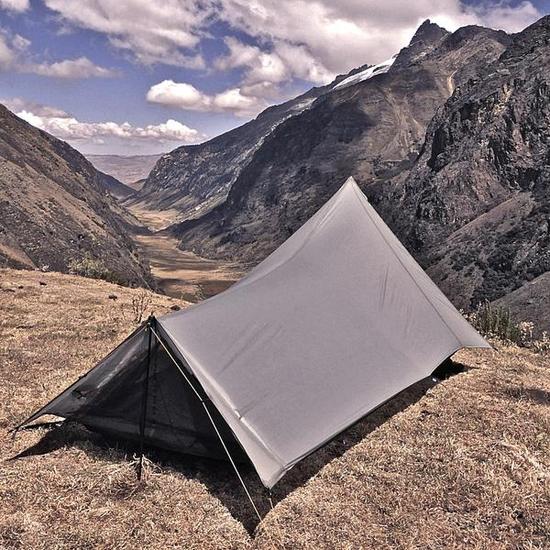
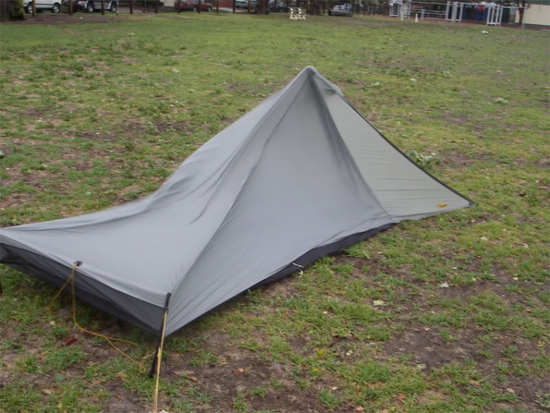 in the same wind, set up a different way, you have a solid shelter with plenty of space inside (The ProTrail is very similar) :
  the trick here is longitudinal tension (front and rear guylines ) the side tie outs alone will not do it. To add, the four corner stakes are in the same place with the same tension.