Hi all,
first: best wishes for 2015.
Then this:
it has been written here (where ? is there a BPL-article ?) that lower FP-down acts better then high FP-down in a humid environment, because of the higher feather content.
Now, I was thinking that now DWR-down gets quite some attention, a treatment of the high FP-down against humidity would be beneficial for that down ?
E.g. when deciding to buy a new SB/quilt, one would have to choose between e.g. 900 FP gear and 600 FP gear (choosing for 900 FP gear has the advantage on needing a smaller fillamount for the same warmth thus reducing some weight while choosing 600 FP gear would act better in humid conditions). 900 FP gear with such an anti-humidity treatment would offer both a lower weight and performing somewhat equal in a humid environment as 600 FP down.
Good (and interesting) question or instead a bad question ?
Topic
Could high FP-down benefit from an anti-humidity treatment ?
Become a member to post in the forums.
- This topic is empty.
Its one of the marketing claims made of DWR down
How it works in reality no one knows … I havent seen any real tests
Also interesting is whether flurocarbon treated DWR lessen body oils getting onto the down as its used as stain guard resistance in other applications
However until theres real published tests its all BPL speculation and marketing spin
;)
it's just that while I do not need a new SB/quilt now, I do am constantly looking for possible replacements and as such I can wait. So I do wonder if it's worthwhile to wait for a treatment that is proven to work.
BTW, that low FP – high humidity claim, is that just forum talk or is it actually discussed in a BPL-article ?
Why would a lower fp down be more vapor permeable than a higher fp down?
If anything, I'd suspect the opposite would be true – unless there's something to the down plumes actually "absorbing" the vapor before it moves along.
Matt,
if I remember wright it should have something to do with how lower the FP, the higher the feathercontent and how higher the feathercontent, the better the perfomance/recovery in higher humidity would be.
That's exactly it. As there is a temperature gradient, moisture can condense within the down. The plumes also aren't hydrophobic so they will absorb moisture in gaseous form too. Both of these make the plumes softer and stickier so they compress easier with movement. Once compressed they don't loft back up as quickly.
Lower fill power down has more feathers with their stiffer plumes and shafts. These stiffer (and heavier) parts aren't nearly as susceptible to humidity. The plumes in between may still collapses, but these will provide a form of scaffolding that still traps air reasonably well.
I still wonder at the hybrid down/synthetic jackets. Given the poor durability of synthetic, it seems like using lower FP down for the shoulders and other high wear/moisture areas would be more effective for long term use…but meh
Its "forum talk" bases on tests that our illustrious dear leader he got the IDFL to do
As to the companies using lower fill power down rather than synth in more moisture succeptible areas, thats what rab did with a pair of down pants .. Theres a prolite vid that talks about it
I really do wonder about he longevity of coreloft when yr compressing the shiet out of it like many do with UL down sweaters
Ryan Jordan
( ryan – BPL STAFF – M)
Locale:
Greater Yellowstone
NEW Re: Re: Re: Introduction to Outdoor Retailer Summer Market 2008 on 08/10/2008 08:04:56 MDT
Bill et al.,
I spoke at length with IDFL yesterday about down testing.
None of their tests stimulate real world testing. 900 fp in a test is going to be a pipe dream in the field, because they steam wash and dry the down to nearly zero humidity before doing the test. Ironically, this most recent iteration of test methods was designed to determine the maximum possible fill power for down rather than what it will look like in the field.
Interestingly as a side note, we did some 900 fp testing of down a few years ago on two manufacturer's 900 bags. We cut the bags open and sent them to IDFL. Neither made the claimed 900 spec (they tested 830-870 using the steam method). What was more dramatic was that when each down (which clearly came from different sources as evidenced by visual inspection) was subjected to 50% humidity, the differences were pretty dramatic. One bag tested at 770 fp, the other at 680 fp. It seems that at least these two sources of 900 down had feathers in it that were not resilient in response to humidity.
The kicker is that we ran the same test next to down taken from a manufacturer's 750 fp bag. at 50% humidity, the fp was 720. Why? It had more feathers that were stiff enough to preserve the loft in moist conditions.
;)
" but these will provide a form of scaffolding that still traps air reasonably well."
Good analogy. Makes sense to me now.
thanks!
(fwiw, I suspect there is a tipping point where too many feathers and not enough down would affect the overall vapor permeability of the system, simply due to the system being more dense. G-d only knows where that point is. One issue is loosing loft due to the RH of the environment we are sleeping in. Another is loosing the "vapor transport" ability of the down insulation itself, due to "more stuff in the way".)
My own opinion is that the whole idea of an anti-humidity treatment is physically impossible. Great marketing spin maybe. Why?
Because whatever chemical you treat the down with has to add extremely little weight to the down for obvious reasons, so the layer is going to be extremely thin. Given the vagaries of down structure, the idea that such an extremely thin layer of anything lightweight could block water vapour seems highly unlikely to me. It would be too thin and coverage would be nowhere near 100%. Highly unlikely.
Yeah, the whole IDFL down rating system is exaggerated marketing spin by both IDFL and some down gear manufacturers. My own personal opinion is that it has gone so far as to be unethical conduct. On the other hand, I trust the European EN system.
Cheers
Roger,
My educated guess is that you are correct.
Every test I have seen demonstrates the down DWR coating repelling liquid water. Most interesting, the 5/14 patent application for the AeonClad/Patagonia/Encapsil process demonstrates its efficacy ONLY protecting against liquid water and increasing the fill power.
If anyone has a URL for a down DWR water vapor protection efficacy test, planned or completed, please PM it to me.
I agree very much with Roger, and have made similar statements in the past regarding down DWR.
If we are ever going to create a truly working down DWR, we need to take a cue from nature.
Natural oils i believe, hold the key, though not ideal or perfect solution. We need to find a highly stable, penetrating oil, put some stabilizers/anti-oxidizers and antimicrobial agents in same, and treat down with this. This penetrates deeper into down, creating a better resistance to moisture both in terms of vapor and water. Instead of regular baffles, use a material that is oleo-phobic or with a coating of same on it.
This is what fowl do, and their nature made DWR works VERY well against both liquid and vapor. Unfortunately, a human version will still be a temporary fix. Fowl have the benefit of both regular cleaning and regular secretion/spreading of such oil based DWR.
However, i suspect that my idea will still be much better than current down DWR's. Perhaps a system could be set up where every 7 years or so, you can have your bag deep cleaned and the down oil based DWR restored? I dunno, but where there is a will there is a way.
> I dunno, but where there is a will there is a way.
Or a bunch of lawyers …
Cheers
Hi Roger,
Care to explain your reasoning why you think an ultra-thin layer couldn't be effective in blocking water vapor adsorption? We routinely coat parts at work with layers of Teflon that are only a few 100's of nanometers thick (using a product called Fluoropel) that dramatically reduces water vapor adsorption onto the surface. While I agree with Richard that no one has (publicly) demonstrated DWR down's resistance to water vapor, I don't think coating thickness has anything to do with it.
Hi all,
sorry for the late reply. A nasty cold and an enduring cough.
A follow-up question: has someone calculated/found the sweet spot where higher FP has a notable weight gain by weight reduction and gained vapor-permeabilty but still has enough feathers to improve functioning in humid conditions ?
Reason for asking this: pure interest as we don't need or want replacing our bags anytime soon yet.
Hi Andrew
"A few 100's of nanometres" sound very, very thin, doesn't it?
Yes, I imagine that a layer of 300 nm or 0.3 microns (um) might block a lot of water vapour.
But the fibres (barbs) you find in down are also very, very fine. Suppose we say the down fibres or barbs are 3 microns in diameter, while your coating is 0.3 microns. Then the coating will add about 20% to the the weight of the down. That is not acceptable under any conditions.
Suppose we restrict the coating to 1% extra weight. Then the coating on a 3 um barb would have to be about 15 nm thick. The vapor transmission will be a bit higher, no?
Cheers
My bet is that, sooner or later we WILL have truly durable water resistant down.
We know that friction reduces the DWR coating on shell fabrics. I'm concerned that friction on down plumules from stuffing and un-stuffing will degrade the DWR on treated down.
Still, I do have Down Tek clothing. We'll see…
as a side question: does anyone know if there is a clear relationship between the ratio down/feathers and the FP ? As I have found all sorts of numbers/FP e.g. 96/4 870 FP, 95/5 850 FP, 92/8 680 FP but also 90/10 850 FP and 85/15 700 FP. So no clear answer.
found this:
"At Summer Market, Down Décor announced the creation of DownTek Zero, a natural waterproofing for down. The Cincinnati-based company replaces the fluorocarbons used to add water resistance to down with natural lipids (triglycerides and fatty acids similar to those naturally found in the feathers of ducks and geese) in DownTek Zero.
The natural solution isn’t as waterproof as original DownTek, but offers an option for brands seeking to eliminate PFCs in their garments."
Good point Roger. I was thinking of human hair at ~10 microns thick but of course down plumules are thinner than that. Do the currently available treatments (DownTek etc.) add a measurable amount of weight? I guess this is accounted for in the before/after fill power measurements.
Woubeir,
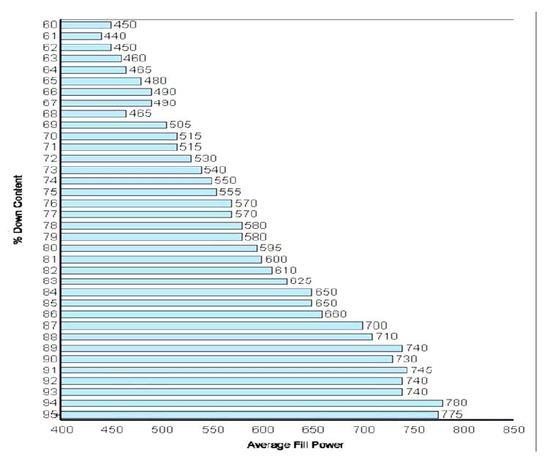
You asked, "Does anyone know if there is clear relationship between the ratio down/feathers and FP". Yes there is a clear relationship if you also consider the conditioning method.
From 1978 till 2004 steam conditioning wasn't used and these were the IDFL averages:

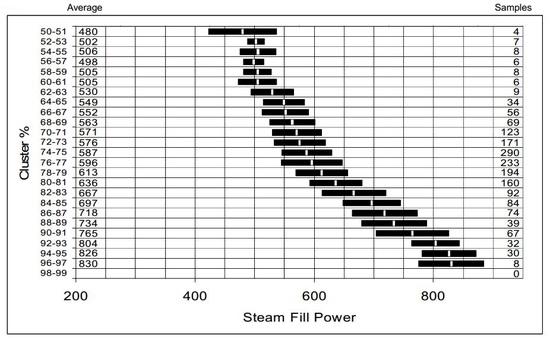
During the June 2005 IDFB meetings in Kyoto,Japan, IDFB approved steam as the “official” world-wide conditioning method. Use steam for bulk down, all pillows, comforters, jackets, sleeping bags, etc. that have been compressed, stored, and/or shipped.
2005 to the present, these are the IDFL averages:

Thanks Richard.
Any idea why these conservative claims from manufacturers ? I mean, according to these tables even higher downcluster%s could be claimed.
OTOH, if the claimed feather%s are indeed wright, this could be a way for us to assess if the FP-claim makes sense. I mean: if a brand claims 850 FP down but also a 90/10-cluster/featherration, an actual FP of 750+ seems more accurate.
It's also related to the quality of down and age and type of birds. Large, older geese will tend to have larger and more fibril dense down which lofts better (under more ideal conditions) than say a young duck.
So theoretically, you could have two samples of down, with the same feather to down ratio (even both being goose, or both being duck), but one be a bit higher fp than the other because of the higher quality of down.
Even the coveted Eider down, apparently only rates highest around 750, but that may be by the old standards and conditioning. Yet, it's supposed be about the warmest per weight you can get, so it's not ALL always just about fp.
Woubier,
Look at the 96-97% steam condition fill power with an average 830 (white vertical marker) fill power as an example. There is a range of ~775 – ~880 fill power for the same cluster ratio. Some of the reasons why were addressed by ArcturusBear1.
Of course, but manufacturermarketing is not known for its humble character and being able to give a higher number/ratio is something they usually jump on. That there exists something like deviation or variation, is something they don't know or just 'forget'. :-)
Aside from that, with a 90/10-ratio I see no 850 FP and still there is a brand who claims that.
Become a member to post in the forums.