


"Anything ice cold, flowing and clear will do you no harm."
I drink untreated water all the time but even I think this statement is stupid and ignorant.
Topic
Become a member to post in the forums.
"Anything ice cold, flowing and clear will do you no harm."
I drink untreated water all the time but even I think this statement is stupid and ignorant.

"Anything ice cold, flowing and clear will do you no harm."
+1 to Justin, i.e. this is wrong.
There have been some extensive studies of water quality in the Sierras. If somebody cares I can dig out the one I read (I think I was pointed to it by John Ladd on the Yahoo JMT group, a source of much wisdom)… a striking discovery was that the best water quality was found in the surface layer of large, still lakes – i.e. large bodies of water with minimal mixing. The explanation is simple: natural UV sterilization. There's a lot of sunlight in the Sierras.
On the other hand, I do agree with Mike's preceding statement that most water in the Sierras is much safer than most people imagine. I'm certainly happy drinking unpurified water from streams high up when it's pretty clear that the water is coming from inaccessible mountainous terrain. I worry most when there may be people or horses nearby or upstream.

I stepped through so much horse crap and saw so many, um, people deposits in inappropriate places in the Sierra I can't imagine anyone just drinking that water without treating it unless you could watch it melt off a glacier
Dammit — I KNEW I should've snapped a photo of the dead mouse I saw in the creek (on the way south from Donohue Pass) where I was about to get water. I went upstream a few yards, and used my Steripen. But a picture would've made my point waaaaaaaaay better than these words!
I just came to a realization that if I got a shelter (ie: tarp) that uses trekking poles for support, I am limiting myself with photography (or vice versa). The Trailpix tripod thing uses your trekking poles as two of the three supports, so save a lot of weight on carrying a tripod. The downside is that the "golden hours" of photography are sunrise and sunset, which also happen to be two times when it is nice to have a shelter up.
It seems that from an efficiency standpoint I should use the trekking poles as a shelter support, or as a photography tripod, but not both.
"It seems that from an efficiency standpoint I should use the trekking poles as a shelter support, or as a photography tripod, but not both."
Or else neither.
I use about three ounces of carbon fiber for shelter support. I have a 17-ounce tripod for the camera.
–B.G.–
I'm always looking for lighter tripods, Bob. :) Could you share the name? Ideally I'd like something with adjustable height, not like a gorillapod or something similar.
"Could you share the name?"
I've reported this before. Try a well-stocked photo department in a Target store. I believe the brand name was Targus. Often they have either 42" models or 50" models, each with a QR.
–B.G.–
Thanks Bob, I checked them out on the website. It got pretty horrible reviews, and they say it can't support a DSLR, but I'm glad it's working out for you. I think trekking poles with a Trilpix looks quite a bit more stable. My mirrorless camera is not as heavy as a DSLR, but it's noticeably bigger than a point and shoot.
I've used 3 trekking poles held together at the handles by an ace bandage. One pole has a ball on the handle which removes to reveal a 1/4"-20 thread; I put a small Giottos ball head on that. I originally used this setup with a small DSLR (Rebel w/ kit lens) and it was barely adequate; with my current mirrorless (OMD EM5 with kit 12-50 or 17/2.8) it works pretty well. As noted, not too useful for star photos if the shelter is pole-supported.
Without seeing Bob's tripod I can't say for certain but I'd wouldn't be surprised if it's a lot sturdier than trekking poles. The trick with a cheap tripod is to keep it as low as possible – don't extend the bottom leg section and especially don't raise the center column unless you absolutely have to. I'd bet that a lot of the folks railing about the Targus had it fully extended and were offended that it didn't perform like a tripod weighing and costing much more.
EDIT: just weighed my travel (not backpacking) tripod; it's 37 oz with ballhead. There's something crazy light about Bob's 17 oz Targus. I may have to go to Target and check it out (shudder).
Typical of these kinds of threads, everyone is going to chime in with their favorite pieces of gear.
The key to really lightening up your kit is to get rid of everything you truly don't need or never (rarely) use. Par, par and par some more.
Once you have gotten rid of all the unneeded stuff, you need to analyze each piece of gear you really need for potential lighter options. One must also keep in mind that there are certain synergies and efficiencies with the total package. How well does your pack carry your gear and makes access to stuff during the day convenient. How easy is it to set up your shelter in driving rain, keep you gear dry and even cook during said deluge? Will the lighter versions require new skill sets or practice?
Yes, your shelter is too heavy. The lightest shelters may not work out for you.
You can go very, very light and still use a canister stove.
I have never owned a waster filter, but there is a certain strategy that must be put in place for chemical treatment. CLO2 is much better than iodine.
Most people are fine with a small and light P&S camera, unless photography is your #1 reason for backpacking. I often leave my camera at home, it interferes with my trip enjoyment.
Even with your pack (assumimg it isn't much over 4 lbs), you can still get very light, so it does not necessarily need to go.
The key of all of this is to really dump the unnecessary stuff.
"It got pretty horrible reviews, and they say it can't support a DSLR"
I don't know what anybody is looking at, but mine supports a DSLR just fine. The question is more of what kind of lens it will support. The lens represents much more of a balance problem than a DSLR body.
"I think trekking poles with a Trilpix looks quite a bit more stable."
Again, I don't know what you are looking at, but a three-legged tripod without any cross supports below the head isn't going to be that stable.
"My mirrorless camera is not as heavy as a DSLR, but it's noticeably bigger than a point and shoot."
Then why do you need the tripod to support the weight of a DSLR?
Examine your logic.
–B.G.–
Bob, my logic is fine, it's probably my communication skills causing the problem. My descision for brevity left information out I guess.
My camera body is 14.5 oz and the lens I'll likely bring is 9.2 oz. Those are pretty respectable weights considering it's delivering full frame sensor quality at 36 megapixels. But it still puts it closer in size and weight to a DSLR than to a point and shoot, in my opinion. The reviews I read said that the tripod (when it doesn't break) is more appropriate for a point and shoot than a DSLR. If I'm using a camera and lens halfway between the two in size and weight, I'd rather err on the side of using something I know will work than something that "might" work. As for the reviews, it got 15 one star ratings and 7 five star ratings…and few in between. Not exactly confidence inspiring, which is why I said I'm glad it's working for you, and I appreciate the head's up. But I think I'll continue looking elsewhere. If a set-up like the Trailpix doesn't work out when I'm out hiking, I haven't really lost anything, since I'm carrying trekking poles anyways. On the other hand, if a tripod breaks or is unstable while I'm out hiking, I'm now stuck carrying an extra pound for no benefit.
WillWeb: I've used 3 trekking poles held together at the handles by an ace bandage.
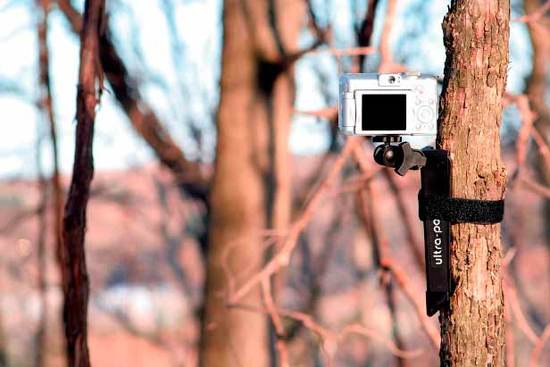
Maybe an Ultrapod II could do the trick with this. It's a small tripod with a velcro strap for tying it to trees; the velcro could work with two poles and a stick. It holds my X-Pro with an 85mm lens pretty well (24.5oz or 665g).
http://www.industrialrev.com/ultrapod-ii.html
ngatel: I often leave my camera at home, it interferes with my trip enjoyment.
Either the camera or binoculars come with me as a luxury item, never both. It depends on my priorities for the trip.
The Ultrapod type of mini-tripod is very limited in use. If you are just trying to shoot a selfy in front of your tent, then it is OK.
However, this assumes that you have a tree or tree branch right where you want the camera. How does that work above timberline? It also assumes that the velcro strap is long enough to get around the tree or tree branch. It also assumes that your camera is small and lightweight. As soon as you start hanging a pound or two of lens off a pound or two of camera body, it doesn't work. There are all sorts of ways that you can set one of these up with a trekking pole and a pile of rocks, but that is not quick.
I was trying to use an Ultrapod on the rocky summit of Mount Goddard once about thirty years ago for a selfy, and the camera was a little 8-oz P&S. I started the time-delay shutter and then started to step into the shot. Naturally, the Ultrapod shifted on the rocks right then, and my camera came tumbling down hard. It broke.
I have not carried an Ultrapod since then.
–B.G.–
BG: There are all sorts of ways that you can set one of these up with a trekking pole and a pile of rocks, but that is not quick.
I can't imagine a truly steady way to setup three sticks to hold a heavy rig. I use the pod mostly for remote flashes, occasionally for the camera. Just thought it'd be a useful way to go if you wanted to lash three sticks together and improvise a tripod.
Richard and Bob, I appreciate the head's up about the pod and about real-world issues with one. An incredibly short height might not be too limiting for a tripod. A lot of the landscape photos I enjoy most are the wide-angle, low to the ground shots of a mountain reflected in a lake or tarn. A short little tripod would be pretty handy for that kind of shooting, and you could easily make it a bit taller simply by setting it on a BearVault or a decent sized boulder. Neither the pod nor the targus tripod are expensive, I could probably play around with each before my next hike and see how I like them.
Nick, you're absolutely right about dropping my unused gear, and going with lighter items where needed. I know a lot of folks like giving favorite gear suggestions, and honestly, it's fun and I appreciate it. Being a gear nut myself, I love discussing and reading up on gear. That said, cutting my weight in half for my next trip isn't going to require buying much of anything (shelter aside). It'll mostly be a decision making process, and I have a great idea of how to make that happen (largely thanks to several years of reading great tips from you folks).
As you reevaluate gear, think about these options:
alcohol stoves, and specifically the TrailDesigns Caldera Cone and stove. Its awesome, and light weight. Canister stoves are certainly fine, but (almost) nobody who goes to alcohol goes back to canisters. Plus, its hard to cook fish on a JetBoil.
I second the motion about Tarptents. I have a Squall II. Unlike a tarp, it has a floor, and bug netting all around. When mosquitoes are bad, they can be really bad. Being able to zip up the door is a lifesaver. The Squall II uses a hiking pole on one end, 6 stakes, and weighs 32 oz. Its great for 2 people. That comes to 16 oz per person! When comparing with a tarp, you have to include the weight of a ground cloth, and a bug screen, and the Squall II comes pretty close in weight to a tarp. I've had it in all weather.
The bottom line, your pack, tent and sleeping bag have to be light weight, like under 3 lbs at least, and preferably closer to 2 lbs.
Check out Mike Clellands website, his book, and his videos on the blog, for some thought provoking ideas. His base weight pack (no food, no fuel, no water) is less than 10 lbs!!
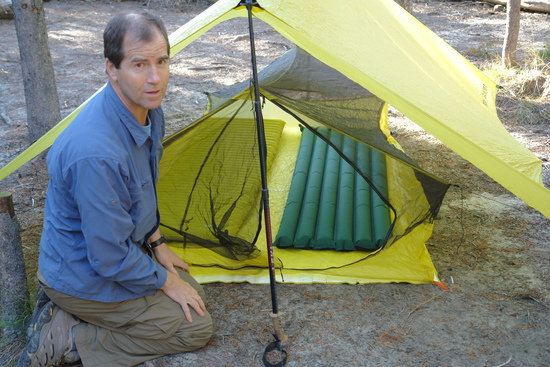
Another tarp type option is the Sea to Summit Escapist. Its a tarp that is big enough for two. It also has a "mostly mesh" separate inner tent which you can leave behind if you want, but is fully enclosed and has a floor for those trips when mosquitoes may be severe.
"Canister stoves are certainly fine, but (almost) nobody who goes to alcohol goes back to canisters"
count me in the Almost crowd.. couldn't stand alcohol. I don't like carrying liquid fuel, didn't like the boil time, didn't save me a considerable amount of weight.
For me it was fiddly.. i don't like fiddly.
Optimus crux.. boils 2c in 3mins. stove, cup, fuel, lighter all fit into my .7L pot. 1 canister lasts me over 2 weeks.
Most alcohol stoves are rock simple.
Not much "fiddly" about them unless you are using a poor design or you are operating it wrong.
I'm with Jake. I found dealing with measuring cups, bottles of liquid, not being able to blow out the stove a little fiddly. I know there are stoves out now that fix those problems, but I switched to Esbit and didn't look back.
Its dirty
Slow
Smelly
Hard to find most places-really only readily available unline for most folks.
As far as dealing with carrying "liquid fuel"..Geezus. every backpacker does that all the time-its called WATER.You guys must have alot of water leakage in your packs too?
Seriously, if you use a flip spout squeeze bittle like a Vargo, and simply drop it in a Ziplock, there is no leakage issue and no messuring cups.
I've never understood how Andrew Skurka can depend on a simple catfood can stove and fuel stored in juice bottles for trips totalling about 15,000 miles over the last 7 years and yet folks claim to have all tbese problems with Alcohol stoves..
It simply astounds me.
Using alcohol is as hatd as you want to make it.If you do it right,it's easy.
I go back and forth between alcohol and canister.
For my frequent 1-3 nighters, I'm liking the alcohol. A couple of 1oz containers plus a 2oz, stove, windscreen, folding spoon, Hotlips for drinking, a mini Bic, firesteel with striker, half a dozen hexamine tabs, and a bandana all fit in a 700mL mug. Very compact, and the single use containers make everything simple and fast.
Longer trip=canister for me so far, though.
I certainly can see tbe bennefit of a cannister or whitegas setup..
But for solo use..a good Alcohol rig is plenty fast. I dont have to catch a train,;)
I'm in no hurry…)
Become a member to post in the forums.
 New Gear with Aluula FabricsLighter, stronger, more abrasion-resistant, and highly water-resistant - explore ultralight backpacking gear made with ALUULA Graflyte fabrics. Engineered for exceptional strength, durability, and lightweight performance, ALUULA Graflyte helps reduce pack weight without sacrificing reliability, making it ideal for demanding backcountry adventures.
 © Beartooth Media Group Inc.
 Loading...