Topic

Collapsible Bucket Options

  • This topic is empty.
Viewing 10 posts - 1 through 10 (of 10 total)
Nick Smolinske BPL Member
PostedDec 27, 2014 at 1:48 pm

So I searched the forums and, unsurprisingly, y'all aren't big fans of collapsible buckets. Me neither. But I'm heading out to the Escalante route in the Grand Canyon in a couple of days and the river is mighty turbid right now. I'm expecting to use alum to settle nearly all of the water for three people for several days – so some sort of settling container would be a good idea. I successfully used alum in my platypus bottles a week ago, but for more than a night or two that sounds like a pain.

So . . . any suggestions? I don't want to buy a dedicated bucket, because I'll probably never use it again . . . so I'm thinking gallon ziplock bags, but we'll have to take really good care of them. I've used them frequently to get water out of potholes, but I've never stored water for several hours while it settled. Anyone have some awesome suggestion that I haven't thought of?

Ralph Burgess BPL Member
PostedDec 27, 2014 at 2:32 pm

Nick,

I've always used multiple 2L Platys, because that's what I carry anyway for high-volume water transport in the Canyon. Easy to shake up thoroughly when I've added the pinch of Alum, and they stand stably in a small sand depression when full.
Obviously you need clean ones to pour off into, so if you don't own/use a bunch already, this may be an expensive solution for 3 people.

I've never tried just using big Ziplocs, but I've heard of them being used, and I think they'll work fine. Obviously you can take a whole bunch with minimal weight penalty. Anywhere that you'll camp by the river on the Escalante Route (Tanner, Cardenas, Escalante, 75m, Papago, Red) you will have soft sand beaches, so it will be easy to dig suitable depressions in the sand to support the bags while settling.

It sounds like you have experience with Alum already, but for any who don't –
an almost unbelievably tiny amount is required, just a pinch of few grains per liter;
it needs to be shaken thoroughly to dissolve fully and completely homogenize with the silt before settling, you need at least one suitable container to be able to do this shaking, from which you can transfer to bag/bucket.
The boaties often use a pre-dissolved concentrate, but that's unneccessary water weight to carry for a hiker – the powder is highly soluble even in the very cold Colorado river water.

Peter Nash BPL Member
PostedDec 27, 2014 at 3:09 pm

I've used Coughlan's collapsible bag for many years. Weighs 2 oz. and holds 2.5 gallons. Urethane coated nylon. (It can loose some waterproofness over time, but it can be renewed with a DWR treatment.) You can fill it up and it will lay flat on the ground like a pancake without spilling. You can pump filter it while it's flat on the ground too.

One problem, these seem to have been discontinued, but some are still available online.

Ralph Burgess BPL Member
PostedDec 27, 2014 at 3:44 pm

I have the Sea to Summit bucket. I don't think it's great for this application – it's really unstable. If you try to stand it up, it just flops unpredictably – even a shallow hole is not enough to stabilize it. You'd have to dig a deep and accurately shaped hole in the sand to support it; which seems to me more work than required to dig shallow indentations to support Ziplocs. I guess hanging it to settle could work, I'm not sure. Anyone tried that? I'm not sure if getting blown around about in the wind would be enough to agitate the settling particles?

Nick Smolinske BPL Member
PostedDec 27, 2014 at 3:58 pm

Thanks for all the good information. Sounds like with sandy beaches, ziplocks should work just fine. I'll bring an extra platy just in case.

Ralph, I have one other question about alum, since you've used it more than me (I've just used it for two days' water this last trip). How long does it take to settle out?

When I used it I used a small pinch per platy, and it took at least an hour to settle noticeably (my control group of untreated river water didn't settle at all). I decanted, treated overnight with aquamira, and then in the morning noticed it had settled out some more. I thought alum worked faster than that, so maybe I didn't shake enough? All the information I've found online has been about the river rat concentrate method, not what we're doing.

Ralph Burgess BPL Member
PostedDec 27, 2014 at 4:21 pm

Usable in no more than an hour. The process naturally slows down as the particle concentration drops, so to go from "mud" to "drinkable" may be an hour, but it can keep improving more slowly before reaching sparkling clarity. Your experience sounds similar to mine.

PostedDec 27, 2014 at 5:24 pm

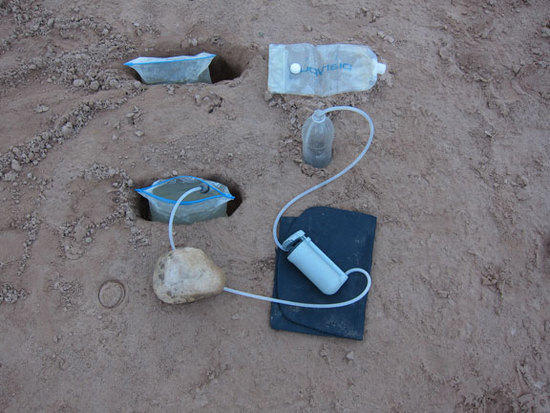
This worked for me –

GC Water3
These are Hefty zip-click 1 gallon bags, with zipper sliders. Even after flocculation the pump was doomed. Waiting overnight didn’t improve things much. So, no pumping next time, unless it is clear water to start with.

– and next time I’m taking Chor-Floc (thanks to Ian.) pH buffered flocculant and chlorine – Pre-measured for 1 liter, I’d do three to a ziplock. And take some sort of flavored stuff to 1) obscure the cloudiness and 2) improve the taste.

This was just for me. I’m heading back in March with a friend (Tanner/Escalante/Grandview), and for two of us we’ll use three pleat-bottom 2.5 liter platys (officially 2L), to yield 6 liters per session. You can get by with less, but from a time perspective, efficiency counts.

The taller aspect of a platy will also help in maximizing recovered water. A gallon bag is wider, and when decanting you get less before hitting the sludge in the bottom (but still about 2 liters per ziplock).

Mike In Socal BPL Member
PostedDec 27, 2014 at 5:27 pm

I tried alum last year on the Escalante and I didn't think it worked all that well but maybe I didn't use enough or wait long enough – I hadn't tried it before then. I did successfully use a Platypus Gravityworks filter but I would backwash it with about a 0.5 to 1 liter after every 4L of filtering. I just filled up the platypus and went about by business setting up my tent while it filtered. I didn't really have any clogs but that silt is a filter killer after 3-4 days. My filter cartridge still works but I'll probably replace it before my next trip.

My hiking partner used the Sea-to-Summit bucket to let the water settle out before pump filtering it. It's more labor but it worked. The nice thing about buckets is that you could have unfiltered water near camp for washing up.

Sea to Summit 10L:
http://is.gd/UGLMYW

Platypus Gravityworks:
http://is.gd/HFkXal

Mike

Mike W BPL Member
PostedDec 28, 2014 at 12:20 am

My hiking partner carries the Sea to Summit bucket and always fills it so that he can pump water in camp.

On one trip this year I was thankful for his bucket as a storm stirred up the glacial silt so badly that the entire shoreline of the lake was a mess. That's a real problem for me as a Steripen user but the bucket allowed the silt to settle out considerably. The bucket stands up nicely when filled to the top.

Viewing 10 posts - 1 through 10 (of 10 total)
Loading...