Topic

MLD Mid Tauntness Cuben vs. Silnylon

  • This topic is empty.
Viewing 23 posts - 1 through 23 (of 23 total)
Marion Watts BPL Member
PostedDec 27, 2014 at 7:54 am

I like a nice drum tight shelter. It's a little of an OCD thing. I understand that if I get the silnylon version, I would have to retighten before bed, but I've come across a few comments (mostly about trail stars, but I'm wondering if it still applies) of not being able to get the cuben versions as tight due to no stretch. Nothing worse than a flappy shelter in the wind. I'd love to hear any thoughts before I order.

Edward Jursek BPL Member
PostedDec 27, 2014 at 8:03 am

Funny, I have always been able to get a much more taut pitch from cuben shelters then sil ones. Getting a taut pitch on my cuben DuoMid is a breeze.

PostedDec 27, 2014 at 8:45 am

+1 on cuben. I have a cuben duomid and have no trouble at all getting a perfect pitch. I really, really like not having to readjust stuff once I set up. I also like not having to cart around a super-heavy soaked silnylon shelter either.

PostedDec 27, 2014 at 8:53 am

I always had a bit of trouble getting a cuben Trailstar pitched tightly, but that's most likely me, not the shelter. Never had an issue getting any cuben mid pitched tightly.

Jon Leibowitz BPL Member
PostedDec 27, 2014 at 9:00 am

I have a bit of an OCD thing too with shelters. Recently got a cuben duomid and I can pitch this beast so much tighter than I ever could with my SMD gatewood. It's not even close.

Edward Jursek BPL Member
PostedDec 27, 2014 at 9:07 am

Jon – same here, my Gatewood never looks quite right when I pitch it. I will now blame the silnylon, not my own suspect skills!

PostedDec 27, 2014 at 9:56 am

My understanding with the Trailstar is that the stretch of silnylon is actually a small part of the original design. That's why it took so long for Ron to come out with a cuben Trailstar–there were some design tweaks that had to account for the properties of the different fabrics.

With the 'mids, with one predetermined shape, that's not the case. You should be able to get just as taut a pitch with silnylon as with cuben. I've had a lot more experience pitching the sil 'mids, but in the brief time I played with a cuben Duomid, I had no trouble getting a taut pitch once I accounted for the slight differences in the set-up process.

With sil, I have no trouble whatsoever getting a taut pitch, but there was a bit of a learning curve. The slight stretch of the fabric means that it will tolerate less than optimal pitches as you figure out the ins and outs of setting it up, but once you get it down, it gets nice and taut. The advantage of sil here is that it is easier to get an excellent pitch on uneven ground, which doesn't match the ideal world of backyard pitches. For cuben, that's harder and may require a different site selection (a problem in places with predetermined campsites), but it's still totally doable.

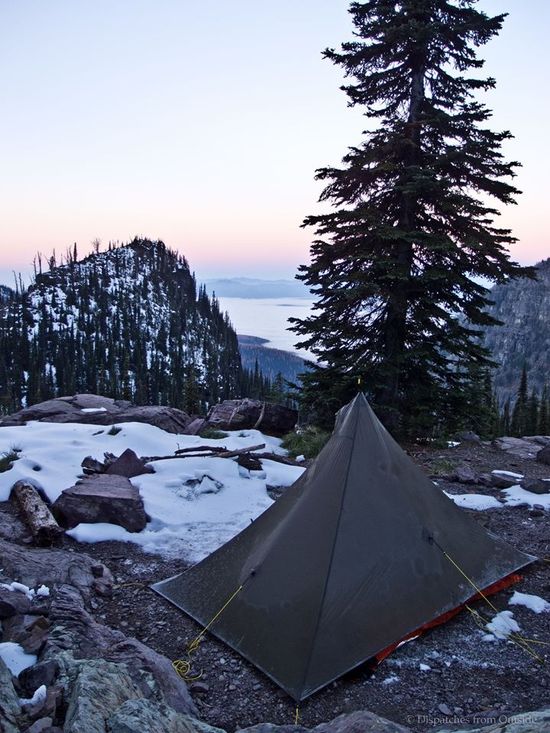
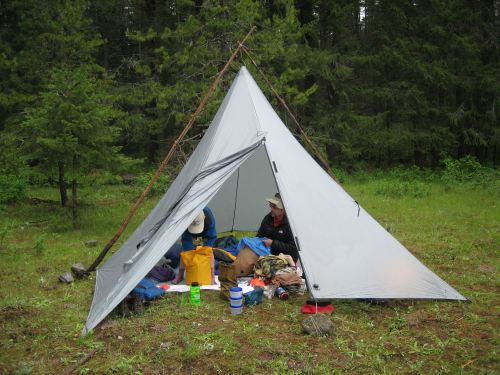
Here's my sil Duomid in Glacier on an okay site (for GNP):

SPERRY-DUOMID

dirtbag BPL Member
PostedDec 27, 2014 at 12:04 pm

+1 what Jennifer said. I have used a cuben patrol shelter and now have a grace tarp. I can get a nice taught pitch every time and that's it. No re adjusting once it's pitched. I also LOVE that it doesn't soak up a nights worth of rain like silnylon does. Just shake it off and pack it up..

dirtbag BPL Member
PostedDec 27, 2014 at 2:09 pm

Silnylon gets wet…and soggy. Unlike cuben where it just beads off. Shake off a cuben tarp after a night of constant rain..and shake off a silnylon fly or tarp after a night of heavy rain and see the difference…

Jon Leibowitz BPL Member
PostedDec 27, 2014 at 3:26 pm

Haha – Ed. I know silnylon is finicky but I swear, I pitched that thing the same exact way for over 2 years, probably 50-60 times – sometimes it looked good, sometimes it looked horrible, sometimes it sagged so much it hit me in the face. I can't explain it. I love that shelter but pitching it was always a mystery. That being said, I'd buy a cuben version in less than a heartbeat. :)

I'm currently very very happy with the cuben duomid and looking forward to my first full backpacking season with it.

PostedDec 27, 2014 at 4:38 pm

Joe, you just need to shake a little harder with silnylon as water beads off silnylon as well – unless you are using crappy seconds that have a very low hydrostatic head. Or wipe it down. It does not absorb water.

Marion Watts BPL Member
PostedDec 27, 2014 at 5:15 pm

Thanks guys. Nice to hear all the positive responses for cuben. Decision made. ;)

PostedDec 27, 2014 at 5:27 pm

My zpacks hexamid twin is alway easy to get taut, FWIW. I think cuben is the ideal available shelter material.

PostedDec 31, 2014 at 5:31 pm

Re: "Joe, you just need to shake a little harder with silnylon as water beads off silnylon as well – unless you are using crappy seconds that have a very low hydrostatic head. Or wipe it down. It does not absorb water."

It is not just crappy seconds that have low water resistance and absorb water. I was dismayed recently to see that Thru-Hiker was now rating its silnylon at >1000mm HH, not very reassuring. Its sil sold a few years ago was tested by Richard Nisley in the 3000mm range. Not to mention the many posts over the years from Roger Caffin concerning the low water resistance of US made sil due to environmental restrictions.

Compared to much of the silnylon currently available, I'd have to agree, Cuben is the better choice, not for MYOG, but when purchased from a tentmaker highly experienced in Cuben joinery and its limits. As for other choices, there are polyesters that do not absorb water and/or sag, but in a really light weave, they are in very limited use, such as the proprietary material used by Snow Peak in its Lago tents.

Using the best sil I've been able to find, from old purchases, Thru-Hiker, Wilderness Equipment and Lightheart Gear, I've never had a problem with it absorbing ANY water, either has a floor or fly material. It does expand and sag a little with temp drops, though; but the better sil much less so. I also treat it with Kiwi Camp Dry sil spray (green can) yearly, but not with the Atsko spray, which I thought had ruined a fly until I redid it with the Camp Dry.

Given even the slight sag of even the best sil with decreasing temperature, it should only be used with a tent designed to keep it in constant tension. Please note very light denier nylon coated with polyurethane rather than sil will also sag with night time drops in temp. We are now seeing low denier fabrics that purport to be coated with both PU and sil, but it may be to soon to evaluate them. I'm working on a tent now that should provide more insight into this when used in severe conditions.

dirtbag BPL Member
PostedDec 31, 2014 at 5:55 pm

Big agnes copper spur 3, mountain hardwear helion 2, mountain hardwear super mega ul 2 and sierra designs lightning XT 4. Hardly would I consider any of these cheap silnylon and they weren't crappy seconds. Or am I wrong? Are they considered cheap? All I'm saying is from my experience using all of those tents then switching to cuben..MLD Patrol shelter and Bear Paw Wilderness Designs canopy 2 (cuben)..and now MLD cuben Grace solo and duo, is that the cuben shakes off a rainy night much better then any silnylon I have used. No contest. AND..The cuben doesn't feel soggy and saturated like the Flys on any of past tents.
Maybe I just had bad Flys on all those tents? Maybe I'm delusional? All I know is what I have had experience with.

PostedDec 31, 2014 at 8:48 pm

sil-nylon sag isn't a figment of your imagination. it does happen.

But it's not directly caused by water. The fabric sags because it stretches under tension. under tension of your pitch, under tension of the wind (and the vibration caused by the wind), under tension of your guy lines.

Water–as we all on this site should know–is heavy. Well, water that beads up (and splatters and forms microbeads upon!) the surface of your tarp/tent is heavy, too. All that weight is yet another force that contributes to stretching your tarp.

So no, your tarp isn't absorbing rain water that's causing stretching. If your tarp actually absorbed water, it would eventually leak it due to capillary action.

PostedDec 31, 2014 at 9:39 pm

The nylon most used for tents/tarps, has a moisture regain of around 4% i think (compared to the much lower .4% or so of polyester). I may be mistaken, but even if the nylon is covered well enough in silicone to prevent direct water absorption, there could still be some vapor absorption perhaps (might take a lot longer though)?

But it's true that nylon has innate stretch, which is likely the cause of most stretching/sag. Likely it could be woven in a different way to minimize that stretch, but it seems manufacturers have largely gone with a certain standard formula with weave including ubiquitous rip stop.

John G BPL Member
PostedJan 1, 2015 at 6:44 am

The Big Agnes and Sierra designs tents mentioned aren't sil nylon.
They are PU coated nylon with a "silicone-treated" outer surface (otherwise known as DWR coated).
Marketing at its finest…

I'm not sure about the others, but if the inside is seam taped, then it's PU coated fabric and not sil nylon.

Real sil nylon is a sheet of nylon that is between 2 sheets of silicone, not a spray on coating. It can't be seam taped, which is why main-line manufacturers don't use it. Sil nylon tents have to be manually seamed sealed with a brush, and left set up for a couple of days until dry.

PostedJan 1, 2015 at 8:48 am

"Maybe I just had bad Flys on all those tents? Maybe I'm delusional?"

Not at all but all of those you mention are not silnylon. From what I can see, you are comparing an enclosed tent to a completely open tarp. A tarp is inherently going to accumulate less condensation than a tent in similar environments. It would be better to compare something like a Zpacks Soloplex in cuben to the same version in silnylon. Bet the condensation accumulation is the same. Water may 'cling' to the silnylon more but again, a wipe will do.

Dave @ Oware BPL Member
PostedJan 1, 2015 at 10:39 am

Some of nylon's stretch can be mitigated by how the fabric pieces are cut out. Curves etc. in seams and hems can help maintain shape. I far as I know, nylon is still the fabric of choice for shock absorption (parachutes, ropes) and does a good job for shelters suddenly loaded by wind or snow.

It does sag a bit at times from temperature drops or moisture. In something like a pyramid tarp, having a method for adjusting the pole upward to take up slack from within the shelter is nice. If your tarp pole is not adjustable, this could be as simple as having a stone handy to place underneath the pole. If you use outside shear poles, reaching under the hem and pulling the two pole bottoms inward can do the same.

Be sure in any case or fabric type you stake out the hem in the right shape. On a symmetrical 4 sided mid, a diamond shape instead of a perfect square will produce saggy walls with any fabric. Floored shelters are easier to get the stake out pattern correct. On a floorless shelter you could tie tiny cords corner to corner to insure proper and repeatable layouts.Pyramid shear scissor poleshttp://blog.owareusa.com/2015/01/01/thoughts-on-tarp-setups/

http://blog.owareusa.com/2014/03/16/pyramid-tarp-set-up/

PostedJan 1, 2015 at 1:10 pm

Seems like this has been pretty well answered, but I'll chime in with my experiences to support what other have said.

I've got a cuben duomid that gets tight and stays drum tight all night. My sil supermid starts of tight, but wet or dry it sags progressively, much worse when it is wet. Cuben is just set and forget even for a couple of days including rain.

Viewing 23 posts - 1 through 23 (of 23 total)
Loading...