Topic

Long distance planning ….

  • This topic is empty.
Viewing 20 posts - 1 through 20 (of 20 total)
PostedDec 21, 2014 at 9:45 am

Hey all,

So I have the opportunity to embark on a long distance trail this year PCT/CDT and am curious for those which have done either. How many actual drops/resupplies do you actually plan for? Seems like a somewhat silly question but given the distance I'm wondering:

1. Do you just stay in touch with someone back at "home" to coordinate drops and continue that for the entire trail.
2. Only plan "key" drops and pickup everything else in towns.
3. Go old school and manage everything on the trail solo.

Up until now I've just done the JMT and with it being "short-ish" I could easily mail stuff to myself no problem. Of course that changes when we're talking about 2500+ miles.

PostedDec 21, 2014 at 10:22 am

If #3, consider the “on-trail” effort, and where you can find a suitable market and PO relatively close to the trail.

From Carrot Quinn’s 2014 PCT –
ReSupply1

At 120 days of trail time, 5 days per drop, you would do this twice. And for instance on the CDT, if you stop in Salida, the PO, Safeway, and hostel are within 4 blocks of each other. But the hitch is 23 miles, each way.

YMMV

Luke Schmidt BPL Member
PostedDec 21, 2014 at 10:33 am

I did a big chunk of the Colorado Trail in 2011 with mail drops. Turns out I needed a bit more food so I supplemented with shopping in some of the trail towns. But it was nice having 80-90% of my food ready to go. The extra 10-20% was mostly extra snacks I could find at a gas station or small store.

If I tried the CDT I'd be incline to mail at least some food to myself to minimize time hitching into bigger towns looking for a bigger grocery store and time shopping. Remember there aren't a lot of people in Wyoming and Montana so there aren't a lot of big grocery stores either.

You'll want to mail some stuff to yourself anyways. For example I imagine you'll be mailing yourself new shoes and socks to replace the ones that wear out. With the seasons changing you might want to switch out some gear too.

Bob Gross BPL Member
PostedDec 21, 2014 at 10:35 am

The answer is "it depends."

It depends on the proximity and spacing of towns and stores where you can pick up a mailed package or else purchase supplies. It depends on how much food you eat or how much fuel you burn. There are too many variables. On the average, backpackers want a resupply box to last one week. If you think about it, that would be 10-15 pounds of stuff, and that is about how much extra consumable load you might accept.

Here is what we may achieve in the near future. We will all be carrying satellite communicators. We send a special message #12345, and an automated attendant ships out the next supply box of a pre-planned series. This could almost be done via Amazon now. The box may go to a nearby post office, or it may be delivered to you out on the trail with a drone. Amazon says that it is coming. Don't hold your breath.

–B.G.–

PostedDec 21, 2014 at 10:46 am

BG:
Yeah, they ran into a lot of issues with those drones :-) When they announced that a guy had a hacker drone on the ready which would take over control of them. The idea was you could "rent" time out on an amazon drone. haha.
http://defensetech.org/2013/12/09/hacker-releases-software-to-hijack-commercial-drones/

Greg:
Sorry, I guess I didn't phrase my question all that well. For those three options I'm wondering the route most people take. I imagine it's to have a person back at home manage everything given a timetable or spot/satellite phone.

I'm currently thinking of mail dropping about everything although with trip prep being cut short it's gonna be a shitload of work :-) I imagine a lot of people start doing this in the fall… or the prior summer.

Luke Schmidt BPL Member
PostedDec 21, 2014 at 10:48 am

I would agree drones have no place in the wilderness (either "Wilderness" or just wild NFS land) but you have me thinking Bob…

What if drones delivered your resupply at a road crossing? So the wild areas are left alone but instead of interrupting your hike for a trip to town you just grab the package and off you go? In my mind that would be more of a "wilderness experience" some trail journals (especially on the AT) read more like a "hitching journal" with a ton of time and money wasted on trips into town.

Sorry for the drift, Bob's advice sounds solid. Let us know the ultimate plans, I should be in Wyoming this summer and if our schedules match maybe I could pick you up and give you the "car tour" through Yellowstone to see the stuff you don't hike past.

Bob Bankhead BPL Member
PostedDec 21, 2014 at 12:10 pm

Like the man said, "It depends"; what is the best use of your time and money?

Packing all your boxes ahead of time and arranging for someone to ship them to you on a pre-arranged schedule:

– optimizes your on-trail time, and thus
– reduces the time pressure to reach trail's end
– allows a more leisurely pace
– allows more restful, less stressful zero days
– forces most food costs into a tiny time window
– incurs huge shipping costs
– requires knowledge of current days and hours of operation for locations where packages are to be picked up

Key Drops only: buy the rest locally: (the best of both worlds and my personal favorite)

– but you MUST know where those key drop will be !
– requires a lot of in-depth research before you go regarding what both IS and IS NOT usually available where.
– may require carrying a few extras "just in case"

Buying as you go:
– optimizes menu selection as your appetite and tastes change (and they will)
– supports the local economies, thus
– encourages merchants to stock hiker supplies
– spreads out your food costs over time
– minimizes shipping costs
– you are at the mercy of local inventory levels and selection
– zero days are less restful and more stressful
– requires more careful planning as to where gear replacement may be needed
– requires enhanced flexibility
– does not work for things like prescription refills, spare eyeglasses, and the like.

Bob Gross BPL Member
PostedDec 21, 2014 at 3:33 pm

It seems a lot more foolproof to have the resupply boxes packed in advance, but not sealed shut. This assumes that you have a person back home who will actually send them out on a schedule and the backpacker has some communications device that is working.

Suppose the backpacker gets out to Mile 999 and is having some major gear failure (boots, tent, sleeping bag, etc.). The backpacker can contact the person back home and tell them to add one replacement gear item (brand, model, size) added to resupply box #X that should be sent off in a few days. Similarly, some special food item could be added upon request.

If there is nobody back home to do this, then the backpacker must ship everything in advance. That can have problems.

–B.G.–

Seth Brewer BPL Member
PostedDec 21, 2014 at 4:15 pm

On your hiking pace, how much food you plan to carry at a time, your cooking preferences, your budget, etc.

Check out my links on my website for how I did the AT and PCT when I thru-hiked. There is no one right way, but I found it easier to have 75% of my packages mailed ahead of time for each section of the trail (700 miles in 30 days — I sent myself a package every 100 miles or so) and in the sierras I had 2 large resupplies sent to Kennedy Meadows, hitched out to Lone Pine over Kearsage, and then a box in at Red's Meadow and Tuolmne Meadows.

Bought all my food drops and mailed them all in Cascades Locks for the whole state of Washington, etc. Plan as far ahead as is do-able and then hit up the few large towns and ship a bunch more boxes when you know your pace and food preferences better.

http://www.peaksandvalleys.weebly.com

Have fun either way !

Buck Nelson BPL Member
PostedDec 21, 2014 at 7:33 pm

There are many things that can change plans, so I like to keep my plans flexible.

I prefer doing as much resupplying along the trail as I can. Where that isn't going to be practical I will stop at a major town along the way and set up my own resupplies and mail them ahead, if that makes sense.

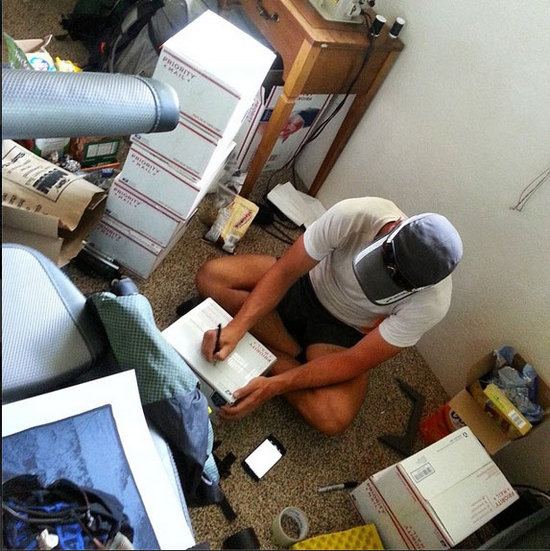
For some things, say guidebooks or other items that I can't buy just anywhere, I will put together a small number of resupply boxes, leave them with a support person and give them very clear instructions on how and when and where to mail them. I like to use Priority Mail flat rate boxes, and have them mailed about 2 weeks before I plan to arrive. Priority Mail can be slow at times, and some Post Offices will return packages if they've been held too long.

I keep a list of what is in each box and where it's going. I often leave other key items with my support person, maybe cold weather gear or rain gear or something that I'm likely to need at some point on the trail, with everything labeled.

Cell phones have made coordinating with your support people sooooo much easier!

PostedDec 29, 2014 at 10:05 am

A lot to consider and thanks for outlining your resupply strategies, always helpful to know how others approach the task. As it stands I'm leaning on pre-packing 60% or so of my boxes and giving very detailed instructions to someone. I have one of those nifty inReach devices so communication shouldn't be too much of an issue. It was brought up earlier but one reason why I'm leaning towards pre-packing so much is to be able to relax more on the trail and not have to worry too much about finding food in the towns. The main difficulty of this trip will be the pre-trip logistics of storing a jeep and personal items since I live in SF and there's no way in hell I can let a place sit for 5 months at the current rate of rent :-)

I won't derail the thread too much but I just came across this and am wondering if anyone else has used it?
http://www.gofastandlight.com/Powerfilm-Lightweight-Folding-Solar-Charger-for-USB-and-AA/productinfo/PO-PWRFILMUSB/#prettyPhoto

Bob Gross BPL Member
PostedDec 29, 2014 at 10:19 am

"I have one of those nifty inReach devices so communication shouldn't be too much of an issue."

The problem is that you are limited to 140 characters or so. You would hate to get into a prolonged back-and-forth discussion of what you need in the next resupply package.

So, some backpackers are trying to develop a shorthand code so that you can jam everything into one message.

–B.G.–

PostedDec 29, 2014 at 10:24 am

Yep, I am working on a shorthand with my parents to get this dialled in as much as possible. I agree, that would suck especially if the bluetooth pairing dropped out on the phone. It's not going to be bulletproof but it does amaze me that the general public can have access to such a device.

I'd love to see some "standard" shorthand notation come out of these long distance treks.

Bob Gross BPL Member
PostedDec 29, 2014 at 10:44 am

"I'd love to see some "standard" shorthand notation come out of these long distance treks."

Yes.

In six months, I expect to be on the support end of one of these.

#1 means this is for resupply package number 1 on a pre-arranged list
#2 means this is for resupply package number 2
#3+1 means resupply package number 3 date should be moved up one day
#4-2 means resupply package number 4 date should be slowed down by two days
&A means add some of food item A
&B means add some of food item B
%1 means add a quantity of fuel item 1
%1×2 means add two quantities of fuel item 1

Then you will have a list of standard gear items that you do not expect to need, but anything is possible. So, you have a list of boots and other specialized gear, all listed by brand and model and size and a likely vendor where they can be purchased.

@boot
@stove

There is no standard to this, so whatever you dream up must be written down for both parties to refer to. A back-and-forth text conversation might totally blow out your inReach service fees.

–B.G.–

PostedDec 29, 2014 at 2:12 pm

Wow, we're pretty much on the same page here but I haven't thought *that* much about it yet seeing as how I just got the idea 2 weeks ago :-)

BG:
I see you're in the bayarea… home of the apps… Sounds like the world needs another app! :-)

Drew Smith BPL Member
PostedDec 29, 2014 at 2:21 pm

Matt, I have one of these Powerfilm solar charges. I'm reasonably but not deliriously happy with it.

Pros – light (5 oz), rugged, easy to hook on to your pack, large panel area
Cons – mostly that it barely puts out the 5V needed to charge an iPhone. I get best results when I "overcharge" it – let it keep charging after the indicator light is on.

Hiking the desert section of the PCT (i.e., ideal conditions), I typically got about 40% of an iPhone charge per day.

PostedDec 29, 2014 at 2:27 pm

Thanks great. Perhaps things are different for hiking that southern PCT section but when doing the JMT I didn't find a need for my cell at any point. So if that panel holds up to weather abuse I'll probably get it. I've heard there are guides/apps/etc.. for finding water in the desert region which I can only assume it means checking a website.

Thanks for the feedback on it … most of the reviews seem pretty good.

Drew Smith BPL Member
PostedDec 29, 2014 at 2:39 pm

I used my phone for a lot of things – camera, journal, (secondary) map, reading material etc, and so needed the juice. I also used Halfmile's PCT app which is free and terrific. Guthook has both PCT and CDT apps which are pretty good but not free. Since I was ahead of the herd, I texted water info to Halfmile, who then posts this info on his website. There are plenty of uses for a phone on the trail.

If you do the PCT, a planning resource I would recommend is pctplanner.com. It provides a nice framework for planning and makes it a lot less overwhelming – lets you game out different scenarios. Don't forget to show your appreciation and donate if you do make use of it.

PostedDec 29, 2014 at 5:20 pm

Drew,

When did you leave? I'd love to get a head start this year because I'm pretty sure the "Wild" film will bump up the numbers this year. Actually it's one reason why I was contemplating the CDT instead :-)

Drew Smith BPL Member
PostedDec 29, 2014 at 8:13 pm

The zero-day kickoff party at Lake Morena is not scheduled yet, but is typically the 3rd or 4th weekend in April. Anytime before that will put you in front of the pack. The drawback to an early start date of course is that you will be exposed to colder weather and you may get to the Sierras and find yourself waiting for the snowpack to melt. But that is 700 miles into the hike, and there will have been substantial attrition by then. My advice is to pick a schedule that works for you and not overthink the crowd psychology too much, these things have a way of sorting themselves out. Be open to the experience and you will have a blast.

Viewing 20 posts - 1 through 20 (of 20 total)
Loading...