


Just wondering if there are any pros/cons for which would be better for sleeping as my core 1st layer in 10-30*?
Topic
Become a member to post in the forums.
Just wondering if there are any pros/cons for which would be better for sleeping as my core 1st layer in 10-30*?
Icebreaker 260 is a great casual layer, but I find that it does not dry very quickly. If you were carrying it and using it ONLY for sleeping, I guess it would be ok, but if you are planning on wearing the baselayer during the day, too, the Cap 4 would get the nod from me.
Welcome, Scott, from 2.5 hrs West!
Since you asked about SLEEPING only:
The 260 should be warmer.
The Cap4 will stink more. (shouldn't matter on short trips)
****************
If you're only wearing it to sleep, pick the one you "like" best (insert your own criteria here).
I have several Icebreaker 260 layers. I have a Cap4 LS Crew en-route. Will let you know how they perform.
I have used the Power Dry HE Cap 4 tops and bottoms as pajamas in temps from the 30s to the upper 50s. It's fantastic. Warm, but breathes enough that it doesn't seem to get damp from overheating. Seems to do well over a wide range of temps.
Went for a run today in Capilene 4. Seems to breath a good bit better than my Icebreaker 260. It's also much lighter than the IB 260 and provides equivalent warmth. It absorbs sweat better, and overall kept me drier. I really like it.
It dries faster than merino, but not *that* much faster. It's been about 5 hours since my run, and the shirt's still a bit damp.
With that said, IB 260 is still quality stuff and I won't be ditching it anytime soon. The Icebreaker 260 feels softer to my skin than Cap 4 (or maybe I'm just used to merino as I wear it every day), and while I need additional testing to confirm this, I'm sure it handles odor much better than Cap 4. It's also flameproof which comes in handy around campfires.
You can also get IB 260 at big discounts at places like STP. My IB 260 half-zip I got on sale for about $40. My Cap4 LS Crew was on sale for $60. So the merino is a great value for what you get.

Regarding price differences, also factor in that in all probability, the Cap 4 material is going to last significantly longer than the IB stuff. Thinner wool gets really weak when wet, and if you were on say a long thru hike, i'd place bets on the Cap 4 coming out in much better shape (especially with occasional washing of both garments, and/or occasional bushwacking with no other layers on).
Regarding dry time, you would have to test this by weight for an accurate assessment because of the nature of wool. Wool has a hydrophobic thin outer layer, but the rest of the inside is highly absorbent. This combination can make wool feel drier when wet than it normally would feel.
But, it still will be holding onto moisture for awhile after it starts to feel more dry on the outside. So, the best way to see which dries completely first, is to weigh both every hour or half hour or so under the same conditions (same humidity, temp, exposure to moving air, etc). I think you will find that the Cap 4 will completely dry significantly faster if you do it this way.
This is actually a really good topic because these are two of the top end heavier base layers that a lot of hikers look at. The PatCap4 gets a lot more attention than the IceBreaker, no doubt about that. Could be a price issue. Could be a technology advancement issue.
As a huge supporter of the IB clothing, as I have said a lot in the past, getting past the initial "ouch" to the pocketbook when compared to other top-end garments, the IB really do justice for the price that they demand for them.
I have over 1,000 days of use wearing an Icebreaker Men's Tech T Lite T-shirt.
I have over 900 days of use wearing an Icebreaker Men's Bodyfit 260 Tech Top.
To specifically address the issue of "sleep wear" I would recommend the IB over the PatCap for the pure reason of the additional warmth that the Icebreaker Merino should provide you over the Polartec fabric in non-motion activity. In high motion activities there is little to question that the Polartec is going to perform better at keeping your core body thermoregulated, it is designed to do exactly that after all.
I think, and this could just be me, but I tend to think that the weight of a 260 base layer being used for just sleeping is a bit on the 'ouch' scale of things. You could be much better served by going with a warmer sleeping bag – as the old saying goes, down is always the better choice. My 260 garment is 226 grams. You take those same 8 ounces and invest it into a bag/quilt with 8 more ounces of down and you would never ever even need a baselayer for sleeping. I have thought long and hard about this over the last two years of using my IB260 and if it were not for the fact I am already committed to the garment I would probably not buy another 260. A much more logical choice, again, I feel, would be to go with an IB150 and more down in your bag/quilt. The numbers just make better value.
I just had to throw away a Capilene 2 base layer piece because I could not defeat the stink with anything, including boiling it for an hour. No more synthetic base layers for me. You get into a situation where the base layer gets wet and then has no chance to dry out quick, repeat a couple of times and it gets haunted by evil stink spirits. Other than that, synthetic is great.
P.S. Macnett's enzime odor eliminator makes no difference. Bleach helps for a short period, but ruins clothing, etc.
Did it have a polygiene treatment? Btw, a few alternative options to bleach for cleaning synthetics, that are less harsh but still fairly effective, are washing soda, borax, and oxy clean. The idea is to use a fairly high ph product, this does a few important things, it kills existing microbes on same, reduces the surface tension of water, and helps to emulsify oils.
Synthetic stink comes from two main things, build up of odor causing microbes (particularly certain kinds of bacteria and fungi) and to a lesser extent build up of oils which go rancid and some absorption of same.
You need really high ph and hot water to get the oils off of synthetics, since oils bond well with same and the hydrophobicity of the material helps to keep water off same.
I wear synth all the time and they get damp to soaked
Never had a big odor problem especially after washing
Thicker merino on the hand takes forever to dry when soaked
Thinner merino aint very durable
And all merino are culinary favorites of moths
Modern synth is easily outpacing sheep for most uses, especially with modern odor treatments
And yes i do own bankbreaker sheep, i just use em for social situations
;)
Moths only eat merino that's not getting washed and used regularly. If you keep your clothes clean and don't leave them in a trunk all winter, you don't have a moth problem. If you're hiking, you don't have a moth problem. Lots of info on this available on the web.
I don't go in for religion, but I am militant about wool gospel and hate seeing this "con" listed. It's like saying Synthetic burns more easily… Easily avoidable "con."
And yet weve had BPLer get holes through moths
Not everyone wears their outdoor gear all the time in their normal life
Moths dont eat polartec powerdry
;)

I like wool base layers for sleeping in but there is no reason to go with a 260 weight, too heavy. Go with a 150 or 200 weight and layer over it if needed.
First let me clarify. What I mean is the "sour" smell. The kind of old damp towels. Multiplied by 10.
Out of curiosity I have tried baking soda (prior to throwing away the Capilene thing), but it did not help.
Bleach is the only thing that somewhat helps, but it's short lived. Myrazime is useless.
There's no question of any life (bacteria, mold) surviving an hour of 100C temps (boiling water) or strong chlorine bleach. Unless it's some sort of thermophile Yellowstone strain. Oils? Not after a few good washes.
There's some sort of a decay process that starts deep in the fibers, and once that happened, it's trash. Interestingly enough it never happens to Merino.
I have a suspicion that it is really the cotton thread used to stitch Capilene (and other things) that rots and starts to stink sour ("musty"?) as soon as moisture is applied. Whatever that is, it does not happen to wool.
The neoprene? Totally starts to to stink, although it takes longer.
I am sort of surprised that nobody has done any research to figure out what exactly is going on with all those clothes that are "gone sour" and forever retain the smell.

@solovam
But you still don't say which anti-odor treatment it had from the beginning ? Chitosan or Polygiene ?
I guess I subscribe to "why choose" :) Employ each per their strengths.
My sleepwear solution is a 150 merino to and bottom + Cap4 (PD HE) top, bottom and balaclava. Add in Luke's Down socks and my EE quilt and it's sleep heaven. Adjust as necessary.
I've had zero problem with smell from either Merino or PD HE, but then I'm never really out for more than 10 days.
"Bleach is the only thing that somewhat helps, but it's short lived. Myrazime is useless."
I wonder if vinegar would make any difference. Strong like bleach, but won't ruin clothes.
Ryan

I have an Icebreaker 200 weight shirt that I picked up for half price. I was excited when I got it, but after using it to hike in, haven't been to thrilled with it. Once it got wet from sweat, it never dried back out until I got it home, washed it, then threw it in the dryer. Also, while I don't think that I am allergic, or have sensitivities to wool, it did seem a bit itchy… I still have it, and should give it another try, but I am not sure… I have also thought about using it to sleep in, but not sure if I can get past the itchiness… It is a nice piece though, and I do like the fit.
OTOH, I live in, and love, my Capilene 2 (which I have been using for 5+ years) as a base layer, and as of the last 2 years, the Cap 4 1/4 zip hoody. The Cap 2 can get stinky, but to be honest, over the years, it seems to have gotten less stinky than when new. I haven't noticed hardly any stink with the Cap 4 piece (or my R1 for that matter). That is not to say that it doesn't stink, it's dirty, I'm dirty, it has that stink (and was the same stink I had with the IB piece after a day of use), but not the synthetic putrid odor that some synthetics do… Also, I can hike all day long in the Cap 2 with the Cap 4 over it, but as long as I give myself 30 minutes to an hour at camp, I am usually dry by the time I lay down. I also find these materials more comfy next to skin since they aren't itchy like the IB shirt…
Edit to add: Also, I am not sure, but I figure that they would use a polyester thread to sew the synthetics as opposed to cotton thread… can't say for sure, but it would make more sense.
>Regarding price differences, also factor in that in all probability, the Cap 4 material is going to last significantly longer than the IB stuff. Thinner wool gets really weak when wet, and if you were on say a long thru hike, i'd place bets on the Cap 4 coming out in much better shape (especially with occasional washing of both garments, and/or occasional bushwacking with no other layers on).
I would just like to say that in regards to durability, high quality merino is VERY VERY durable. I have been wearing merino socks, underwear, and t-shirts every single day for the last year, and none of them have any holes. Of course, you have to buy a good brand. For socks I use darn tough, and for shirts/undergarments I use Icebreaker. The stuff is just very well put together.
Thinner merino tends not to be durable, bankbreaker or not
150 weight and below tends to be more succptible to holes … Theres BPL threads with his very issue no matter what the brand
Here is one where no one is quite sure whether its moths or normal wear on their bankbreaker
Now you will wear holes in cap4/t2 eventually as well if you use em enough where it matters, but it usually takes longer
;)
I've been wearing IB 150 every day for over a year now. No holes.
I take pretty good care of it. Cold water wash, hang dry, etc. Perhaps that's a factor?
Anton, I wouldn't give up hope on synthetics just because of Capilene 2. I've also had to get rid of a Cap2 shirt because it smelled bad, but have had much better success with other fabrics. Cap2 is the worst I've ever experienced for odor retention. But I have several Cap1 and Cap3 shirts that I've used forever and don't smell after a wash. Of course after a day or two of hard activity they smell more than merino, but not in that god-awful way that Cap2 starts to stink.
Regarding Cap4 vs a heavier wool layer – I used to use wool and switched to Cap4 when they went to Power Dry HE a year ago. Warmer for the weight, dries faster.
I've been wearing IB 150 every day for over a year now. No holes.
I take pretty good care of it. Cold water wash, hang dry, etc. Perhaps that's a factor?
I bought my favorite climbing partner several bankbreaker and dead bird merino tops over the years as she love the feel
She washes em in cold water with wool wash in a front loading machine and hang dries em
And she wears em daily … After about 6 months of wear they start getting holes around the hems and sleeves
The dead bird synth tops also eventually get holes but thats after much scrapping against the rock and much more wear
Once you get to 200wt+ the durability of merino gets better, but then drying time when soaked becomes an issue
On a side note no one i know has ever had a stink issue with the modern dead bird phase base layers, which you can get for 50% off in canuckistan
;)
I don't wear my Cap 2 shirt year round, so it only sees around 30 days of use per year with a pack on, and maybe a few more here and there as an undershirt. Saying that, after 5+ years with my same Cap 2 shirt, there is some noticeable wear. Mainly around the front where my packs hip belts lays, and on my upper chest, where the shoulder straps lay. However, there is still some good use left in the shirt, so I'm not ready to chunk it just yet… but once I do, I will replace it with another just like it!
Become a member to post in the forums.
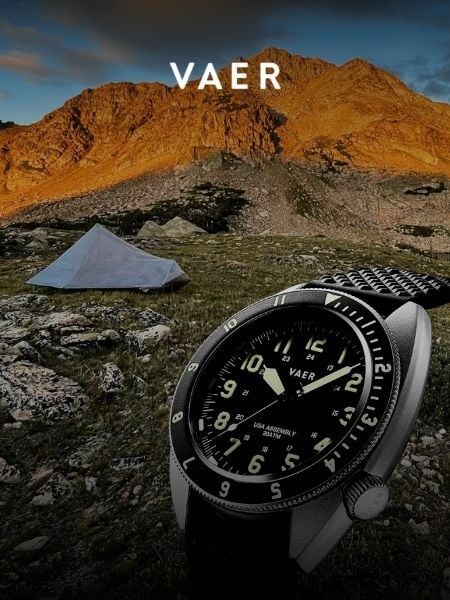 Vaer C4 Tactical Field SolarDurable timepiece for wilderness users - 20ATM (200m) water resistance, 120-click bezel, 316L SS casing, sapphire glass, solar-powered, Epson VS-42 Japanese movement, C3 Lume, USA assembly.
 © Beartooth Media Group Inc.
 Loading...