


"But us big ones can still take your lunch money."
If you can catch us. ;0))
Topic
Become a member to post in the forums.
"But us big ones can still take your lunch money."
If you can catch us. ;0))
"The little guy has the advantage up to a certain point."
There is absolute strength and relative strength. I have only observational evidence to offer, but I have seen a whole lot of little guys, climbers mainly, rack up heinous numbers of pull ups while the knuckle draggers flame out after just a few, typically less than 10. Same goes for hill running, to name another example. Again I stress, just personal observations.

Before i took my current climbing hiatus I could crank out 20 pull ups pretty much whenever, post climb.. pre-warm up. whatever. We used to do ladders.. 10 rep.. 9.. 8.. 7. at the end of the night pretty much to failure.
I can use smaller holds than many heavier friends and overhangs are much easier.
Biking they yell at me on uphills too then coast past me on the downhill :P
now i want to climb.. no time :(
> Not following you Roger. You're saying the limit of what someone can carry in a
> backpack is determined by spinal cartiledge?
Not quite. Many kids and young males can carry a whole lot more – been there, done that myself.
What I am saying is that there is a serious medical risk to loading up a young kid to more than 25% of their body weight. They may not show any ill effects during the hike, but in the long term the disks in the spine can be cracked or displaced a bit, leading to untold amounts of back pain in later life.
For the same reasons, OSHA now place limits on what a worker is allowed to lift in an industrial situation. Exceed that limit and you start risking popping a disk out sideways (or backwards), leading to the huge medical costs for back injuries in the workplace. Your spine did not evolve for lifting heavy weights.
So the question is what sort of a future life do you want to give YOUR children?
Cheers
I read a study once on the physics involved with King Kong and why he could never exist in real-life. An ape of that size would be crushed under his own body-weight. Its an extreme example, but analogous to why smaller hikers can move more weight, proportionately. Smaller hikers carry smaller clothes, smaller sleeping pads, smaller sleeping bags and can use smaller packs and it all weighs less. They also tend to burn fewer calories because they don't have the mass to carry all the time. They also don't bump thier heads as often.
"There is absolute strength and relative strength. I have only observational evidence to offer, but I have seen a whole lot of little guys, climbers mainly, rack up heinous numbers of pull ups while the knuckle draggers flame out after just a few, typically less than 10. Same goes for hill running, to name another example. Again I stress, just personal observations."
No, not in the strictest of definitions. Strength is defined by the potential tension a muscle is capable of applying in a single maximum contraction.
If you have a 150 lb guy able to knock off 15 chin ups and you have a 250 lb guy able to knock off one, if the 150 lb guy cannot strap 100 lbs to his waist and do one chin up, then the 250 lb guy is stronger. Period. What the 150 lb guy has is more efficient endurance. There is no such thing as strength endurance or whatever term Cross Fitters like to come up with.
Would I want to be 250 lbs and free climbing? Of course not. Are 150 lb elite climbers strong. Obviously. But how you measure strength is very specific and comparable between people via a one maximal repetition lift, pull , push, etc.
Also note that there is a strong correlation between bodyweight and maximal strength, but I digress.
Disregard former statement. I stand corrected… =/
Frye
just look at weightlifting records:
56kg weight class:
clean and jerk 165 kg
snatch 135 kg
total 296 kg or 5.285 X body weight.
105 kg weight class:
clean and jerk 236 kg
snatch 200 kg
total 436 kg or 4.15 X body weight
so, even in the worlds best trained athletes, the smaller is 20 % stronger for their size than the larger.
Ants, fleas, and many insects are incredibly strong for their size. An ant can carry 100 times its body weight.
I follow pro cycling, doping in pro cycling, etc, so I ended up learning a fair amount about endurance factors. The basic formula is watts/kg of body weight, which is why pct hikers and pro cyclists are generally thin. There's also V02 max, ie, how much you can pull in to your lungs, which then gets into your blood. Then there's the percentage of natural red blood cells in your blood, which carry the oxygen. That number varies significantly between non doping people, and can really determine how much you can do over days/weeks. 50% is about the highest naturally occurring number. Sometimes a touch higher. The body's reaction to daily activity also varies widely, usually your count drops over days, sometimes it doesn't. Roman Kreuzinger (currently under investigation for biological passport violations) at the moment claims his rise in hematocrit during long races recently is natural and is just how his body responds to that type of stress.
Big bones, required for a big body, obviously add exactly zero to the watt/kg, same with large internal organs etc, so after you hit the ideal size, you would clearly go down in efficiency and up in energy requirements as body weight increases. In other words, you have to use watts to carry around those bones, which themselves do nothing to moving you forward. This is why you will basically never see a big boned endurance cyclist, though you may see larger sprinters, but they still have to do the whole day's race to sprint, so there's a limit there.
Since backpackers are very rarely hitting v02 max limits, ie, your max performance physiologically, that probably isn't a big factor however, so it's probably more about watts/kg sustained. Hematocrit levels would matter over time, days, weeks, as would your body's ability to create new red blood cells quickly. Obviously, people interested in setting the next ridiculous speed record over some finite distance backpacking should really look into blood packing or EPO, they don't test so it's a clear benefit. For shorter trips, under a week, blood packing would be particularly effective because you have a lot more red blood cells in the blood volume to transfer o2 to.
Something I see very rarely here is mention of leg/stride length, walking that is going to be a pretty big difference, unlike in cycling. So length of leg relative to torso is probably a significant factor as well, plus the absolute stride length.
So it's pretty clear that body weight is going to be a big factor in terms of watt/sg, fat has a lot of blood vessels, and the heart has to work hard to get blood through them. I ran into a guy when I was briefly on the pct this summer in oregon who has been doing it every year for 6 years, and his body type struck me as probably close to ideal, fairly thin, but not skinny, medium height, reasonably long legs. I'm sure he has very good red blood cell replacement, and a good hematocrit level naturally, or he probably wouldn't have found it a good or fun thing to do to do the pct every year.
"Obviously, people interested in setting the next ridiculous speed record over some finite distance backpacking should really look into blood packing or EPO, they don't test so it's a clear benefit."
right up until you have a heart attack and die ;)
i was going to post about W/kg being a skinny ass cyclist myself but you did a good job.
Also, being an xray tech student, bigger people have generally the same size bones as everyone else. Taller people have longer bones but that is about it.
ie.
"right up until you have a heart attack and die ;)"
+1
"Yes. For example, erythropoietin has been misused as a performance-enhancing drug in athletes such as cyclists (in the Tour de France), long-distance runners, speed skaters, and Nordic (cross-country) skiers. When misused in such situations, erythropoietin is thought to be especially dangerous (perhaps becausedehydration due to vigorous exercise can further increase the thickness (viscosity) of the blood, raising the risk for heart attacks and strokes. Erythropoietin has been banned by the Tour de France, the Olympics, and other sports organizations."
Reference: http://www.medicinenet.com/erythropoietin/page3.htm

Also, bigger people have to carry bigger, heavier gear and more food.
All I have to say about being short is….anytime I need something up high, my husband finds it hilarious to "Does the wittle girl need this?" and wave it above my reach.
Although I could probably punch him in the man bits if I wanted ;-)
And frankly, being short also means I have to take more steps to keep up with him – and my tall teenager as well. I have a barely 29" inseam and my oldest has a 34" – Legs over there I cannot keep up with. His stride is always longer than mine.
On the heavier gear note mentioned: not always true. How so? Well, yes, there will always be more material involved, but if one is like my husband (who is a foot taller than me), he buys UL gear to carry less weight. His pack isn't anymore heavy than mine.
"I have a barely 29" inseam and my oldest has a 34" – Legs over there I cannot keep up with. His stride is always longer than mine."
For us shorties, speaking as a 30" inseam here, turnover is the name of the game. You have to pay your training dues to make it work, but it can be done.
I give him the car keys now on the way back….and that if he drives off I'll make his life miserable ;-) Lol! Although by the time I get to the van with his brothers….all the "emergency" and "snack" foods are long gone, unless I hide them in the Stow n' Go area under the seats. Yeesh!!!!!
I'm a freak, 5' 7" with 31.5" inseam, but boy can i run fast when i really want to–not that i've ever trained and i'm definitely a bit out of shape.
I'm 5'8" with closer to a 31" inseam. I can also run pretty fast. I have a large stride for my height. I wonder what is average. My brother in law is almost 6' with a 29" inseam and looks normal to me.
I know one of my hiking partners, who is barely taller than me – he might be 5'6", can outhike most tall guys. He was a Marine and had to keep up with guys who were 6 feet tall. So he learned to walk REALLY fast. As a civilian it has taken him a loooong time to work that one out ;-) His girlfriends were never happy….lol. He walks slower now.
Everyone complains that I walk fast. I walk at about 5 mph, I can slow it down to 4, but anything slower hurts after awhile. I don't "stroll" very well. Yeah, all my girl friends complained to. Now my daughter (and sons too for that matter) are the ones complaining. ;^)
Hiking is a different story. I can out hike most of my friends, but they are all old and fat!
Become a member to post in the forums.
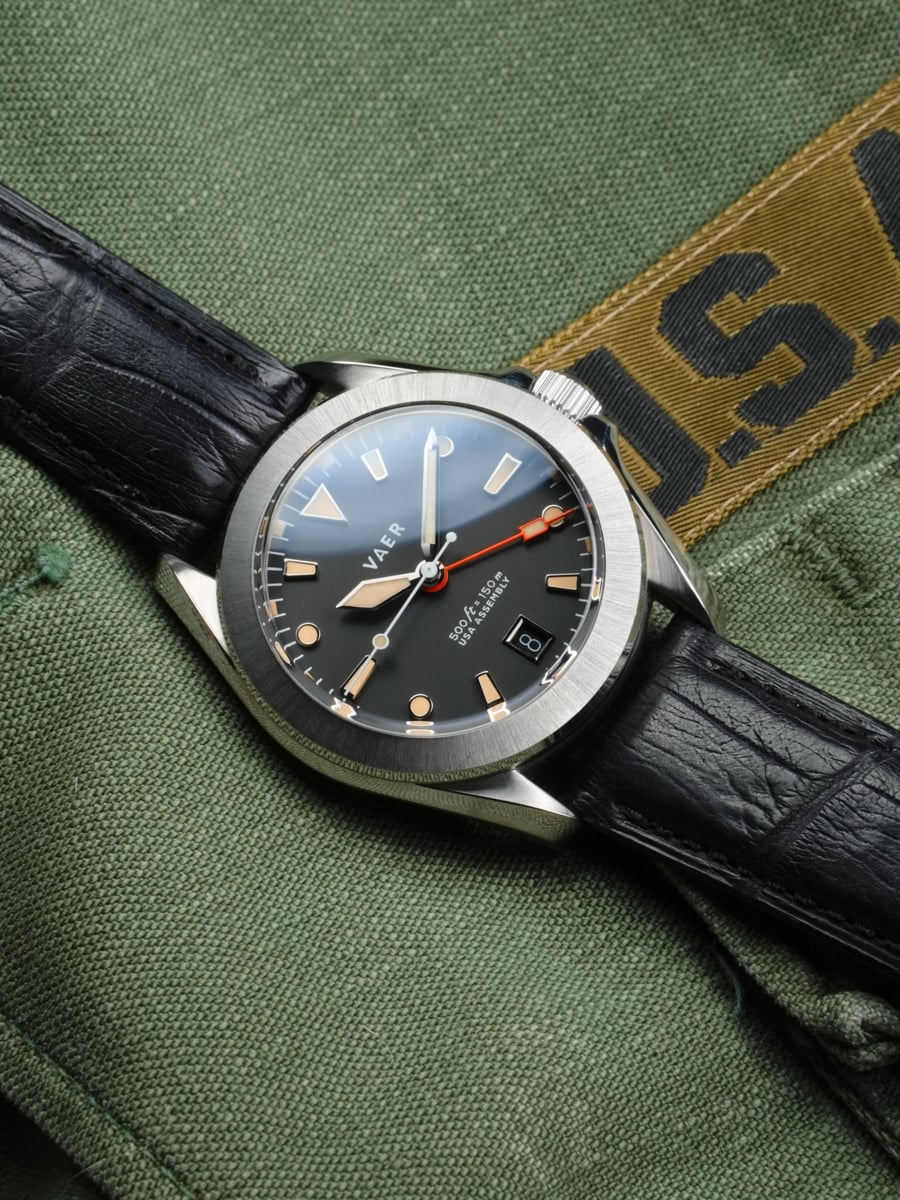 A Cult-Classic GMT Reimagined for Everyday WearInspired by the famously bezel-stripped Rolex GMT-Master worn by Marlon Brando in Apocalypse Now, the G2 Apocalypse turns a piece of 1970s film and watch history into a practical everyday GMT. Its restrained 39mm design pairs a Swiss Ronda quartz GMT movement with sapphire crystal, 150 meters of water resistance, strong BGW9 lume, and USA assembly. The result is an accurate, low-maintenance travel watch with a story collectors will immediately recognize.
 © Beartooth Media Group Inc.
 Loading...