I'm making a shelter similar to Nemo Bugout, but with fly and two walls of silnylon and two walls of polycro. Probably a mesh floor too. I like views. But what is the best way to join polycro to silnylon? (Or would you recommend some other transparent material like ETFE?)
Topic
How to join polycro to silnylon?
Become a member to post in the forums.
- This topic has 16 replies, 9 voices, and was last updated 10 years, 6 months ago by .
Can't tape silnylon as far as I know, so is there some sort of tape you can attach to the polycryo and then stitch to the silnylon?
That's a good question. Sounds like any kind of durable, long lasting bonding or adhesive type connection would be really hard to accomplish. Polycryo is kind of a cross between polyethelene and polypropylene plastics, both with rather low surface energy, and then silicone is another animal all together.
I don't know of anything for sure that would bond well with both. You could try Tyvek tape, or a 3M VHB type tape.
Other than than, using excess silnylong material, and folding over the polycro with same, and then sewing with a long stitch might work ok? The thicker the polycryo, the better. I would fill in the thread with some silicone after.
Dunno, tough one.
One idea would be to abrade the silicone coating just off the edges where you want to attach to the polycro, then use a tape or adhesive that would bond to both the nylon and polycryo. The main problem is the silicone.
Line of tape on the edge of the polycro. The tape will need to be tough enough to hold stitches. Roll the two fabrics together and stitch. The tape will need to be wide enough so no stitches will be in polycro only.
Even so, (sew) the polycro is not up to long term use I would imagine. Can you make it easily replaceable?
Maybe sew a strip of non silicone coated fabric to the sil, then use just tape to attach the polycro to the uncoated fabric?
+1 tape the polycryo and then stitch through the tape to the silnylon.
Scotch Heavy Duty All-Weather "Tough Duct Tape" sticks well to polycryo in my experience:
Treated carefully, the durability of polycryo is pretty good. I had a prototype tarp set up outdoors continuously for six months through winter a couple of years ago, and the plastic did not fail. There is another long thread here on BPL about polycryo tarps/tents (http://www.backpackinglight.com/cgi-bin/backpackinglight/forums/thread_display.html?forum_thread_id=59450). Duck 1.5 mil "heavy duty" polycryo can be obtained from Amazon and Walmart, amongst others:
http://www.walmart.com/ip/Duck-Brand-XL-Heavy-Duty-Patio-Door-Window-Shrink-Kit/26977958
I would run the tape along the edge of the polycryo to be sewn, then fold the tape over:
Problem!
You can get a siloxane tape which will bond (very well) to silnylon, but it relies on making a chemical bond with the silicone polymer in the fabric. It will be quite poor on polycro – as in hopeless.
Sewing is your only method.
Cheers
You'll find that sewing through the duct tape David G mentioned will be a major pain (gumming the needle).
The bad part is not much sticks well to polycryo either, but I'd also try using the nylon sail repair tape that David and I have tried on polycryo shelters. Once sewed maybe it will adhere better? Not sure how badly its adhesive would gum the needle since I didn't sew any of it.
I think David Olsen's suggestion of rolling them would be advisable as well.
I'll be interested to see your final prototype!
Tyvek tape works fairly well with polycryo ime (i made and used a tarp out of a combo of polycryo and heat sheet reflective material).
Tyvek tape is specifically made to be bonded with tyvek which is polyethylene. Polycryo is a cross between polyethylene and polypropylene which are both in the olefin plastic family and both have low surface energy.
After thinking about it some more, i would combine David's and my last idea. Take some sandpaper and abrade the silicone off the silnylon on the edges (and wash off with some soapy water after) where you want to tape, tape and then roll the materials together, then sew also with a long stitch.
Surprisingly, I have sewn a fair amount of duct-taped polycryo without any real gumming problems. I could see that there was some adhesive on the needle, but it never really interfered with the sewing. This was when I was sewing zippers on the ends of polycryo tarps. The longest single seam that I sewed was 30", so if you're sewing a long seam like the ridge line of a tent there is a possibility the adhesive would build up more.
This picture is a portion of one of the zippered tarp ends, showing Scotch Transparent Tough Duct Tape folded over the edges of the polycryo, to which the zippers were then stitched.

David,
Curious what size needle and thread you were using? I couldn't go more than 10-15 inches at a time without adhesive all over the needle when I sewed through the 3M 2120 (eg, transparent tough duct tape) but I was using whatever needle and thread my wife happened to have. Maybe a smaller needle and poly thread would have helped???
Not really sure about the needle size. Whatever came "standard" on the Brother machine I have. I did use poly thread though.
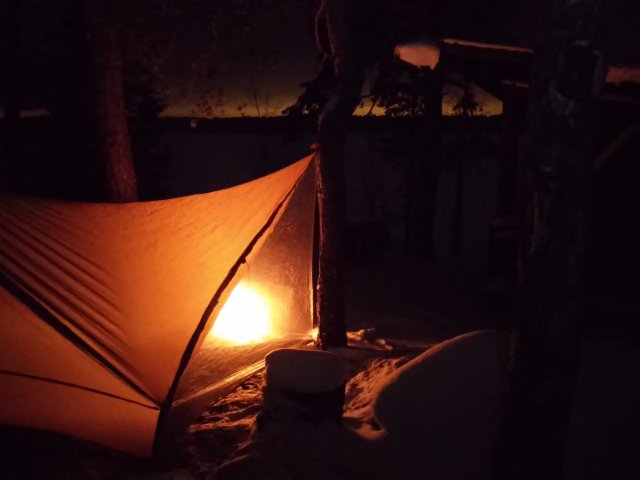
I went for David Olsen’s suggestion to tape polycro (with it’s own double sided window tape) to a strip of polyurethane coated fabric sewn to the silnylon. I’m sure polycro will need to be replaced once in a while.

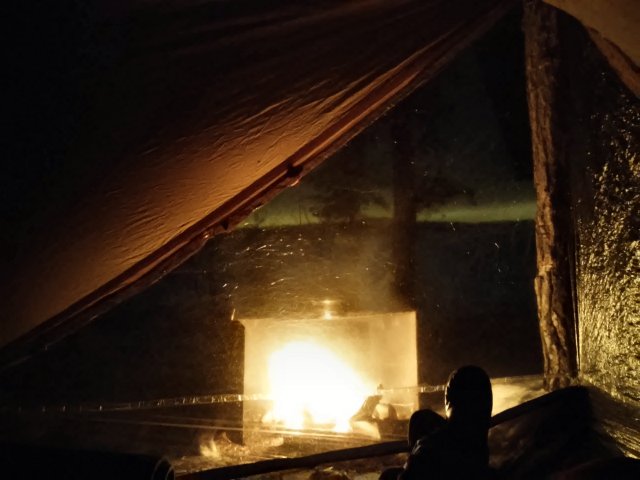
With a small campfire outside the window it was quite comfortable inside. T-shirt in near freezing temperatures. But the views are distorted as the polycro sheet crimples when packed.

So this is promising. A really light ‘hot’ tent. But I need to try other window materials too. Where to get thin ETFE in small quantities? Or is there a way to keep Polycro clearer, other than rolling it carefully every time? And yes, polycro gets easily small round holes from sparks.
Cool tent!
For all my musings, I’ve never considered putting walls on a wing tarp.  What are the dimensions?  How is it?  How does it handle wind?  Have you pitched it with poles in the corners?  How does the door work?
Also, have you considered putting a sheet of Ti foil behind the fire to reflect more heat?
Cheers!
Thanks!
This is my third version of a window tent. First one was a lean-to with one high back corner (was a bit too sensitive to wind) and second one a tipi (need to enlarge it’s window for better views). Wing tarp was an idea to give wide open views with reasonable wind tolerance. It’s a sheltered place setup anyway.
Floor is a sewn in bug net square with 2.2m/7.2ft sides. Top is a bit diamond shaped so the walls are not planar. Intention is to give them some wind stability but I still need to adjust the cut. Height is between 1m/3.3ft at the center and 1.9m/6.2ft at the corners. Can’t be pitched any higher because of the floor but maybe there should be extra tie-outs for a low pitch. There’s a vertical zipper full height door in the back corner. I like to walk in instead of crawling. Yeah, the weight – estimate is about 1.2kg/2.6lbs. I don’t have a scale (imagine!)
Overall I like it and think it’s ready for short hikes to find out all the little improvements. And to see how polycro wears out. There are few small spark holes already so no spruce for firewood. No shrinkage of the window anyway. ETFE-window could be more resistant. And I should make a slit in the floor near the front corner to be able to take care of the fire from inside.
Titanium sheet is a good idea. I have thought about an alu foil coated glass fiber cloth for the same purpose but Ti could be much closer to the fire and perhaps shield the fire a bit from wind and rain. And thus also the window from flames in wind gusts. Of course if firewood is abundant the lightest way to get a warmer tent is just to build a bigger fire.
“Cool tent!”
No, it’s warm. Few days ago on an overnighter it was -15C/5F outside and I made a two feet wide fire outside the window + added a metal sheet to reflect more heat in. It soon became so hot inside I took off clothes and washed myself with snow outside. For many readers’ relief, photo evidence of that is not included.

Portable winter sauna from outside

and inside.
Went to grocery store to check the weight: 930g/33oz – less than I thought! (tent only, no metal sheet)
Nice set up. Â I’m a bit surprised that the polycryo doesn’t shrink up from the heat–guess it’s just far enough away.
Become a member to post in the forums.