Topic

Realistic Expectations for UL Tent?

  • This topic is empty.
Viewing 19 posts - 1 through 19 (of 19 total)
David K BPL Member
PostedNov 15, 2014 at 2:28 pm

First time post. I apologize in advance if this topic has previously been covered extensively. If so, I'd appreciate getting a link to the any past thread(s).

My son and I did a 5 night backpacking trip in the Bechler region of YNP this past August. Before the trip I invested in some UL gear (i.e., tent, down bag, etc.) because I wanted to carry most of the group gear and food in order to keep my son's pack weight as low as possible. The weather on the trip was pretty unusual for August in the Northern Rockies and I ended up sleeplessly listening to steady, sometimes heavy, sometimes driving, rain hitting the fly for most of the last 3 nights of the trip. (Of course, other than during a fairly epic thunderstorm on the first of the rain-soaked nights, my son slept soundly throughout).

The first two of the three nights, the tent was surprisingly (to me) weatherproof, performing at least as well as other higher-end standard-weight backpacking tents I've used before. Enough water had made it though the fly to create a couple of drops that had fallen on to the mesh ceiling, but I'd say that was to be expected given the amount of rain and its duration.

At some point during the third night, however, I began to feel micro-droplets hitting my face. By morning I'd say that most everything exposed in the tent was fairly damp including the shell of my sleeping bag. It's hard to say if any of the water on the shell had soaked into the down, but it felt like the down was a bit less lofty than it had been other mornings.

Most of the backpacking I do is in very humid mid-Atlantic environments, so I'm used to waking up with dampish gear due to condensation, and the "dampness level" of our stuff that morning was on the high end of what I've seen happen from condensation alone. I've not before had gear in a tent get so damp from rain, though. We'd had a bit of sun that afternoon, so the fly was dry before it started raining, but a contributing factor may have been that we had pitched our tent in a somewhat exposed area and some of the rain was hitting the fly directly without being broken up by trees. I also wonder if I had not been careful enough with the fly during the trip. I had draped it over trees and shrubs to dry and had been stuffing it into pack more or less like I wood a standard weight tent.

Anyway, with all that being said (thanks for reading this far), Is the tent performance I describe to be expected from a brand new UL tent? Along with durability is that just one of the tradeoffs involved?
PostedNov 15, 2014 at 2:37 pm

"At some point during the third night, however, I began to feel micro-droplets hitting my face"
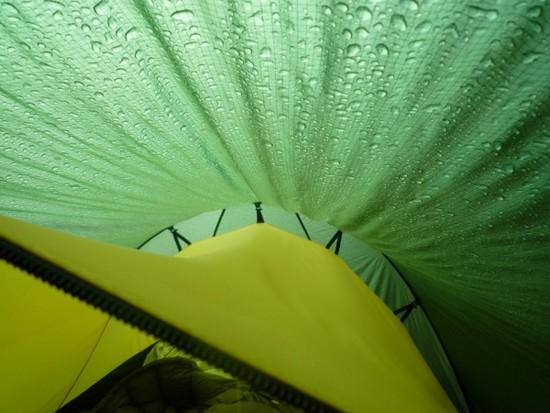
I strongly suspect that what you describe is not mist from penetration but just condensation dislodged from the underside of the fly by the rain.
If your previous tent had a fabric inner you would have had a similar result except that the fabric would have prevented that mist from penetrating the inner.
Not much you can do with a mesh inner (with fly only you can wipe that condensation down) except for trying to maximise air flow (cold air in from the bottom, hot air out from the vents ,chimney style) at the same time trying not to get the rain in.
If and how you can do this it depends on the specific design.

This photo illustrates the point :
Condensation

Jeff Jeff BPL Member
PostedNov 15, 2014 at 2:39 pm

It depends on a lot of things. When you use lighter gear, you sometimes have to pay more attention to site selection or rely on other skills.

In your case, it still depends on many things. Everything is waterproof up to a certain point. I've definitely used shelters that misted through with a hard rain. My guess is that you had condensation on the tent fly and that was knocked down onto you due to the fly getting hit by rain from the outside.

PostedNov 15, 2014 at 2:41 pm

What was the tent you were using? and were the seams properly sealed?

Going to need a bit more information.

kevperro . BPL Member
PostedNov 15, 2014 at 2:49 pm

As Franco said… you probably have condensation that you feel as misting.

If I'm carrying a tent I carry a double wall design where you are protected from misting by the inner. That extra layer does a lot to protect you from the condensation and in my experience it adds some warmth.

Pretty much all ultralight designs trade-off some form of durability although in the past I've found out I've carried durable materials where I simply didn't need them. The key is carrying durable materials where they really matter.

In a tent I think the floor is what takes the most wear/tear. Floorless designs make a lot of sense to me.

Jerry Adams BPL Member
PostedNov 15, 2014 at 2:54 pm

or it could be misting through if it's silnylon

I have found that yeah, you can feel it on your skin and maybe even on the fabric below, but it's not really enough to get the down wet or anything

Todd T BPL Member
PostedNov 15, 2014 at 5:25 pm

What Franco said.

I've had it happen, and it was very clearly condensation misting off. I've never experienced the so-called misting through silnylon. I'm a skeptic. :)

PostedNov 15, 2014 at 6:05 pm

My Toyota gets as wet from condensation as the neighbour's BMW…

I have experienced the type of condensation seen in my photo above with polyester,taffeta nylon, Epic and silnylon and felt it on ToddTex (original Gore Tex) but mitigated by the fuzzy stuff .(all my own tents)
The only fabric the is immune , apparently, is Cuben except that I see from the ones that have got over the need to justify the price, that indeed they also get condensation.
Funny that…

PostedNov 15, 2014 at 10:10 pm

"except that I see from the ones that have got over the need to justify the price, that indeed they also get condensation"

Speaking from experience, Cuben is as susceptible to condensation as any of the fabrics you mention. It is conditions, not the fabric, that determine whether or not you will get condensation.

Roger Caffin BPL Member
PostedNov 16, 2014 at 12:21 am

> It is conditions, not the fabric, that determine whether or not you will get condensation.

Every time. Every time.

Cheers

Ian BPL Member
PostedNov 16, 2014 at 1:17 am

Yes cuben is sadly not immune from condensation or the spray resulting from the energy transfer from the rain drop to the condensation. Been there done that with a Hexamid twin.

Derek M. BPL Member
PostedNov 16, 2014 at 1:51 am

"It is conditions, not the fabric, that determine whether or not you will get condensation."

Warm, moist air rises off of you while you sleep/breathe/move/etc. This air then hits your tent or tarp fabric, and that fabric is usually quite a bit colder than the air coming off of you (because the thin fabric is fully exposed to the outside air temperature).

What happens when warm moist air hits a cold object? Condensation.

It doesn't matter what your fabric is made of, if the inner fabric surface is significantly colder in temperature than the air rising off of your body then you inevitably will get some condensation.

Wind helps to minimize tent and tarp condensation because it both blows away your warm inner air and it helps to evaporate any condensation that is forming.

No magic here.

PostedNov 16, 2014 at 7:49 am

Exactly. Now if we want to discuss which fabrics absorb water weight…..

PostedNov 16, 2014 at 8:33 pm

I had made and used a tarp made out of a combo of "polycryo" and reflective heat sheets. The materials were only taped at the perimeters, and so there usually was a small air gap in between most of the material. The heat sheet was the inner, and polycryo was the outer.

I used it a few times with my spouse in conditions that normally would have left quite bit of condensation on a closed up tarp (especially with two people under same), however, with this tarp, it was much reduced.

But yeah, otherwise, expect condensation, and potentially lots of it depending on circumstances.

(tarp, btw, went into a friend's bug out bag).

PostedNov 16, 2014 at 10:04 pm

I hope that we didn't scare David (the OP) away.
As I pointed out my comments were a guess based on the description of the events and matching that with my own experience.

These words : "I had draped it over trees and shrubs to dry" could point at possible tent damage however unlikely to have caused WP degradation but could have possibly resulted in some tiny holes.
But I am guessing that those, under steady rain, would result in drips at a predictable pace (that is every 30 sec (whatever…) you get another drip).
When this happen more often then not it is incomplete seam sealing (particularly on those bits (ribbons/Velcro/straps) sticking out from the fly or faulty /perishing tape.

David K BPL Member
PostedNov 28, 2014 at 4:42 pm

Thanks Franco, et. al. for the responses. They are very helpful. And sorry it's taken me so long to follow-up. It makes a lot of sense that what I experienced was condensation being knocked off the fly by rain drops. I doubt there's much that can be done about that with a mesh-only ceiling, but it's also unlikely that the amount of moisture dislodged (even over a long period) would ever present a serious issue in conditions where a mesh ceiling was appropriate. I'll now sleep a little better next that happens. Thanks again.

PostedNov 28, 2014 at 7:31 pm

Whenever this comes up, condensation seems to get the blame. No doubt that's often the case, but it didn't seem to explain some of my experiences:
1. Never having condensation drip onto a net inner in a tent that was extremely well ventilated by open awnings on its two longer sides. (WE Bug Dome used extensively in the worst weather, but in forested areas only – below T-line).
2. Long and heavy rain that dribbled into a tent when camping at an exposed area on a mountainside; but the next night, after moving to a less exposed area, the tent remained totally dry inside during lengthy but not quite so intense rain. (The intensity is usually pretty apparent from the volume of the wind and the hammering of the rain on the canopy.)

In no. 1, condensation never got into the tent despite some severe rainstorms over several years of use. In no. 2, on the last few trips before the tent was cashiered, the entry of water appeared to turn on and off depending on the intensity of the rain and the degree of exposure to it.

This led me to experiment one rainy fall with various coated fabrics stretched tight over bait buckets on the back deck. (BD Malibu-Epic treated polyester, pre-2006 silnylon tested to 3000mm HH, several post-2006 US silnylons, and the silnylon introduced by Thru-Hiker in 2011 and tested to 3000mm HH). All of the fabrics resisted a number of rain storms of varying intensity during several rainy weeks.
However, when the granddaddy of rain storms eventually occurred, lasting over 24 hours, all the fabrics except to two 3000mm HH ones allowed water to penetrate, soak the fabric, and drip into the pails, as also occurred later with Porcher-Sport Skytex 27, a .9 oz paraglider fabric.

My first concerns now are, in no particular order, the quality of the coating and seam sealing, the durability of the coating, and the amount of ventilation. Using that approach, there have been no problems with moisture when tenting, whether it is thought to be from condensation, leakage, or a combination of both. However, one experiment in pounding rain and high wind with a prototype canopy of at least 3000mm HH silnylon, but open on two sides, did give some pause. The interior of the canopy was quickly soaked, either from condensation or very damp air blowing in many directions.

So another priority may be to design vents with as much wind protection as is feasible. I'm not sure, and don't think there are any blithe, easy generalizations that can be made on this subject. Roger's points about using solid, water repellent inners are well taken; but solid inners that may be excellent in winter don't appeal to me for the high humidity in other seasons during extended rains. So far I've not found any solution better than focusing on the above mentioned priorities and hoping for the best.

PostedNov 28, 2014 at 9:36 pm

"I'm not sure, and don't think there are any blithe, easy generalizations that can be made on this subject."

Concur. I break all the rules of site selection, and rarely have condensation, yet have it appear in places that make it seem most unlikely relative to those where it hasn't occurred.
Most recently was in Utah with moderate weather, excellent ventilation, and ideal site on a trail that I've been on with more challenging weather conditions four times in the past, and never once seen a speck of condensation, even using a bivy. Wasn't much, but just the fact it was evident at all really surprised me.
Why this time? I have no idea…

Viewing 19 posts - 1 through 19 (of 19 total)
Loading...
