Topic

Minimum temperature for inverted canister stove

Viewing 13 posts - 26 through 38 (of 38 total)
David Thomas BPL Member
PostedMay 3, 2017 at 12:54 pm

“according to wikipedia, propane boiling point is -43 F, so it should work down to that temperature”

If it was pure propane, and you needed no pressure for losses through the valve and burner.

I used propane at -40F for three days in 1999.  But they were big tanks (three x 60-pound capacity), plumbed together and I was only running one stove burner for 10-15 minutes at a time.  Still, it puzzled me – seems like it should have crapped out – maybe the local mix has a bit of ethane in it?  There’s no need to make 99.9% pure anything if you’re just going to burn it.  If you aspired to, you’d build a huge, tall, expensive distillation column and your boss would fire you.  So all fuels are mixtures that contain bits of the next-higher and next-lower boiling point compounds.

I’ve also iced up a 500-gallon propane tank in +48F but I was doing 24/7 vapor feed at 500,000 BTU/hour (equivalent of operating 160 stove burners at once).  Point being: heat rate matters. You need to recover that heat of vaporization from the environment or through a Moulder Strip, hand warmer, warm water, etc.  Or have liquid feed from an inverted canister.
Bob Moulder BPL Member
PostedMay 3, 2017 at 1:15 pm

Still, it puzzled me – seems like it should have crapped out – maybe the local mix has a bit of ethane in it?

Perhaps because the amount being vaporized was very small compared to the total mass (and therefore heat contained therein), keeping it just above vaporization temperature?

So all fuels are mixtures that contain bits of the next-higher and next-lower boiling point compounds.

Funny, after learning more about it, I stopped calling the tabletop canister stuff “Pure n-butane” and started calling it “straight n-butane” and finally “I don’t know what the hell is in those cans.” :^)


David Thomas BPL Member
PostedMay 3, 2017 at 7:31 pm

How about “cheap table-top butane” of unknown vapor pressure (unless you’ve measured it).

Bob Moulder BPL Member
PostedMay 4, 2017 at 5:09 am

Good enough!

I like your observation that you’re just going to burn it so it isn’t that critical anyway.

Jerry Adams BPL Member
PostedMay 4, 2017 at 2:41 pm

I crudely measure another cheap butane brand from the Korean grocer – “Vulcan” – $5 for 4 cans 8 ounce each

It is also about 50% isobutane-50% n-butane

that is, the boiling point is about 20 F, halfway between iso and n

that is, with a canister about 20% full, it slowed down at 33 F.  Subtract 3 F for the margin required to run the stove slowly, plus subtract about 10 F for evaporative cooling

Bob Moulder BPL Member
PostedMay 4, 2017 at 6:20 pm

That sounds just about right.

Canister stove performance generally seems to slow down at temperatures that are warmer than most people expect.

Bill S BPL Member
PostedMay 6, 2017 at 1:46 am

Thanks for the information.

I couldn’t read the complete Dunckel article because I’m not an advanced member so his comments on inverted stoves were not available to me. I have a new to me Kovea Spider inverted canister stove.

I do not have winter experience with it. My questions  center around running a cold canister empty. My perception of how things will work is that the propane will force the liquid butane out of the cylinder and that it will be vaporized by the preheater tube. In that way the canister will completely empty itself at temperatures below 0 F without warming the canister.

Is that correct, does anyone have personal experience.

I live in northern Wisconsin. We use propane to heat our houses and to cook with all winter. The tanks all sit outside the house. Propane works fine at -30F. Butane at -30F might be getting viscous so I’m not sure the propane would push it.

Bill(B-3)

Bob Moulder BPL Member
PostedMay 6, 2017 at 6:34 am

At those temperatures you will still need to warm the canister. It is usually enough to leave a 2-3″ gap in the windscreen so that some convective and radiant heat from the stove can warm it up a bit. It doesn’t take a lot.

I’ve done very little testing with this remote inverted setup, although what little I have done has been with the Kovea Spider. One thing I remember is that when inverted it takes a little while to get the pre-heat tube good and hot, so start off with the fuel valve only slightly opened and work your way up to operating temperature. Otherwise there will be some sputtering and some flaring from liquid fuel that is not completely vaporized.

Jerry Adams BPL Member
PostedMay 6, 2017 at 8:47 am

“Propane works fine at -30F. Butane at -30F might be getting viscous so I’m not sure the propane would push it.”

Roger, Gary, and I have all written articles that go about that from different perspectives.

For each fuel, there is a boiling point temp where there’s barely enough pressure to push gas out of the stove.

Propane is -44 F, isobutane 11 F, nbutane 30 F.  Cheap butane is typically a mixture of iso and n so it’s about 20 F.  Good butane like MSR Isopro is mostly isobutane plus they put some propane in it so it’s about 0 F (but that preferentially boils off so towards the end of the canister it’s more like 11 F).

Then, you need it to be a couple degrees warmer to provide enough pressure to push enough fuel out to burn at a good rate.  3 F or even 6 F for and upright stover.

Then, for an upright, the canister cools from evaporative cooling during operation.  About 2 F for a full 8 ounce canister.  more than 10 F as the canister gets close to empty.  The air temperature needs to be that much warmer than the boiling point.

If the air temperature is less, then you have to use one of the methods to warm the canister.  The Moulder strip where a copper strip takes the heat from the flame down to the canister,  Or set the canister in a tray of water, maybe 4 ounces, and occasionally add some of your heated water to keep it from freezing.  Or use a BIC lighter (let’s call that the David method).  Or the clearly superior method – a 1 foot square of aluminum foil underneath, folded up so it reflects the IR from the flame onto the bottom of the canister (let’s call that an Adams reflector) : )

Gary Dunckel BPL Member
PostedMay 6, 2017 at 9:49 am

“Or the clearly superior method…”

C’mon, Jerry, it’s only “clearly superior” to you because you came up with the idea. While I agree that it does indeed work (down to 0* F in my testing at least), there’s no doubt in my mind (as well in Bob’s and David’s) that the copper Moulder Strip and insulating cozy technique rules them all. It allows a canister to purr along nicely at temperatures well below 0* F regardless of the fuel mixture, and it is far more durable than a piece of aluminum foil. It is, however, a bit heavier. My cozy/ strip/base setup weighs 1.40 oz., while my complete Adams reflector (including foam base) is 1.03 oz. This slight weight penalty is acceptable to me because (1) it will function in the coldest temperatures I might be exposed to, and (2) nothing can break or be blown away in the wind.


Jerry Adams BPL Member
PostedMay 6, 2017 at 10:26 am

Some internet subjects can produce heated arguments (pun intended), better to talk about Trumpcare or some other less controversial subject : )

My reflector weighs 0.1 ounce.  Temperatures like at 0 F or below are not common to us testers so I don’t think we have fully characterized this.  I suspect the reflector is just as good.

Of course I’m biased against Moulder strip because my stove is 1 inch taller, and I was using 8 ounce canisters which are an inch taller.  Those two inches make a big difference.

Roger Caffin BPL Member
PostedMay 7, 2017 at 3:57 am

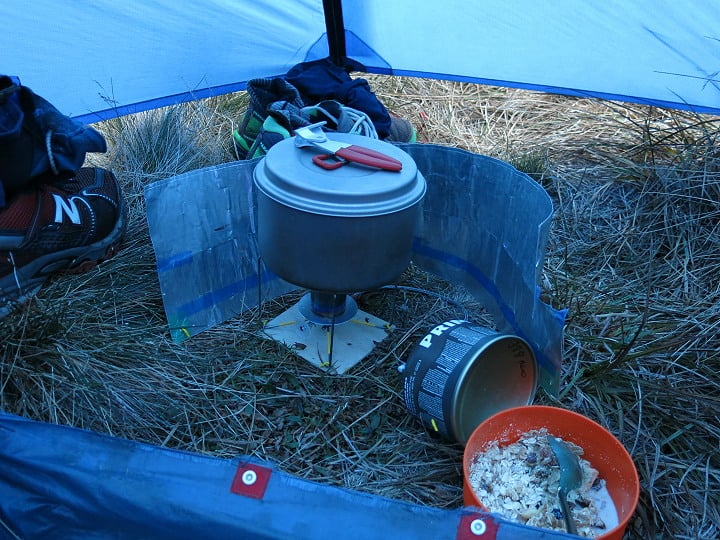
Taken a few mornings ago at about 1,600 m. Night times of -7 to -10 C. Warm milk for muesli breakfast.

About 10 seconds of gas feed, then inverted for liquid feed. Note: canister stored overnight under end of my quilt!
Biggest problem: we only took our UL summer quilts. We snuggled closely.

Cheers

Jerry Adams BPL Member
PostedMay 7, 2017 at 7:58 am

your canister will probably get way more heating from radiative heat from the stove than the small amount lost due to evaporative cooling in an inverted stove

Viewing 13 posts - 26 through 38 (of 38 total)
Loading...