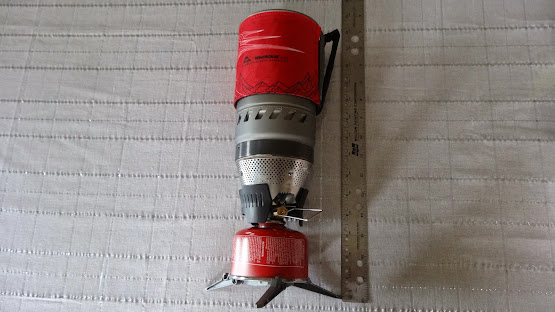
Jim, did you weigh the Windboiler yet (of course you did)?
Gary,
Yes I did. The weight of each component is in a table in the Appendix. Sorry the review is so long. I once had a boss who described me a “thorough.” I guess I’ll own that one. Tech nerd, you know. My “day job” lately has been writing tech specs. :)
The Windboiler, with a tag still on it, came in at 17.2 ounces without fuel, which is heavier than my 14.4 ounce 1.0 liter Reactor.
My total is 457g/16.1 oz. Basically one pound. My unit is 25g (about 0.9 oz) over spec. Interestingly my 1.0 L Reactor is also 25 g off spec, but the other direction (i.e. it’s lighter than spec).
Now, I emphasized the word “stated” in a post a couple posts back in this thread. MSR needs to “watch it’s weight.” There’s something psychological about passing the “pound barrier”. Somehow 15.25 oz sounds a lot lighter than “over a pound.” The word “pound” implies heavy. I think MSR needs to keep the units pretty close to their stated weight. My unit is within an ounce, but yours is about 2 oz overweight. That seems like maybe they need to tighten things up a bit. Shoot, a lot of whole stoves weigh less than 2 oz.
Since neither of us would take the bottom cup with us…
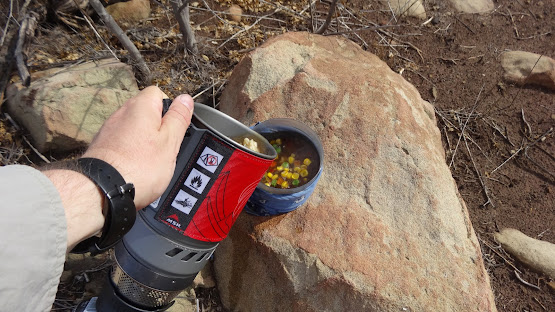
I actually like the cup/bowl. At 500 ml it’s big enough to be actually usable. I usually carry a bowl anyway, especially if I’m hiking with another person.
…we both wondered why people will choose the Windboiler over the 1.0 L. Reactor.
One word for you: Price. The Windboiler is $60 cheaper.
If the heating element truly allows one to simmer, that would be an advantage over the Reactor.
It simmered — and simmered well — in the tests I did. I still need to do more tests. I want to see exactly where the flame out point is. You can’t see the flame (if the pot is on), so it’s a little tricky to adjust things while cooking compared to flames that you can see. One could mark the spindle though…
If the Windboiler can match the fuel usage of the Jetboil Sol, and can do it in much more windy conditions, maybe they will have something there. But if the Windboiler’s fuel consumption matches that of the Reactor, then I’m thinking that the Reactor is the stove to take.
I think you mean “the Jetboil is the one to take,” yes?
From my cold weather patio tests last December, I found that the Jetboil Sol actually outperformed the Reactor in windless 20* F conditions. It used less fuel to achieve a boil, and it was only slightly slower to get the water boiling. So far, I’m thinking that the Sol might be a better stove in all but the most windy conditions.
Well, there’s the proverbial $60,000 question. Just how windy does it have to be before it pays off to carry the extra weight of a Windboiler (compared to a Sol)? That’s going to be a hard one to get a good handle on. You’re really going to make me work for this one, aren’t you?
And they’ve discontinued [the Sol]!
Yeah, well you can thank the Jetboil Zip for that. The Zip is only about 1 oz heavier than the aluminum Sol. The aluminum Sol is $40 more expensive than the Zip. Apparently a lot of people weren’t willing to pay $40 for piezo ignition and one ounce lighter. I obviously wasn’t in the board room the day they decided to kill the Sol, but I think that’s what happened. The Ti Sol is even more high end and is $70 more than the zip. Just didn’t cut it economically I think. I hope I’m wrong and Jetboil has something even lighter in the works, but I doubt it. Most people aren’t on BPL and just don’t care about one ounce.
Please let us know what you learn about the Windboiler, Jim. Do it for science, right? The planet needs to know the results.
I’ll see what I can do. You know this cuts into my time on the trail, right?
HJ
Adventures In Stoving
Hikin’ Jim’s Blog