Topic

Personal locator Beacons (PLB’s) recommendations

  • This topic is empty.
Viewing 25 posts - 1 through 25 (of 49 total)
HeathP BPL Member
PostedNov 1, 2014 at 11:03 pm

All,
I have been spending more time deep in the backcountry or on the tops of mountains where there isn't any cellular service. I was wanting to get a PLB/Satellite messenger to reassure my wife that I am ok and so she could check in on me if need be. I'd prefer one of the PLB's you can send text messages with (not just the canned responses) and was wondering if anyone had experience with the versions available from Spot and Delorme. I have read that the Delorme inReach Se is much better than the Spot but the price is significantly higher. Which is better for sending messages and in calling for help if/when that is absolutely necessary? Your thoughts would be greatly appreciated

D M BPL Member
PostedNov 1, 2014 at 11:34 pm

I have been using the Delorme InReach for nine months. It works and you can turn the subscription on and off and not have the bill when you aren't using it, and it's pretty cheap insurance. My spouse loves it cause we talk by text every day and it's very reliable. Very worth the investment.

Charles Grier BPL Member
PostedNov 2, 2014 at 4:28 am

I'll second the recommendation for the Delorme Inreach. I've been using one now for about 9 months including 3 weeks on the JMT. It gives two-way communication, you know whether a message has gone out and mine has been extremely reliable.

HeathP BPL Member
PostedNov 2, 2014 at 4:36 am

All,
What your saying matches up with the reviews I have read. I didn't know you could turn the subscription on and and off. I heard that Spot's subscription is a PITA and as you said you don't know if a message was sent or received with their PLB. Thanks!

jimmy b BPL Member
PostedNov 2, 2014 at 9:03 am

Is the Inreach a "true" PLB as one would think of in that it sends an emergency signal to a government satellite receiving center and then that info is delivered to the proper SAR agencies or is a privately run satellite communications system? I do like the idea of two way communication with the Inreach but there are strong benefits to a true PLB system as well. Best to educate oneself on the differences of how they work, response time expectations ect, that is if there are in this case. Just wondering.

jimmyb

HeathP BPL Member
PostedNov 2, 2014 at 9:12 am

Yes the inreach is a true PLB. Both the Spot and the Inreach use the GEOS network

http://www.geosalliance.com/

However I have heard the spot doesn't always work where the inreach appears to be more reliable.

PostedNov 2, 2014 at 9:50 am

"Is the Inreach a "true" PLB as one would think of in that it sends an emergency signal to a government satellite receiving center"

Cospas-Sarsat is the government operated search and rescue system.

InReach and SPOT connect to a USA-based privately run commercial operation using the Globstar system.

Edit: I incorrectly linked SPOT to the Iridium satellite system, and fixed that above.

HeathP BPL Member
PostedNov 2, 2014 at 10:16 am

If I was in a truly remote location I would probably carry both the DeLorme and the ResQlink so I can keep in touch with my wife with the DeLorme and still have the piece of mind that if needed I will be rescued via the ResQlink. I don't see myself being in a situation where I will need the ResQlink for a few years though.

http://www.outdoorgearlab.com/Personal-Locator-Beacon-Reviews/ACR-ResQlink-406-Personal-Locator-Beacon

I am following a guy I know climbing a mountain in Nepal at the moment and he is using the DeLorme and it appears to be working quite well.

HeathP BPL Member
PostedNov 2, 2014 at 10:33 am

This is what the folks who make the ResQlink have to say about their beacon;

"The Spot uses 400 miliwatts while 406 MHz Personal Locator beacons on average use 5 Watts. So you would need about 12 SPOT units to equal the power of one PLB."

David Thomas BPL Member
PostedNov 2, 2014 at 10:57 am

I have the $270, 4.6 ounce ResQlink and prefer it to the SPOT I had:

– much more consistent ability to send a "rescue me" message.

– no annual fee

– 10 year battery life

– USA and Russian satellites can hear it and it is a government-operated center that relies the message to local S&R.

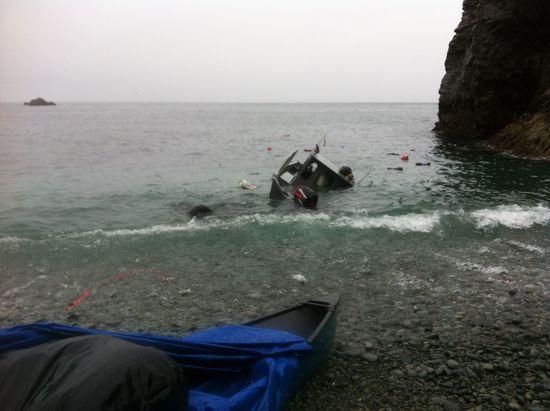
I ALWAYS have it IN my life jacket pocket when I'm on the ocean in a small boat and the time the boat sunk 7 miles past the last native village made all the times I carried it and all the times I will carry it in the future worth it. (I never hit the button, because we hailed a passing ship with a VHF handheld (also, ALWAYS on my life jacket).

_____

SPOT was so unreliable for me in sending "OK" messages that many people back home worried MORE when I had it than when I didn't. (If your family can grasp that no news doesn't equal bad news, no news is just no news, then fine. But that appears to be a rare skill).

I see reports that the Gen3 SPOT is more reliable about getting messages out. I can't speak to that.

_____

Manfred's use of the InReach during his Brooks Range traverse was helpful in many ways. He could accurately track his progress versus a on-board map and versus his pre-planned schedule and make decisions accordingly. He was able to text me for air flight and resupply options which I researched the old-fashioned way (internet and phone) and then texted back to him. When a tent catastrophically failed, I sourced him a replacement and had it shipped to his bush plane pilot for his next resupply. He and his sons were in truly remote wilderness, as far north as anyone ever backpacks, encountering unseasonably cold weather and very high water conditions, they were pushing it on both mileage and UL fronts and all of that increased the value of being able to get a message out.

Sending messages can also help OTHER people. Manfred sent a message that I was heading out (I accompanied them for the first day and there was a serious river crossing I had to do solo to return). I sent a message back once I was in cell service so they wouldn't worry about me. Occasionally, in ridiculously remote settings, you find someone else who needs medical or police (e.g. having a kill a belligerent drunk in Wood-Tikchik State Park comes to mind) and being able to send a message can feel like a very substantial good deed.

PostedNov 2, 2014 at 11:00 am

"The Spot uses 400 miliwatts while 406 MHz Personal Locator beacons on average use 5 Watts. So you would need about 12 SPOT units to equal the power of one PLB."

Not quite apples to apples…

A 406 beacon has to reach out to ~20,000 miles to hit a geosynchronous satellite.

A SPOT or InReach only have to reach out ~500 or ~800 miles respectively to hit a low orbiting satellite.

Edit: Assuming a SPOT works with 400 mw, reaching out to 20,000 miles would require 400 times that amount of energy (inverse square law at 20 times the distance) – 160 watts! Or, going the other direction – 5 watts/400 = 12.5 mw. So, clearly there is a Lot more going on than just raw power. Ignore the marketing.

Jenny A BPL Member
PostedNov 2, 2014 at 11:35 am

I have both a DeLorme inReach Explorer SEND (Satellite Emergency Notification Device) and a McMurdo Fastfind PLB (Personal Locator Beacon). I've never had to activate the PLB but assume it would work as advertised. There are many years of history and many rescues credited to that technology, which is supported by a worldwide system of governments. My only complaint about the PLB's is the battery life and necessity of sending it off every few years for a very expensive overhaul/replacement.

The satellite phone-based systems like SPOT and DeLorme's systems were brought into being and are administered by private companies. My daughter and I used the inReach Explorer for 5 weeks last summer on a Colorado Trail hike. The two-way text messaging feature made most of the other hassles of trying to figure out the system worth it, and I really liked the speed and accuracy of the GPS location feature of that device. During our hike I was able to pick a monthly plan that gave us unlimited messaging, an idea which I would recommend to anyone during the familiarization process. I've since ratcheted down the subscription fee to an acceptably low amount during the quieter winter months.

Both the SPOT and DeLorme devices have their share of fans and detractors, but the ability of the DeLormes to provide 2-way communication blows SPOT away, as far as I'm concerned. I carry the PLB when out by myself and would only activate in an emergency; the DeLorme gets used when we need to rely on others for trip resupplies, etc.

In a nutshell: PLB pros – no subscription or annual maintenance fees, simple operation, bombproof (?) SOS, supported by worldwide government dollars, worldwide satellite coverage. Cons: SOS only, no 2-way communication, unit must be shipped off to who-knows-where for battery replacement every 5-10 years.

SEND pros – 2-way text communication and tracking points available, GPS location available (only with DeLorme), non-emergency notification to friends/family. Cons: monthly or annual subscription required to activate, satellite coverage not necessarily worldwide, potentially frustrating user manuals and hit-or-miss customer service.

Hopes this helps somewhat.

PostedNov 2, 2014 at 11:44 am

And, being on different frequencies, a watt of power on one probably won't translate to the same transmission distance as a watt of power on the other.

The key is in the OP's statement, "and still have the piece of mind that if needed I will be rescued via the ResQlink." That is the one and only function of a "true" PLB. Spot and DeLorme are good products, and you could hope to use them for rescue needs, but they are satellite communication devices, not true PLBs. If they were true PLBs then the OP wouldn't need to make the distinction between what to use to communicate with family and what to use for a rescue. It is because of these kinds of devices that we're even talking about a "true" PLB.

HeathP BPL Member
PostedNov 2, 2014 at 12:43 pm

Sounds like I definitely need to pick up both the DeLorme and the ResQLink. Thats intense David I spent a decade in the Navy and sailed all over the world never thought twice about my boat sinking.

David Thomas BPL Member
PostedNov 2, 2014 at 12:55 pm

At the head of Qugyugtulik (Dogfish Bay) on the Kenai Peninsula, 7 miles south of the roadless community of Nanwalek, here's a small gravel beach at the base of some cliffs. The three guys from NM looked at the two of us from AK and asked suspiciously, "Why were you two wearing PFDs?" (what did you know that we didn't) and I replied, "Dude, I ALWAYS wear my PFD (with PLB, VHF, knife, and fire-starting kit) when I'm on the water"

Boat sinking

P.S. the ocean is pretty cold at 60N.

HeathP BPL Member
PostedNov 2, 2014 at 1:14 pm

David,
We sailed as far North as Vladivostok on my ship and spent a lot of winters off the coast of North Korea and it was frigid. Especially when we had to make repairs to antennas in those conditions. The only time we wore a PFD with a beacon was when we were in a combat zone or on a small boat. For me that was in 2003 sitting off the coast of Iraq. Thanks for the info. I definitely know what I need now.

jimmy b BPL Member
PostedNov 2, 2014 at 6:02 pm

If in the market for a PLB such as resqlink some good deals can often be had at defender boating supplies. Resqlink also has rebate offers frequently.

Dave, good to see you using that PFD as was intended. Hard to get to the safety gear quickly sometimes. Even when sailing the lakes here we are always with PFDs, HH VHF and sailing knives. Fairly expensive for gear you hope never to use, before it hits the fan, very inexpensive when it saves your @ss.

jimmb

PostedNov 2, 2014 at 7:25 pm

I bought the Inreach SE this summer. I really like it.

Even with the superior specs, I did not think the ResQlink made the most sense for solo hiking. Seems to me, if you are real trouble, you may be too incapacitated to push the button on the ResQLink. The Spot and Inreach offer continuous tracking, so someone could at least follow those breadcrumbs to you if needed. And if you are not incapacitated, seems to me the two most likely emergency scenarios for the weekend warrior are that you twisted your ankle, and you'll be delayed by a day. Or, you are at the trailhead and your car won't start. Really handy to have the two way messaging of the Inreach for that – SPOT does not offer that.

And like you said, if you were real worried, you could carry BOTH an Inreach and a higher power dedicated PLB.

PostedNov 2, 2014 at 7:50 pm

"… you could carry BOTH an Inreach and a higher power dedicated PLB."

"Power" per se, is irrelevant.

The two distinct functions are the crux of the matter.

David Thomas BPL Member
PostedNov 2, 2014 at 8:17 pm

>"Seems to me, if you are real trouble, you may be too incapacitated to push the button on the ResQLink. "

For me, mostly on foot in a cool to frigid climate, I have trouble imagining a scenario where I lose consciousness, stop moving, and someone sees the bread-crumb trail stop and launches a rescue in time. If I was dressed to hike and I am now laying on the ground, I'll get hypothermic very quickly.

Pilots, on the other hand, LOVE the bread crumbs. Stuff happens, and it can happen quickly, before a MAYDAY could be transmitted or in a location beyond radio reception. A track that stops moving, when the plane stalls at 45 or 70 knots says a lot. In conjunction with filing a flight plan (planned route, souls abroad, fuel duration), the bread crumbs could be very helpful. Because when your fuel duration is up and you haven't closed your flight plane, people will be making calls and trying to figure out what happened.

One thing I readily grant Spot and InReach is for less immediate rescue – say, a broken leg and I'm not hiking out on my own, but if I can splint it and make a camp, no one should fly in the dark to grab me 12 hours earlier – a legitimate but not immediately critical rescue.

The SPOT "help" button seemed weird to me. What does "help" mean, if you haven't decided in advance? "We'll be late"? "Rescue us, but less urgently"? "Airdrop a super-sized Big Mac meal"?

You could decide in advance it means, "I'm bailing to Trailhead X" or when a friend borrowed mine and said "help" would mean "deliver another 55 gallons of fuel to Tanana". In lieu of that advance understanding, I called the "send beer" button.

HeathP BPL Member
PostedNov 2, 2014 at 9:25 pm

Guys I really appreciate all the thoughtful feedback and discussion here. It truly sounds like having both devices would be the best bet for deep backcountry use but for weekends without cell service the DeLorme would be the best option. Thank you.

Randy Nelson BPL Member
PostedNov 2, 2014 at 10:28 pm

I love the functionality of the inReach but I have doubts about the reliability. I had mine malfunction on a week long trip in September. It started working again and I didn't have any problems the rest of the trip. When I got back I contacted Delorme and they said it needed to be replaced. And they did replace it.

I only have one other friend who owns one. He just left for a 3 week trip to India and arrived yesterday. His inReach now won't power up unless connected to his laptop. Then a screen comes up saying it has malfunctioned.

I had a SPOT for 4 years and another friend has had one for at least 6. Neither of us ever had a problem with them.

I know those are small sample sizes but you can see why I'm concerned.

David Thomas BPL Member
PostedNov 2, 2014 at 10:55 pm

Randy: Helpful data points. What that says to me is, whatever the make and model, do a serious "burn-in" at home. Use it, test it, learn it, all before you leave your local area. That was driven home to me watching Manfred navigate between multiple screens to do the various functions. I wouldn't want to have to puzzle that out manual-less, with numb fingers and a cold brain.

Mike W BPL Member
PostedNov 2, 2014 at 11:23 pm

I used a Spot initially, switched to the original inReach (the brick) and now have upgraded to the new inReach (Explorer).

I think you had better check the plan details in your area because they are not the same for all countries. In the USA I believe you pay for your monthly contract in full regardless of usage, but in Canada we have "Pay as you Go", which means I can sign up for a plan and use one week of a plan and then park the unit and I'm only charged for 1 week of use (essentially charged for a quarter of the monthly plan cost).

The most important thing to me is that in the event of an emergency, I can communicate directly with the International Emergency Response Coordination Center (IERCC). They will confirm that they have received my SOS and I can communicate the nature of my emergency. That's worth a lot to me. That's not something you can do with a PLB or Spot.

The other bonus is that if I hit the SOS button (maybe to help somebody else that's in trouble), I'm able to contact my family and let them know that I'm fine. With the PLB, the IERCC will notify your family that you are requesting an emergency evacuation… and they won't know what's going on.

From the Delorme site:

"Who is contacted when I need help?

When you send an SOS, the message is received by a 24/7, global search and rescue monitoring center called GEOS. A trained expert in emergency communications will confirm receipt of your distress message and attempt to contact you through your inReach and coordinate help with the primary first response agency closest to your reported coordinates. The search and rescue monitoring center will also notify the emergency contacts loaded into your inReach Explore account, so it is very important that you include people who are capable of receiving and handling an emergency call."

Bob Moulder BPL Member
PostedNov 3, 2014 at 6:14 am

I've used SPOT Gen3 for a few months now with nary a glitch and excellent battery life.

FWIW, SPOT Gen3 has 3 message options that can be modified as you desire – the OK message, the Helping Hand message and the Custom message, all of which can be sent to multiple e-mail addresses. The SOS "Call out the full Cavalry" message cannot be customized.

Therefore with a little pre-planning with the messages it has the capability to advise your family that there is an emergency but that you are okay. And with a little bit of research beforehand you might be able to use the Custom message to notify the SAR authorities in whose area of coverage you will be traveling. Or you could customize a message to several of your climbing buddies who could respond if something happened and you weren't too deep in the backcountry. HOWEVER, I have not done this.

So the Spot is a tool that offers a little more flexibility and capability than some might be aware.

Viewing 25 posts - 1 through 25 (of 49 total)
Loading...