


Does anybody make a free standing cuben tent?
Topic
Become a member to post in the forums.
Does anybody make a free standing cuben tent?

Terra Nova in the UK make a semi geo tent, I think it's called the Voyager Superlite CF.

I think many will agree, the prices are outrageous, especially since for a lot less $$ and the same or slightly better weight a Big Agnes Fly Creek UL one or two fits the need.

Wow, how did Easton get that cuben tent to weight over 3 lbs? It's cuben and single wall. There's a lot of other tent options at 3.2 lbs or less that don't cost $2000.
Those are expensive.
I believe Big Sky makes some free-standing cuben tents.
to me the easton tent is the most reasonable free standing cuben tent for the money. the weight penalty is in the e-vent fabric witch makes this a true 4 season tent. as anyone knows true 4 season tents call for $$$ and the Easton weighs about half the weight of most 4 season tents of the same size. but well out of my budget, but nice to see the future technology coming into play.i'll stick with my bd hilight epic fabric tent for freestanding winter tent and cuben mids for the three season. just myho. i wonder how easy they are to set up
Cuben is usually only desired by the more experienced backpackers.
Most of the more experienced backpackers do not require or want freestanding shelters.
You get a lot more flexibility and less weight with many other designs.
Freestanding is a limiting concept designed for pristine campsites that rarely exist away from established campsites.

del
"concept designed for pristine campsites that rarely exist away from established campsites."
Ah, no I beg to differ. In my experience, parts of the AT, all of the CDT and the PCT, a free standing tent allows one to get a more complete protective shelter up quickly and is more eficient for weather and bugs, and can be warmer. I've used tarps and love my Cuben tarp, but it was insufficient for the Mosquitos in the Sierras, late snow storms and hard rains, ( for me ) and I personally prefer the freestanding tent for inclement weather. And I don't always need an established campsite to put a freestanding tent up, and in fact prefer a place where I can clear a bit but then LNT by putting back what was moved the night before in the morning.
That being said I would pay a lot for a cuben Big Agnes , but not over what I paid for my Yama or my Hexamid.
The biggest disadvantage of a non free standing tent or tarp is that not all soil and ground types lend themselves to holding stakes well, and I found myself hunting large rocks and small boulders to hold lines down sufficiently in high winds and storms. One only has to do this for five hundred miles of trail (or whatever) before it becomes intolerably old, hence my love of the free standing tent.

I have a Mountain Hardwear SuperMega UL 2 tent that I love. I now use a bivy with my MLD cuben Patrol shelter which I love also. If the MH SuperMega UL 2 had a cuben fly I think that would make it an ultimate free standing tent.
Though most freestanding tents are not truely freestanding because you need to stake out the fly..
I really was turned off of useing my tent because silnylon gets wet..and stays wet. The fly gets saturated and just sops up water, now with cuben, the water basically beads and rolls right off, making it much nicer to pack and stuff.
I wonder if zpacks is still working on that one. I really like it

"The biggest disadvantage of a non free standing tent or tarp is that not all soil and ground types lend themselves to holding stakes well, and I found myself hunting large rocks and small boulders to hold lines down sufficiently in high winds and storms."
I wonder if you would still feel that way if, other things being equal, only three stake/rock points were needed to secure the tent in moderate winds, and only five stake/rock points were needed to secure it in severe winds. Would that make any difference as far as you are concerned? Thanks for any insights you can provide.
My main concern is to be able to get the tent up quick, throw my gear in and get inside asap. When you are hiking and a storm comes up most of the time you have left before it hits is spent finding an appropriate spot. And if it's mosquitos you are dealing with, the faster you can get inside the better too. The less fiddly things are the better. Staking down and or finding any rocks in some areas is a pain so fewer rocks really makes no difference. Sometimes you get really lucky on the PCT and AT cause there are spots where others have camped and rocks already there but one can never count on it being like that when you need it. Once in a snowstorm I had the first few rocks I needed but I spent the good part of the slim time I had left before the snow hit in 50 MPH winds to dig out the rest of what I needed from the surrounding countryside. But I managed and got inside just as it got really bad.
When Sierra Trading Post had the SD Mojo UFO a while back, I used a 40% off code and picked one up. I thought, "what the heck. The worst that happens is I return it."
Wow. That thing was the biggest POS I have ever spent a night in. Everything was wrong with it. Fragile poles, crappy stake loops that tore out, too short not to touch the walls with your head and feet (I'm 5' 10"), and it leaked LIKE A SIEVE!! After a full tube of aquaseal carefully applied over all the canopy seams and the water still pouring in, I returned it. Total design fail. I wished I had brought my TT Moment on those trips instead.
Thanks, DM, for your additional post.
The thinking on BPL seems to be this:
With a tent like Roger Caffin's tunnels, or TarpTent's Moment, to name only a couple, the upwind end can be staked, and the poles can then be installed while the tent is still flat on the ground.
Then the stake point or two at other end of the tent is/are pulled to raise the entire canopy swiftly into place. Some prefer and are familiar enough with the required dimensions to place the stakes or rocks before erecting the tent, and that approach is helpful on rocky surfaces where you can't just plunge the stake into the ground at any point and expect it to hold. Things work best if there are only two or three stakes points that bring the tent to its full shape, not counting guys added afterward to better cope with severe winds.
With all the FS tents I've seen, the canopy cannot be swiftly erected in the above manner, as the poles cannot be fully installed beforehand. The Hubba and its many imitators are a good example. It is the installation of the pole that raises the tent (the inner tent with the Hubba), while one attempts to insert the points of the spreader poles at each of the four corners. In high wind, this can be difficult. And if the inner must go up first, as with the Hubba, the addition of rain to the equation will make matters even worse. If there is another long pole to be installed, as with a more conventional dome, things get even more worse.
This issue with FS tents may be partially addressed by designing to have the inner suspended from the outer, and the two go up together. But that doesn't solve the difficulties with installing the poles with a less than swift pitch in strong winds.
Even if these problems were somehow avoided, as by the wind and rain magically abating just long enough for the pitch, even an FS tent must be anchored with stakes/rocks/scrub, as shown by Hilleberg's well known photo of the camper in his tent on the water. More typically, the tent can just blow over or about for varying distances, depending on what may be in the way to stop it. Lots of little leaky holes in the canopy can come from that.
So I don't see how you get away from the rock problem just by using a FS tent, and with most of them that pitch the inner first, you'll just be making yourself more vulnerable to the weather. Perhaps you have a plan to deal with this. I've pitched lots of FS tents in the rain and wind, and its always a hassle, so I'm leery of pitching them outside protected areas. But I'm still looking for solutions and any you can suggest would be most welcome. Thanks.
Note on Phillip's experience with the SD Mojo UFO: Watching the Outside cable channel the other day, I finally got to see SD's M. Glavin in the flesh promoting his tent designs and other new products. He's the same in person as on BPL. I remember the SD of my youth with its 2-3 person mid supported by one central pole and a reasonable number of peripheral stakes. It was a top performer. Progress can go in circles.
I've been able to set up my tarptent faster than most of my friends set up their free standing tent. It takes a while to assemble poles, attach all the clips, then put on the separate fly (if it is needed). My tarptent is a hybrid double wall, so everything is together (and my poles are adjusted to the right height in about five seconds).
One big advantage I've noticed with freestanding tents is that it is easy to change your mind about the placement. That is why I spend a little more time with a very thin, very light groundsheet, just to make sure I have my location just right. In other words, while I might be able to set up my tarptent faster than someone with a free standing tent, it is much easier to move the freestanding tent.
The other advantage to a freestanding tent is stake redundancy. With most tarptents, a single point of failure (a single bad stake) means the tent will collapse. With most freestanding tents, it is the opposite (you would probably be just fine in one even if all the stakes come out).
I've never felt like paying the weight penalty for a freestanding tent, but can understand why someone would (there are always trade-offs).
Other than the flexibility issue with freestanding tents, you also have the fact that people make the mistake of not staking their tent down or at least not secure enough.
I was on one trip with eleven others. We setup base camp at an established site next to a river and then went for a hike.
While we were gone a big wind storm came through. When we got back 9 of the tents were in the river with all their gear, sleeping bags and all.
Luckily it was a warm summer night and we were able to recover everything.
Mine was not freestanding and so was staked down.
The other tent that didn't blow into the river was owned be a guy who always stakes his tent down.
He was on a trip in Yosemite (I think) where one of the members of his group had his tent blow away with sleeping bag and was never found.
"With most freestanding tents, it is the opposite (you would probably be just fine in one even if all the stakes come out)."
Many FS tents use stakes to support the end covers that are either at head and foot, or on either side of the sleeper – so-called side-entry tents. The end covers shield parts of the inner tent that are either netting, or uncoated fabric. If the stakes supporting the end covers go, things will get pretty uncomfortable in a storm.
Also, FS tent poles are usually flexible, to bend over an arc. So they do not keep the floor as taut as stakes at the bottom corners of the floor. If those stakes go, wind and water can blow underneath, and the tent will shake and distort pretty badly. In a slim solo dome tent with a light occupant, the tent can blow over around the occupant if winds are strong enough.
Looking at climbers' FS tents that are intended to survive severe storms, there are generally a number of hooped poles criss-crossing. A number of those tents are made by SD, and are on their site. Check out the weights. The poles are the single most heavy part of a small tent, and that much pole can't help but put a tent well over a weight acceptable to SUL packers. Carbon fiber poles are lighter, but still have substantial weight with that much pole. And they are more prone than alloy to break, rather than bend under high wind pressure unless guyed out and supported by more stake points, just what some seek to avoid with FS.
For a small SUL (super ultralight) tent to be used in exposed and unprotected locations, in high basins along the CD for example, there is no way I know of around the need for several reliable stake points. So why bother with endless efforts to reduce the weight of a FS mountain tent with multiple poles, when that weight can be eliminated or greatly reduced by a few reliable stake points.
Cuben does not help here. For a tent that is bound to get blasted above timberline, I'd think at least .76 oz/yd Cuben would be desired. Coated nylon is now down to around 1.1 oz/yd, or only .34 oz/yd higher. I've found that a solo tent, whether FS or not, requires around 6 sq yds of canopy to creat a shape suited to withstand high winds. So using the Cuben on an FS solo tent is only going to buy around a 2 oz weight reduction. That's not going to make much of a dent in the weight added by an alloy pole set in, for example, a Hilleberg Suolo tent, a tent that may need to be guyed out anyway in exposed locations.
As a lover of FS tents, I'd like to see it otherwise; but it seems that an SUL storm worthy Cuben tent that is completely FS may be a pipe dream. I think it is more worthwhile to look at an another approach, that requires a minimum number of reliable stake points and much less pole yardage; thus making an SUL storm worthy tent achievable, whether Cuben or low denier nylon.
Like many on this site i own a bandful of tents. For my method of hiking I prefer a free standing tent. Here in the PNW I hike alone , and I hiked until dark. At that time I need to start looking for a flat piece of groumd to set up my tent. Most of these sites are small and fit a free standing tent more easily.
I owe a wonderful Lightheart cuben tent, that I really like. However it takes a heathly size area to set it up. Some of the lines extend a good distance out from the tent and I find it won't fit, but a free standing tent will. Free standing is a bit heavier, but works for my style.
Become a member to post in the forums.
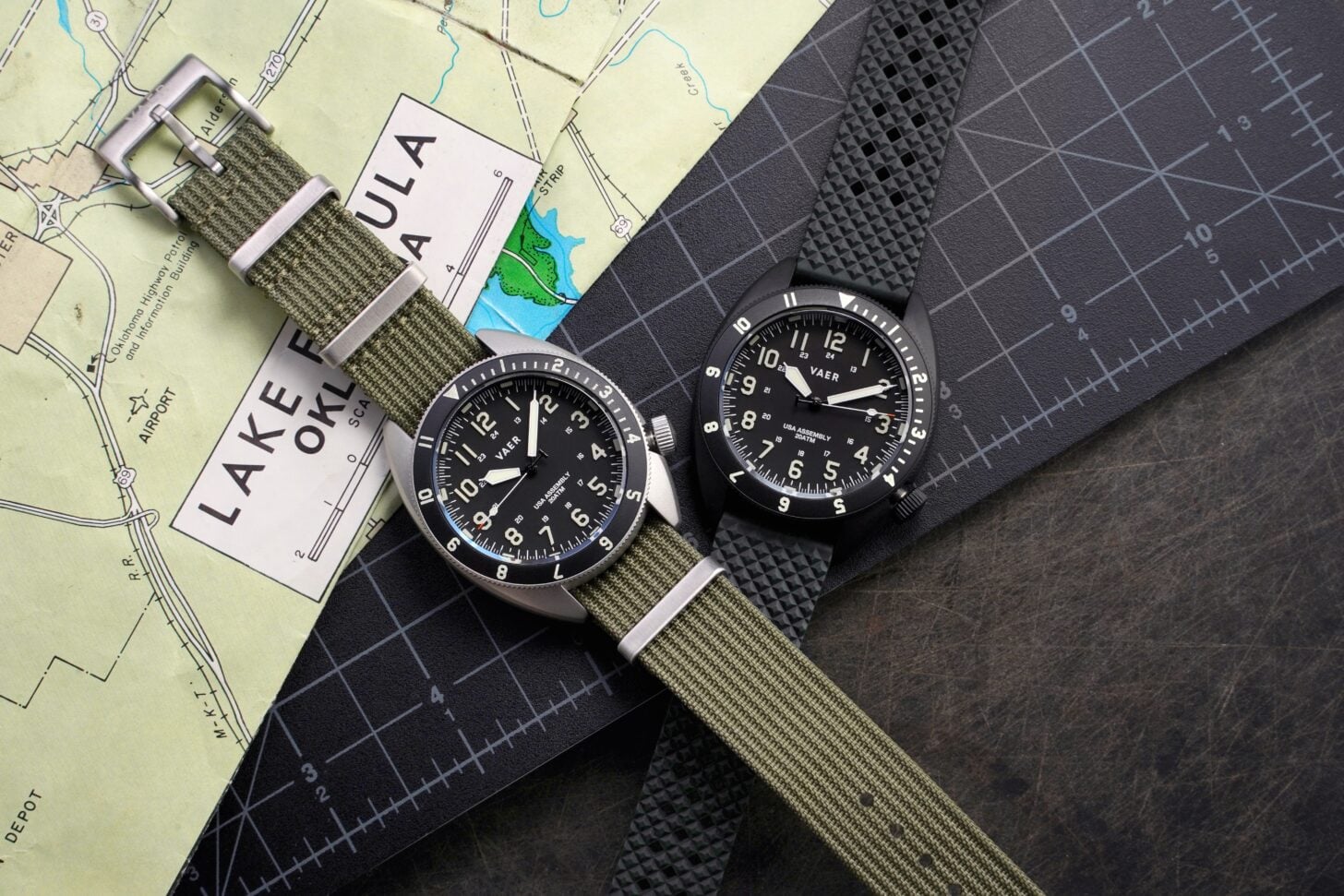 Analog by Design: The Vaer C4 Tactical Field SolarThe best gear works the moment you reach for it. The VAER C4 Tactical Field Solar (41.5mm) combines rugged functionality with everyday practicality, featuring a matte dial with bold stencil numerals, raised 3D Super-LumiNova markers, and a 12-hour bezel for timing a climb or tracking a second time zone. Powered by light, it delivers up to six months of operation from just six hours of exposure, with no routine battery changes required. A sapphire crystal, 200 meters of water resistance, USA assembly, and a two-year waterproof warranty make it a dependable companion for adventures on and off the trail.
 © Beartooth Media Group Inc.
 Loading...