Topic

idea for unique extreme cold weather top insulation.

  • This topic is empty.
Viewing 21 posts - 1 through 21 (of 21 total)
PostedOct 25, 2014 at 7:29 pm

This is actually a blend of mostly pre-established ideas and assuming use of a pulk. For extreme, Arctic like cold weather, i was wondering if something like this might work well to save weight and provide fool proof sleeping insulation?

Make a quilt or blanket out of a material that can seal gas in same–since it's going on top as a quilt, it doesn't have to be as heavy duty as a sleeping pad. CO2 cartridges are somewhat ubiquitous, have a nozzle that can be connected to these. CO2 has a lower thermal conductivity than both air and argon.

Inside, have a similar design as the Neo Airs, the IR reflective triangular that is collapsible.

VBL's are somewhat popular in extreme cold climates anyways. Fill up it up with CO2 right before you go out on a trip. (likely some air will mix in but that's ok).

Could high quality down still beat such a set up insulation per weight wise? Assume use of separate VBL as to prevent down frosting (lghlllghlllgh down frosting, sounds de'lish).

Now, just to convince Cascade Designs or similar company to take a gamble on making such an odd and specialized duck…

PostedOct 25, 2014 at 8:06 pm

Why would you need 3 inches thick? With a combo of IR reflecting inside, very low conductivity CO2 gas, a VBL, an *inch or so might be adequate. Also, those CO2 cartridges are pressurized and usually go into pressurized applications like bb guns.

With the quilt, it wouldn't have to be pressurized much at all, the gas could be more free, and fine if a little air is mixed in.

I think "a gazillion" is perhaps a rather large and over stated exaggeration.

*edited to fix my own exaggeration

PostedOct 25, 2014 at 8:18 pm

You can buy bulk, 20 lbs of pressurized Co2 gas tank for 249 dollars.

http://www.choicepaintballguns.com/product/020262

I would imagine this could fill up a shaped quilt to about .75 inch at least a hundred times or so? (on this, i'm completely guessing).

Again, this wouldn't be one's "normal quilt", but when you're going to experience truly cold, -20*F or below type temps.

Jerry Adams BPL Member
PostedOct 25, 2014 at 9:36 pm

I think that would work

A Blizzard survival blanket is sort of like that, except it uses regular air. Elastic pulls it into a shape with several layers of reflective material.

Maybe blowing it up with regular air would be about as good as CO2 or Argon.

Maybe you'de need one extra layer with regular air compared to CO2 or Argon.

They use Argon in windows, but they want the window to be just one air space and as thin as possible. Quilt wouldn't have that requirement.

Or, you must be able to calculate the volume of CO2 gas in a cartridge, and your quilt.

PostedOct 25, 2014 at 9:48 pm

Thank you for the feedback Jerry.

CO2 has a 40% lower thermal conductivity compared to air. That's a significant difference and despite the fact that it's a bit more dense, it's density is not going to factor in much in such an application.

Roger Caffin BPL Member
PostedOct 25, 2014 at 9:53 pm

You can already buy that. Klymit use argon instead of CO2. Made for the ski market. Can't say it has been a huge success though.

Btw – check for the likelihood of extreme condensation of sweat in the inside, at least in some corners. Yuk – and dangerous too.

Cheers

PostedOct 25, 2014 at 10:15 pm

Interesting Roger, i just checked out their systems. A few impressions. Overbuilt and heavy, and for something as light as Vests, doesn't make much sense when one can make a silnylon vest and have a down vest on top of it for around the same weight and less money.

And why the heck do they use Argon instead of CO2?!?! Money making scheme? CO2 by comparison is cheap, and it's slightly more thermally efficient than Argon anyways.

Also, they are not using IR reflective materials inside.

As far as the condensation of sweat in this theoretical quilt, why would that be dangerous? Most of the time it would be filled up with mostly CO2 gas, which i don't think many pathogenic (or typical) micro-organisms could live in..? And when it's not being used, you keep it open and air it out like any blow up type pad.

PostedOct 26, 2014 at 2:09 pm

First basic problem is that folk that pull a pulk in -20f or below don't want to fiddle with equipment that has a great built in opportunity to fail.
That is why most have a solid foam mat for example.
Anyway looking at the 15 oz Klymit vest, I don't think it is "over engineered " just to make it more expensive but because it needs to be, neither I assume that Argon was chosen because it is more expensive.
All those baffles are there so that the vest does somewhat wrap around you without too many cold spots ; no point having an insulated garment if when moving you pump air in and out (between it and the other layers)
In a similar way a quilt/cover will need to be articulated to somehow sit on top of you, so more fabric , extra weight and possibly cold spots.
Now the other bit is that if you need to have it inflated, it will be obviously bulky but worst of all will be subjected to a lot of jarring and prodding inside a pulk so the skin needs to be rather thick and strong, that is heavy, negating the possible advantage in more insulation for less loft.
Of course I am only guessing.

BTW, years ago someone made a low temp inflatable sleeping bag.
It sort of looked like a hooped bivvy, but I can't find it now.
It was bulky and heavy , possibly the reason why it failed .

Roger Caffin BPL Member
PostedOct 26, 2014 at 4:19 pm

> CO2 by comparison is cheap, and it's slightly more thermally efficient than Argon anyways.
My understanding was that Klymit claimed very high insulation from Argon, but I can't find any figures on their web site comparing it to CO2. However, the Engineering Toolbox gives the thermal conductivity of Argon at 25 C as 0.016 (metric units), while CO2 was 0.0146. So CO2 dooes have a lower thermal conductivity. Hum … so why did they go for Argon? In the hope that customers would keep buying it from them? (Give away the shaver, sell the razor blades idea.) They do mention that you can blow their jackets up by mouth and then top them up with Argon.

> As far as the condensation of sweat in this theoretical quilt, why would that be dangerous?
Misunderstanding. I was talking about condensation happening on the inside of the jacket against the wearer, not inside the bubbles. The collars for instance do not seem to be as insulated as the body: condensation there against your neck could be nasty.

The idea could be fine for a static use, but I would not wear one while moving.

Cheers

PostedOct 26, 2014 at 5:49 pm

"First basic problem is that folk that pull a pulk in -20f or below don't want to fiddle with equipment that has a great built in opportunity to fail. That is why most have a solid foam mat for example."

Good point. But, a lot can fail at those extreme temps, even Goose Down. People have reported that even with a VBL, on longer trips, the down starts to get ice forming in same. Not good in those conditions. One of the reasons why i was thinking of alternatives to begin with, that and price. That much high quality down is usually quite expensive. In comparison, this doesn't have to cost much at all. A Chinese company could make it for a few dollars or so

Also, are you saying that people don't ever use pads like the Xtherm or Downmats, in conjunction with foam pads, in more extreme cold weather environs? Seems i remember having read accounts where people have used combos like this in those extreme cold conditions and fared just fine.

Sure, a quilt like this could fail, and extreme temps can make it more prone to same, but if it was built well, since it's being used for static use with very little pressure on it and not much chance for abrasion etc–most of the problems would be limited most often to the valves and to proper sealing. Like anything, it would be wise to test it out under more safe conditions before going out in the wilds. If a company made something like this and went to sell, i would hope that they would do some testing first before releasing it. Most companies with a good reputation would likely do that.

Re: the Klymit Vest, again some good points, but why not just use a lightweight VBL in conjunction with a Down vest especially since you're not saving much if any weight to begin with? Yes, i understand about the adjustable insulation and all, but talk about fiddle factor–practically a fiddle factory if you're going to use in that adjustable way in conjunction with the Argon.

And, it makes no sense to use Argon instead of CO2. I happen to agree with Roger, possibly some marketing strategy to sell a more expensive go along product. For 250 dollars, you can buy 20 lbs of CO2 gas. For a vest, this would last a VERY long time.. contrast this with 134 dollars for a tiny little "tank" of Argon that for the vest lasts 80 fill ups. Wonder how much that Argon's price is jacked up above cost?

"In a similar way a quilt/cover will need to be articulated to somehow sit on top of you, so more fabric , extra weight and possibly cold spots."

With a thin and light enough shell/lining material, and not over inflated to begin with, and large enough, this should not be much of a problem for a relatively static use as compared to an active vest piece. Keep in mind that CO2 is a bit denser than air–it's not exactly going to just bump and half float off you. I'd imagine that you could also throw your Down jacket on top as well, which could help.

"Now the other bit is that if you need to have it inflated, it will be obviously bulky but worst of all will be subjected to a lot of jarring and prodding inside a pulk so the skin needs to be rather thick and strong, that is heavy, negating the possible advantage in more insulation for less loft.
Of course I am only guessing."

Yes, it would be bulky. However, as far as jarring and prodding and all that, unless one packs like an idiot, with sharp or abrasive items sticking out (who would do that anyway), i think this issue is largely over stated. Put it on top of your stuff which is likely to be covered with some kind of fabric to begin with, just strap it down on top. Molehills don't need to be mountains with a little planning and foresight.

One could probably get away with 40D materials (maybe even 30D), and even with a good thick coating, it wouldn't be that heavy. It's not a pad, nor an active vest, after all. The Klymit Vest and Jacket uses 50D material.

PostedOct 26, 2014 at 5:58 pm

"Hum … so why did they go for Argon? In the hope that customers would keep buying it from them? (Give away the shaver, sell the razor blades idea.)"

That thought occurred to me as well.

"The idea could be fine for a static use, but I would not wear one while moving."

I can't say for certain, because i've yet to try VBL for active use–only have used it for static use, but offhand i would tend to agree with you. I could only see myself using VBL for feet or hands for more active use.

PostedOct 26, 2014 at 6:06 pm

Fun facts. A few human recorded times, it has gotten so cold on the Earth (near the poles), that CO2 gas would have converted to a solid if it had been present. This happens at -109.4 F*/-78.5 *C. However, if you happen to be out on a backpacking trip at temps below this, chances are, you got a lot more to worry about than just your quilt's insulation turning solid on you… ;) I don't think even wildman Shug would go out in those temps.

Roger Caffin BPL Member
PostedOct 26, 2014 at 10:52 pm

> pads like the Xtherm or Downmats, in conjunction with foam pads, in more extreme cold
> weather environs?

Just a tangential comment, which anyone who has ever camped in really cold conditions probably knows only too well. Any condensation which falls to the floor in the evening and gets under your mat will, in the morning, appear as solid ice. This is a very good reason for using a silnylon floor and a mat with a slippery synthetic surface: so the ice can be brushed off easily. That's also a very good reason for using a full-length mat in winter: to keep you down gear off the floor.

But I would be VERY cautious about using a Klymit mat of the design where your sleeping bag is meant to 'fill in the holes'. Under those conditions you will find lots of ice forming a pattern across your SB!

Survival gets a bit technical at 0 F!

Cheers

Alpo Kuusisto BPL Member
PostedOct 27, 2014 at 1:20 pm

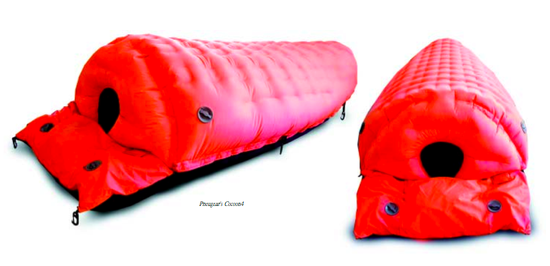
If you are going to deflate it every morning, like envirogear/pneugear cocoon (search BPL thread 4105), why not. With NeoAir technology it could be really light. Just duct tape three NeoAir X-Therms together?
If you are not going to deflate it, maybe a thick closed cell foam instead? It's not that heavy and nearly indestructible. Pulks can roll or hit a tree and the stuff on top gets some beating.

When you have a non compressible watertight 'sleeping bag' and suitable tent design, (maybe like Tad Englunds sleeping spokes igloo in thread 58852) you could increase the 'bags' insulation by piling up snow over it.

PostedOct 27, 2014 at 2:14 pm

Thanks Alpo, that was the one I was thinking of.
Note that the project started in 1975 :
http://www.whiteblaze.net/forum/showthread.php/59971-Anyone-Remember-the-Cocoon-3-amp-4-Sleeping-Shelter-Systems
Cocoon
Note that various reviews and studies stated that in principle the system worked well however in practice not so much and that is why it died in 2002 after apparently having had an enormous amount of money on it .
(1.5 m according to the manufacturers)

"Just duct tape three NeoAir X-Therms together?"
That well explains the problem…
It appears to be simple to do but it isn't ,if you want a product that actually works not one that may or that is 90% there and so on, it isn't simple nor cheap once you spent months or years testing.
If the system is sealed up , as the Cocoon was, once you reach a temperature you are comfortable with it will keep getting warmer so you start to sweat.
To counteract that you need to partially deflate it and then inflate it again once you start to get cold.
If it isn't a sealed system , the one proposed here (blanket/quilt style) the warm air will escape from the gaps on the side and ends as it does when a quilt is not tucked in.

PostedOct 27, 2014 at 4:06 pm

"If it isn't a sealed system , the one proposed here (blanket/quilt style) the warm air will escape from the gaps on the side and ends as it does when a quilt is not tucked in."

Again, this depends on both pressure in said quilt, as well as materials used. More pressure, plus heavier duty shells would make it difficult. Less pressure and lighter, more flexible materials would make it more feasible. Something like that enclosed bag had a lot of air put in same–much more pressure than i propose for the kind of quilt i'm proposing. With such a quilt, if it's large enough, you can still pull the sides under you to some extent–the extra CO2, will equalize to other areas.

Also, it would be easy to put some kind of different insulation flap on the sides to put under you if one really wanted to and didn't think the above would be sufficient.

PostedOct 27, 2014 at 6:09 pm

CO2 does not expand as much as you would think. I tried to use the CO2 cartridges (12 grams of liquid CO2, BTW) to fill up a BA IAC mat. When it didn't work I looked up the expansion rate of liquid CO2. It was going to take something like 50 grams of CO2 to fill it up. Not practical at all. You could easily use a regulator and bulk tank, but you aren't going to be able to take that with you (the storage tanks are heavy, even the very small ones). While you could fill it before you left, what happens if it deflates? 0 degrees is not the place to have failure prone gear. Especially when a small failure means the complete loss of your insulation.

PostedOct 27, 2014 at 7:24 pm

Hi Larry, thank you for the reply, this is the kind of more experiential feedback i was looking for. I wouldn't expect it to expand that much, since it's denser than air, but that, with it's significantly lower thermal conductivity (40% less), means you need less volume per given value of insulation as compared to air. Or in other words, you don't need to inflate "all the way". A little air mixed in is ok too, that will help with the expansion some, but with CO2 being denser, it will tend to form a layer on the bottom closer to you the heat source–hence whatever CO2 is in there, will be used most efficiently as a trend.

50 grams doesn't sound like a lot to fill up a BA IAC mat, but yes, my initial idea of cartridges is not all that practical and efficient. A portable tank ala something like Klymit's Argon tank for their inflatable vest or jacket, would be a lot more practical.

Heavy is only heavy once you get out to the wilderness and put that backpack on imo. Transporting a small tank of CO2 in your car or the like, doesn't seem like a bit deal to me. Flying might be more tricky, i don't know the rules and regulations for that.

"While you could fill it before you left, what happens if it deflates? 0 degrees is not the place to have failure prone gear. Especially when a small failure means the complete loss of your insulation."

Provided there isn't something wrong with a valve, seals/seams, or a hole, how much do you really have to worry about this? I've been out in 0 degree and slightly below weather, and brought a NeoAir All season pad and had no problems–yes, i also had some foam with me "just in case", but only enough to barely survive is something happened to my pad. Could i have had some problems? Yes, and pretty much anything but foam can have problems in these kind of conditions. Down is great, but even it's not fool proof in conditions like this on extended trips.

The point is to have the best kind of valve system (with a lightweight backup fix), and sealing/seems that you can have. Those would be the major areas of weakness and failure probability wise.

People do sometimes use inflatable pads in these conditions and worse. And theoretically, if you do lose your CO2 somehow, but it still can inflate and not leak fast, if there is an internal IR reflective system like a Neo air, well blowing it up with air will let you survive if not be comfortable.

Pads are much more prone to failure simply because the nature of conditions you subject them to, like putting all of your 150-250 lbs on them regularly, and sometimes with less than ideal conditions beneath. Yet, unless you're dealing with a lemon, old age/severe use, or a manufacturing defect, they are fairly reliable–if they weren't, they wouldn't be so common and used.

This idea is not a perfect solution by any means, but when it comes to extreme temps and conditions, little is.

If i was doing some kind of crazy Antarctica or Arctic expedition, would i bring a quilt like this? Most likely not, unless it proved itself very tried and true from a lot of users experience over some time. But, if i was going into the White Mountains during the Winter for a week, might be able to swing it.

PostedOct 27, 2014 at 8:16 pm

In any case, probably time to retire this thread. While it's interesting to think about, it's too far in the realm of theoretics because i don't have the know how or money to design it myself, and i doubt any companies would be all that interested even if the concept does have practical merit.

So long, weird CO2 quilt, RIP.

PostedOct 28, 2014 at 6:12 pm

Never mind, according to Richard Nisley's research the Cuben won't work well at all for this application because of the relatively thick mylar coating. Heat Sheets or spaceblankets are alternatives, which i may try, but durability is an issue with these.

Viewing 21 posts - 1 through 21 (of 21 total)
Loading...