I did a bit of hiking over the last few weeks and noticed something. In temps in the lower 50s and below and when it is damp out and I am walking around on a flatish surface I don’t mind wearing the R2 over a T. Some people say they are too hot but if I am just walking around it does not bother me because the R2 breathes so well and doesn’t keep that much heat in due to its multitude of small holes. It even kept me dry in a light rain of about 25 minutes because I guess my heat was pushing the water out. Nice.
Topic
r2 as insulation and rain gear
Become a member to post in the forums.
- This topic is empty.
I feel the same way.
A lot of hiking here is in the 40's and light to medium rain so I slap on my Helium and I can hike comfortably. I'll sweat bit on uphills but I can do camp chores to dry out if I have to. Also I have a Columbia grid fleece that is a bit lighter than an R1 so that probably helps with me being able to get away with a shell. I just got a long-sleeve thin syn T from OR that I want to try under a shell, maybe with an additional T if needed. If I get my hat, gloves and neck gaiter combo dialed in with that shirt combo it should be nice.
But back to the Original post yeah in a lighter rain, especially when you're on the move and creating some heat, a fleece is nice. I try to stay as breathable as possible all the time. If my shell is on its pretty rainy and/or I'm stationary.
Brett, I've found that once a piece of clothing is damp I am able to thermoregulate (whatever you want to call it) better. I stay plenty warm on the move but I don't overheat. I prefer damp and breathable over a shell. But then if my activity level decreases I get cold and I have a damp layer… it's a toss up.
Justin, That 'activity decrease' is when you throw on a light shell and continue with the lower level of activity. This will cause a reasonable amount of heat to build up and start the breathability process of your jacket. You can use this to dry out your layer.
If your activity level here is too high you'll overwhelm your shell and continue to be wet. If your activity level is too low you'll not produce enough heat and the wetness will just get cold and you'll be cold.
This is also when you want to use thin layers. If your R1 is wet there is only a small amount of water trapped in the fibers and it can be dried quickly. If your R4 is wet it'll take longer to dry. Maybe you'll run out of activities… end up walking around in circles. Maybe the temp drops and to create enough heat to keep the drying process going you'll have to do high exertion activities. (a joke… kinda)
I have found that when I stop I just put the poncho/tarp or the windjacket on and I tend to heat up enough. The light rain never really gets to the inside of the jacket so I never really get wet/damp.
I find that shells, both rain shells and wind shells, are useful for slowing or stopping evaporation. Sometimes the evaporative cooling can be a bit much and I get too cold, so I put on my windshirt to slow it down a little. It's the same reason why my windshirt feels so warm when I take a break after a sweaty ascent on a cool day.
I also like the R2 as outerwear when I'm moving in 40-50 degree F temperatures.
For one reason or another (I suspect it's largely marketing and price), fleece is no longer seen as a very high performance option when it comes to insulation.
That's a misguided notion, IMO. I can't imagine a more versatile insulation piece in the context of an entire clothing system.
It seems that the few of us who have already posted in this thread have historically been the most verbal supporters of R2 fleece jackets here on BPL. Maybe there are more R2 lovers out there in the BPLverse though? Either way, I think a lot of people are missing out.
I keep seeing thin synthetic jackets marketed as warm-while-wet active insulation pieces. I think it's ridiculous. Fleece is where it's at.
I hear you Justin.
Each time I see that kind of marketing I can't help but think:
Step 1: don high loft fleece jacket
Step 2: enjoy your warm-while-wet active insulation piece (that you probably already own)
or if it's cold and windy:
Step 1: take off your wind shell (if it's already on that is)
Step 2: don high loft fleece jacket
Step 3: don windshell over fleece jacket
Step 4: enjoy your warm-while-wet active insulation piece
I think a lot of the reason that fleece hasn't really caught the hearts of backpackers as much as the lightweight puffies have is because of what I call the "coat culture." That is, the long held (perhaps even nostalgic?) notion of just throwing on a big jacket and being instantly warm, every other consideration be damned. We did this as kids, and the "all-in-one" nature of a puffy jacket harkens back to this idea.
I think that in this desire for "instant-on" warmth that the puffy promises, many backpackers have lost sight of the myriad other benefits of choosing a clothing system that is more versatile and allows many more layering possibilities both on the move and at rest.
Just my theory though…
One cold winter trip I wore a fleece vest over my wind shell over my R1 and found myself more comfortable than I could have imagined. Too cold and windy for just the R1 and shell, and too much aerobic for a real jacket. It was snowing hard, the kind of snow that sticks to everything and melts perfectly into your clothing by body heat. As a result my fleece vest was damp on the outside but dry to the touch on the inside, apparently pushing moisture to the surface by means of body heat. And in times when I was working hard, moisture had enough space beneath the backpack to clear out of my R1 and shell and instead pass to the fleece vest. My back was more comfortable and less damp than ever! That sticks out in my memory as fleece being a superb temperature regulator, providing you also do have a wind shirt in your quiver for the stiffer winds.
> I think a lot of the reason that fleece hasn't really caught the hearts of
> backpackers as much as the lightweight puffies have is because of what I call
> the "coat culture."
Me, I am far more cynical. The cheap Chinese fleece jackets have killed the market for high-end expensive fleeces (which used to be very profitable), so the spin doctors are now trying to persuade us all that we need puffies instead – which are of course expensive.
Just follow the money
All The President's Men, 1976
Yeah, cynical. But logical.
Cheers
Can't say I disagree with that theory either, Roger. I'm sure that's at least part of what's going on, maybe even a very large part of it.
I still wish more people considered fleece as an option before just defaulting to a puffy. I think many would be surprised at just how versatile the newer fleece materials are. I think of them as my removable fur!
I actually own two R2s. One from Spring 09 in XXL that was one of the pile ones that only had R1 by the cuffs and a Spring 12 one because the made the XL longer in the body and sleeves so if fit better than the XXL, the fabric was much more like hair and fur and it only had Power Dry in the side panels. Yeah, they weigh about a pound but when you can find a synthetic that will last about 10 years being compressed, thrown around, washed repeatedly and worn repeatedly, please let me know. And since they are different cut/sizes I can layer them in the winter if I want a really breathable insulation layer. The only thing that would make it better was a hood but no one makes a fur/hair type fleece with a hood.
Agreed Roger. For high output activity in the winter I haven't found any system that beats my cheap wool sweater and fleece jacket. Paid about $5 total for both of them and they are usually getting used while my expensive puffy sits at home. The biggest benefit to fleece is the breathability in the winter.
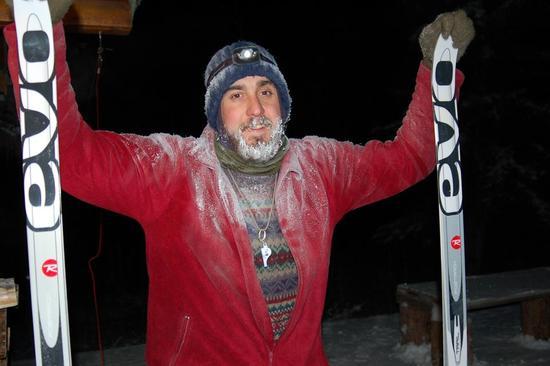
This picture was taken after a xc ski at -30c. All of the moisture pushes itself to the outside of the fleece and all I have to do is wipe off the frost and I'm warm and dry.

You fleece conspiracy theororists have it wrong
fleece is good if you're exercising and only need a little warmth. Puffy would be too warm and cause excessive sweating.
since the fibers are fixed onto a surface and stick out the other side, they retain their loft better if wet. A puffy would tend to collapse.
If you stop exercising, you need more warmth of a puffy. Fleece is just too heavy for the warmth.
Fleece and puffy are just good in different conditions
I never need fleece. I don't go out in snow storms or below about 25 F. Base layer and WPB jacket are sufficient.
You're right Jerry. I think I made a comment just the other day about how useless my R1 midlayer was for me all summer. 95% of the time a base layer and wind jacket are all I need. However, once winter rears its ugly head the fleece becomes very valuable indeed.
Fleece is perfect for the cool wet conditions in the Pacific NW. I have a LOT of fleece and use it in combination with wind and rain shells like a 3-in-1 jacket. A light fleece and wind shirt will trump the most expensive soft shells on all counts but abrasion.
Fleece excels in 32F-55F conditions with rain and high humidity. Fleece breathes and transfers moisture from your base layer. It will dry with body heat or careful campfire warmth where down is just goose flavored oatmeal when wet. Once down is wet, it will stay that way, where soaked fleece can be wrung out and will still provide some warmth.
Fleece is prefect for sleep and extending the range of your sleep system.
Fleece is heavy for the loft provided and bulkier to pack. Fleece needs a shell to be a complete system. You can wear it alone like a sweater in mild calm conditions, but it needs a shell when the wind picks up. It is far tougher than a down garment and doesn't leak stuffing if torn.
Down is definitely lighter and comes into it's own for cold dry conditions for rest stops and camp below 32f and the colder the better. The down proof shells have poor breathability, making it less useful for aerobic activity, even in the thinner versions. Shelled synthetic insulation will dry faster than down, but have similar breathability issues
If you want good cheap fleece, the military versions are a bargain, with R1/R2 items as well as classic 100w and 200w versions. Sizing runs on the large side.
"Fleece excels in 32F-55F conditions with rain and high humidity."
But you have to carry a waterproof jacket. And you have to have a base layer.
Wearing those, I'm good down to below 32 F.
There's no reson to carry an extra fleece garment that weighs maybe 12 ounces.
And sleeping, the fleece provides much less warmth for the weight. I carry a synthetic or down vest to keep warm when I stop exercising. I can wear that when sleeping to lower temperature rating of sleeping bag. Adding a fleece garment would only lower the temperature rating a little.
The only condition where fleece makes sense, is at some point below 32 F when I'm exercising, if I need a little warmth to stay warm. I can go down to maybe 20 F before I need a fleece garment, but I don't ever go out in temperatures below that so for me, fleece has no place.
I like wearing fleece around the yard or inside if I'm a bit chilly. Or car camping when I don't care about weight.
fleece is the best thing ever if things go to hell and back
no doubt as experienced top of the class BPLers nothing goes wrong for us =P
in real life sometimes the DWR fails and out rain jackets fail to "breath" leaving us soaked, or they plain just fail, or you need to move slowly through technical terrain the the rain
in high humidity rain all day environments normal down (who knows about these new fancy DWR ones) provides no more "warmth" than a fuzzy fleece …
one things BPLers focus too much on is the warmth per weight rather than the "warmth per garment" … sure down and synth is lighter in most cases for the weight, but youre only bringing one insulation piece … which in a moisture saturated environment will get a bit damp and lose some insulation properties … sure you can get 2 down sweaters for the weight of a fleece and itll be much more warm, but you arent carrying those 2 down sweaters are you?
how quickly we forget …

I left my fleece mid-layers at home during my Alaska-Yukon Expedition, thinking their warmth didn't justify their weight. Bad move. Fleece would have extended my comfort range during wet stretches even after my rain shells failed. Out of desperation, I began wearing a trash compactor bag over my rain jacket.
http://andrewskurka.com/2012/stupid-light-not-always-right-or-better/
;)
so, if you're doing an Alaska-Yukon expedition take fleece
or if you're doing a trip in extended rain even if not in Alaska-Yukon
I look at weather reports and do a trip when there won't be extended rain
or youre just out a day or two in the extended rain …
especially for newer folks a good fleece will provide a bit more "safety" if they make mistakes in that environment … and the extra few oz wont matter for a day or two
im sure everyone whos been in all day rain here has once made the mistake of getting their clothing systems wet, including down and synth
especially in technical terrain (scrambling, bushwachking, mud trails filled with roots) or if you just got plain lost, youll be moving more slowly and can easily get chilled in the freezing rain
not to mention youll be wearing that fancy dead bird fleece to "outdoorsy" bars anyways …. or using that el cheapo wallymart fleece while working in the yard
;)
I can't imagine not bringing a fleece mid-layer.
My system is pretty simple, and applies to both moving and resting:
if I'm cold I put on a fleece.
If I'm still cold I put the puffy on top of that.
If it's raining hard enough I put on a rain layer.
Maybe I'll add a windshell sometime to complicate things.
I guess it must be nice to be warm enough with just a baselayer and wpb jacket at freezing. You must be running up some hills both ways. I get a bit chilly below 50F walking on mostly flat surfaces when it is damp out. The fleece with a thin T baselayer helps that. If it gets windy I can always pop on the wind jacket. If it gets rainy the poncho/tarp comes out. All of those options are very breathable and don’t create a huge wet microclimate next to me. I am cool and maybe mildly damp but not wet. If it is much below 30F I can always bring a down jacket to put on at stops and if it is above I can use the poncho/tarp and windshirt.
I personally run way too hot for a fleece during activity, until it gets down to freezing. A lightweight baselayer is great for me by itself for wet/rainy down to the 40s, at which point a wpd layer (driducks) is great until I stop moving. Even when the driducks wets out, the "semi-VB" keeps me warm. Can't say I've found a place for fleece between May and November in the PNW.
I find a thin fleece very usable while active. Sure it must be rather cold but it's not rare for me that a base layer plus windshirt is not enough. A thin, fitted fleece weights just a bit more than a typical long sleeve base and it's a great item for a super-versatile system. There's hardly anything you can't do with base, fleece and shell (wind or rain proof, depending on conditions)
The synthetic puffy wear-while-active is definitely a marketing thing but marketing works. I often hear people repeating things like "Primaloft breaths better than fleece" apparently according to some odd test (Primaloft must be the current hype in my locale)
Sellers without a clue spread the word among customers and customers love miracle products.
Become a member to post in the forums.