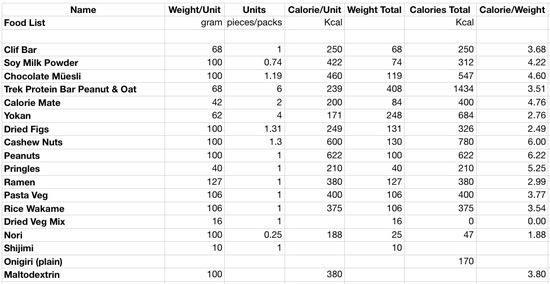
Ito Jakuchu said, "So add 91gr. of Malto to 1L of water, if I plan to drink the 1L/hr, and not take other food.
I prepare little packages of 45gr. for half litres of green tea, or for whole litres of green tea when I am supplementing with other food."
====================
I do something similar to this, but make a concentrated 1-L bottle (about 100g malto with water) and sip it over the course of 3-4 hours. Even concentrated, the malto is barely perceptible in taste. I also mix in electrolytes, so that overpowers the malto taste anyway. I could make it stronger but my body seems to want something more substantial between meals. So I throw in a trail snack mid-morning and mid-afternoon. My main source of hydration is plain water from a hydration bladder.
I experimented to see how concentrated I could make the maltodextrin, thinking I could make it work out of gel flasks. 50g (1/4 cup) dissolved completely in 125 mL of water, and it was still not a "gel" but was getting syrupy. Kind of a gross mouthfeel, actually, but it worked.
Maltodextrin is easily found in the U.S., in small quantities (beer homebrewing supply) up to big bulk bags from food industry suppliers (google "maltodextrin 50 lb"). Search for it on Amazon to find brands you can also get at brick & mortar nutrition shops, or for convenient sized packaging you can have shipped to your resupply stops.
One downside to the malto is the preparation. Even in my wind-free kitchen that powder seems to find a way onto places other than the inside of the bottle. No matter how careful I am, the outside of the bottle gets sticky. In bear country I would do the bottle prep well away and downwind from my other gear.
Another downside is the bulk. To get a lot of calories you'll need to carry a lot of powder and on long stretches between resupply that can take up a significant percentage of your food volume.