Topic

Perceived Warmth Experiment

  • This topic is empty.
Viewing 22 posts - 1 through 22 (of 22 total)
PostedOct 12, 2014 at 10:14 am

This post addresses my observations from recent, multi-day, pseudo-science clothing experiments in my yard . Warning!-dealing with perceptions….not objectively measured data.

Skies were overcast with temps in the 50sF. I sweat very heavily and was working hard so all garments shown were subjected to potentially soaking sweat.

For all trials I wore polypro fishnet as the first layer and a Patagonia Houdini for the outer layer. The ? represents the layer with which I experimented.
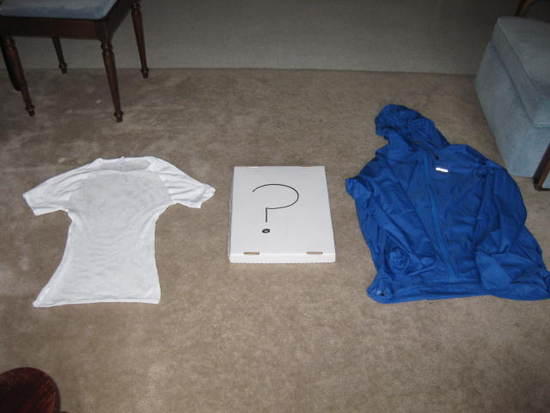
x

I tried 3 different mid layers, A,B and C.
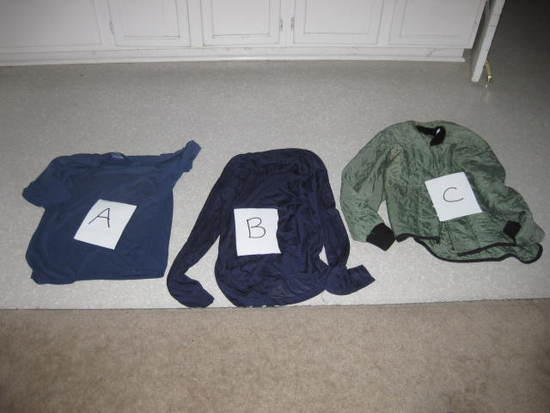
x

A=6.6 ounce cotton/poly t-shirt
B=6.8 ounce polypro pullover
C=13.4 ounce fiberfill (sandwiched between two nylon layers) underwear

After about 2 hours of work I am sure that all garments were subjected to a potential soaking of sweat. My pants and undershorts were also soaked down to about my knees.

So here's the question. Which mid layer garment gave me the greatest perceived warmth at the end of this two hour period? (Take a guess before you look).

Answer: A-the cotton poly t-shirt. Wasn't even close. B and C were both uncomfortably cool even after I entered the house.

Why? I'm guessing here and would like your ideas. I think the 50% cotton of the t-shirt was enough to absorb sweat that would have otherwise stayed on/in the fishnet next to my skin. My wife said the fishnet felt almost dry. The fishnet under B and C was wetter.

I did a similar experiment a few years ago with similar results.

In the early 70s I used an all cotton parka (Ventile?) as my outer layer. It was surprisingly warm when wet (and heavy). I'm guessing it absorbed a lot of the perspiration that otherwise would have stayed on the garments against my skin.

My other idea/guess with cotton is that it swells, when wet, more than polypro, fiberfill or nylon. This swelling might reduce airflow and evaporative cooling.

PostedOct 12, 2014 at 10:53 am

Daryl – I have a suggestion for you if you have the time and interest to try it: repeat your test but use three t-shirts – one all cotton, one cotton/poly blend, one all-poly. And also, in each case after your exertion, stay outside but sit around for an hour. Doing this would eliminate the wide variance in insulating value and fabric mass that your first test had, and by staying outside until you cool off would better replicate a real-world scenario in the outdoors.

PostedOct 12, 2014 at 11:15 am

Paul,

Your suggestion makes sense. I definitely have too many variables interacting at once.

Justin Baker BPL Member
PostedOct 12, 2014 at 11:16 am

Daryl, I think the polycotton felt warmer because the cotton caused it to dry slower (evaporative cooling). Also the fishnet base layer could have been keeping the cotton off your skin and preventing the rapid conduction associated with damp cotton.
Cotton is the best wicking garment but it doesn't let go of that moisture quickly.
Drirelease uses small amounts of cotton or other hydrophilic fibers.
Give wool a try.

Dale Wambaugh BPL Member
PostedOct 12, 2014 at 11:53 am

Perceived warmth is a good thing to grasp. I find humidity to have a big effect and of course a little cold wind can hose your layering scheme in a hurry. I find that cold hands and ears can make me feel colder than I really am. Some liner gloves and a fleece beanie can make you perceive to be warmer.

A wet outer garment isn't as bad as next to your skin, but still good to avoid. I always assumed that cotton anoraks were made with cold dry winter conditions in mind, bolstered by good wicking layers under. Any historical accounts of arctic travel warn against high levels of activity and perspiring heavily. Much cotton outer clothing was waxed too. The 60/40 fabric parkas were a backpacking standard in the 1970's. They were water repellent and breathable but nowhere near waterproof.

Of course your level of activity and wearing a backpack are very different than walking around your neighborhood or standing at the bus stop. Still, local testing is good and far easier to correct than 20 miles out form the trailhead. I'm surprised how many ask questions about layering that could easily be tested at home, especially those living in areas with crisp winter weather and plenty of opportunity to test layering, gloves, hats, etc. I could excuse the folk in Southern California or Florida :)

PostedOct 13, 2014 at 7:50 pm

Confused by your reference to polypro. Is that polypropylene, as distinguished from polyesters intended for this purpose, such as Coolmax?

Another question: Polypropylene had a reputation for holding odors. As a user, has that been your experience? I still have an old polypropylene knitted fiber sweater that quickly developed more holes than a family of moths could make in a wool one.

So, I gave up on Polypropylene, and use a discounted Beans polyester polo for the base layer that is supposed to "wick." When it's cool, over the polo goes a loosely woven nylon smock from Beans or Montane, but not a Houdini which has heavier DWR treatments that block perspiration vapor. If it gets really cold, a light Polartek polyester sweater goes in as a middle layer. Or one of those $99 waffle inner Patagonia sweaters. And if it gets really rainy, the smock goes into the pack and a WPB jacket like the M-10 goes on. Often with that on, the sweater has to come off. It can be a close call, depending on all the circumstances – temp, humidity, exertion & etc.

The deal with polypropylene was that it would not absorb water, so it wouldn't get wet and increase heat loss. But that works only if the moisture has some place to go.
I think the Houdini may have been a big factor. As a heavy perspirer, the moisture got trapped in the layers, although that batt insulated jacket probably didn't help either. With the trapped moisture, the cotton sucked up at least a little of it, relieving a little of the cold, clammy feeling against your skin. You must have been dying in that fiberfill jacket under a Houdini though.

That's my best guess, Daryl. Have you tried polyesters?

PostedOct 13, 2014 at 8:07 pm

I agree with Justin B.'s assessment. Likely the absorbing cotton had just enough space between it and the skin to create an insulating layer of air, but close enough to absorb a lot of moisture, which helped the polypropylene or inner layer to feel dryer.

The real question is how much or little does perceived warmth influence actual body core temps?

PostedOct 13, 2014 at 8:09 pm

Samuel,

Yes I was referring to polypropylene when I used polypro.(I couldn't remember how to spell polypropylene)

Yes my polypropylene stuff stinks. Just about everything I wear stinks.

I was cold with the fiberfill jacket under the Houdini at 55 degrees F once the sweat saturated everything.

"the cotton sucked up at least a little of it, relieving a little of the cold, clammy feeling against your skin" This makes sense to me.

Have you tried polyesters? Yes, I've tried dozens. No magic there. Staying warm during heavy exertion remains as my biggest equipment challenge due to my heavy sweating. Wearing a closed cell foam coat and/or changing into dry clothes are the only two strategies that reliably work for me. I'm always experimenting to improve upon my system however.

Jerry Adams BPL Member
PostedOct 13, 2014 at 8:24 pm

55 F – if I wear anything I'll sweat. Thin nylon shirt will be more than adequate.

Hard to evaluate what happens when you have three layers.

PostedOct 14, 2014 at 8:28 am

Jerry,

I'm definitely an outlier when it comes to sweating. Any vigorous exercise on my part will start the sweat faucets going, regardless of how warm or cold I feel and regardless of what I'm wearing. The sweat wets all garments and chills me but the sweat keeps coming as long as I'm exercising vigorously.

If I was in a 70 degree gym with a fan blowing on me a sweaty wet nylon shirt would leave my uncomfortably cool.

But I'm tired of talking about myself. Would you talk about me for awhile?

Dustin Short BPL Member
PostedOct 14, 2014 at 9:27 am

Daryl, you just need to move to the desert. Fixes heavy sweating instantly! Seriously though, between the rapid evaporation and your body's adaptation to minimize moisture loss, desert folks don't sweat much.

As for your test, I've stuck with "cotton kills" but I can't help notice that cotton/poly blends are different. I have an old pair of cotton poly shorts that were the quickest drying pants I've ever owned. They also got wet the quickest… There's some kind of dynamic between the fiber mix that negates the bad qualities of both pure synth and cotton garments. Cotton helps wick and poly helps evaporate.

PostedOct 14, 2014 at 9:53 am

Dustin,

I usually stay warmer in desert or low humidity environments. My clothes don't get soaked as badly as they do with high humidity because there is some degree of drying going on most of the time. I also have some chance of the clothes drying out after I stop.

"There's some kind of dynamic between the fiber mix that negates the bad qualities of both pure synth and cotton garments. Cotton helps wick and poly helps evaporate."

I think you speak the truth. My goal is to use this truth to my advantage…..if possible.

Jerry Adams BPL Member
PostedOct 14, 2014 at 10:08 am

"But I'm tired of talking about myself. Would you talk about me for awhile?"

Do you sweat when you're not wearing anything and it's 35 F?

In 70 F gym with fan blowing on you and wearing nothing do you feel cool?

PostedOct 14, 2014 at 11:17 am

"Do you sweat when you're not wearing anything and it's 35 F?"
I think I would if I was hiking up hill with a pack. Closest I've come to testing this one is starting out on a cold morning with the lightest, thinnest, coolest, most breathable short sleeved nylon t shirt that I have found. I was very very cold but not shivering. As we headed up hill the sweat started and I got even colder. I let things proceed in this manner for 20 minutes or so. Kept sweating and getting colder and colder due to the wetness of everything. My hands got really cold and lost a lot of dexterity and I was starting to stiffen up. At this point I abandoned the experiment and started adding layers. By the time we reached the ridge I was wearing all of my clothes and they were all wet and I never did get even close to warm. It was snowy and breezy and I was really cold. Didn't get warmed up until I got to camp, put on dry clothes and jumped into the tent and sleeping bag. I've conducted similar experiments many times over the last 40+ years of backpacking. Results are always similar. For comparison, my hiking partner Eric wore a thin synthetic pullover the entire time and was warm and dry throughout.

"In 70 F gym with fan blowing on you and wearing nothing do you feel cool?"
I can't go down to "nothing" in the gym but I am down to bike shorts and a thin cotton or synthetic t-shirt. If someone turns a fan on me I get cold quickly because I'm soaking wet. They, of course, turned the fan on because they are overheating and can't cool without it.

Jerry Adams BPL Member
PostedOct 14, 2014 at 11:43 am

weird

when it's 35 F I'll wear thin nylon shirt. going uphill with pack, a little sweat between back and pack is all.

oops – that's not talking about you : )

PostedOct 14, 2014 at 12:36 pm

Jerry,

You are more like my hiking partner Eric.

Thanks for thinking the equation through and a reality check with me. My experience is definitely different from most people, however. It's just something I have to live with. I'll have to play with the hand that I was dealt.

James Marco BPL Member
PostedOct 14, 2014 at 12:55 pm

Cotton is a great insulator. And it will absorb a lot of water directly into it's molecular structure. It is my choice for a bandana, for example. As a dish towel or even a bathing towel it is great for picking up water and wrings out easily. Folded it makes a good pot cozy, along with my hat, keeping things HOT for a half hour or longer.

But, the same property of holding water works against clothing in about 70% of cases. It works in the desert, of course and in other very dry areas. But here in the NorthEast, it is nearly impossible to dry. Even removing the shirt, hanging out overnight and putting it on in the morning leavs it damp. A plastic shirt usually works better, but simply does not insulate with the same effectiveness. Generally speaking, you are better off with a 2 poly shirts because they dry in 10-20% of the time it takes cotton to. As a mid layer, as in your experiment, it was indeed likely better. But if you had been hiking all day, soaking the back thuroughly, you would have been cold all night because the shirt would still loose body heat (evaporative cooling) long after a poly shirt (or a pair) would have dried. That sort of tells me that half the time I should not be using cotton, hence, my decision would be nylon, poly or wool (and thus usefull 100% of the time.)

There is nothing wrong with cotton, provided you can deal with the moisture absorbing and drying time. Cotton underwear doesn't work well in spring and fall in the NE, it never dries. Synthetic works better. Cotton has a slight edge in mid July to mid August because it is hot and dryer. Wool/synthetic works better for socks, your feet are always sweating and wet. Etc. . .

PostedOct 14, 2014 at 1:02 pm

Cotton is a decent insulator when it's dry. When it's wet, it's conductive nature makes it a very bad insulator.

Wool absorbs a lot of moisture, but because it's not particularly conductive and because it's otherwise pretty insulating, when it's wet, it remains a decent insulator and one of the best when wet beside polypropylene or more exotic furs or wools (like Angora, good quality Alpaca, Qiviut, etc).

PostedOct 14, 2014 at 6:13 pm

Re: "There's some kind of dynamic between the fiber mix that negates the bad qualities of both pure synth and cotton garments. Cotton helps wick and poly helps evaporate."

You may be right, Dustin. I looked at the labels on the Beans polyester polos that have served me so well and for so long, and they are 70% polyester, 30% cotton!

But I can see why Daryl can use the hydrophobic fishnet under such a garment. In his shoes, I would also, just to create some breathing space. I notice that I get a lot less clammy issues close to or above timber line in northern and central Colarado
than back here in New England where the humidity is much higher, especially this year for some reason. Is climate change turning us into a rain forest? I understand the humidity is also high in the Pacific NW where Daryl lives. Maybe the answer is to toot down to the Sierras in California, or to the Sawtooths or White Clouds in Idaho, or Uintas in Utah, or even Colorado. The only catch is the hiking altitudes, which in Colorado run 9-14,000 feet, a problem for some for any number of reasons.

A great way to get into Rocky Mountain hiking is Raymond Bridge's Tour Guide to the Rocky Mountain Wilderness, which is still available through Abe Books.

PostedOct 14, 2014 at 6:27 pm

Samuel,

Western Washington is wet and humid but eastern Washington (e.g. Pasayten Wilderness) is dry with, usually, low humidity like you describe. So I only have to drive a few hours for a change of climate. Much easier for me to keep warm on the east side.

I read somewhere that humidity makes it harder to stay warm when it's cold and harder to stay cool when it's warm.

I would add that starting and maintaining a good fire on the east side of Washington is child's play….even after a rain. Starting and maintaining one on the west side of Washington can be a challenge, especially after a rain.

James Marco BPL Member
PostedOct 15, 2014 at 5:03 am

As far as blended cotton goods, they seem to suffer almost as badly as full cotton. Blending does not reduce the hydrophylic nature of the cotton fibers. It will still absorb lots of water into it's structure, unlike the plastics (poly, nylon, rayon, etc.) They still take a long time to fully dry.

Yeah, global warming is effecting the climate, especially localaly. Some areas seem little changed. The High Peaks area in NY for example. Still always cold at night, usually in the 40's even in high summer. Other areas seem much warmer, for example the Ithaca area in NY. Snowfalls have dropped from a 12-14" average storm load to about 8" over the past 10 years. Wind patterns are different, the jet stream is sending loops further south than ever, but they are not pulling the extreme cold (-20 to -30) of bygone years…maybe -10 to -20.

Humidity adds a lot of heat retention to the atmosphere. Cold, very moist air will take longer to warm up than cold dry air and it'l take longer to cool.

'Corse, this doesn't really effect your percieved temperature experiment.

Brett Peugh BPL Member
PostedOct 15, 2014 at 5:16 am

I think a lot of this has to do with how thick the material is also. I have some very thin poly/cotton shirts that dry really fast because they are very thin and some poly shirts that dry pretty slow because the material is really thick while I also have some poly shirts that dry really fast because the weave is loose and they are super thin.

Viewing 22 posts - 1 through 22 (of 22 total)
Loading...