Topic

New camera

  • This topic is empty.
Viewing 23 posts - 51 through 73 (of 73 total)
PostedOct 14, 2014 at 12:22 pm

Adam, I thought the whole point of the LX100 was that it actually has a 4/3rds sensor – meaning 1.5x that of my awesome Sony (and no, you guys can't have it…).

So this is a compact camera that has the same sensor as the mirror-less interchangeable lenses. Am I missing something?

But regardless, I really like my Sony, and I'm going to pick up an a6000 once I get the chance.

Ian BPL Member
PostedOct 14, 2014 at 12:55 pm

+1 Bob. Best sensor in the world will still be handicapped by bad glass. Not the case for the LX100 or RX100 but is for the NEX/A6000 line if you use their kit lens. I've noticed an improvement just switching from Sony's kit lens to the 16mm prime. I look forward to mortgaging my house and spending my kids' inheritance to buy some Zeiss touit lenses… some day. But yes, Sony makes great sensors which Nikon uses in many of their cameras.

Jennifer,

As far as I can tell, the LX100 does indeed have a 4/3 sensor and per a review (I believe you cited it earlier), one of the challenges Panasonic had was building an integrated lens that would work with that sensor without becoming a monstrosity. Size wise, I think they succeeded. My understanding is that it's a 2/1 crop factor which results in 24mm(?) 35mm equivalent at its widest.

I think the A6000 is a superb camera for the money and it's fun to experiment with all the lens options. Focus peaking made manual focus lenses a viable option for me which has opened up a number of fast yet affordable lenses. My most recent acquisition was a Fujian 35mm F1.7 CCTV lens. Best $28 I ever spent.

Jacob D BPL Member
PostedOct 14, 2014 at 1:10 pm

Size isn't everything (rim shot) but the 4/3 Panasonic sensor would have to be extremely, incredibly bad for the RX100 sensor to best it.

…and unless you're talking about a Full Frame Sony sensor, none of these are even close to the size of 35mm film (A6000 included)… not that anyone needs a FF these days to get very good image quality.

Jerry Adams BPL Member
PostedOct 14, 2014 at 1:11 pm

Can smaller sensors have more pixels per inch?

Bigger sensors capture more light, but again, you can make up with that with more sensitivity, up to a point.

Are the optics easier to design with a smaller sensor?

If the lens is bigger, you have a smaller depth of field, what about the sensor size, must affect the optical properties.

Adam Klags BPL Member
PostedOct 14, 2014 at 1:11 pm

Jennifer, it appears I didn't read carefully enough. That's pretty sweet right there, I'm going to do some research on that myself – I didn't even know it was available technology.

Ian BPL Member
PostedOct 14, 2014 at 1:20 pm

"Are the optics easier to design with a smaller sensor?"

Per Panasonic, yes. The LX100 is their first P&S with a 4/3 sensor. I believe its predecessors are 1" like the RX100; please correct me if I'm wrong here. Part of their advertising campaign promotes how difficult it was for them to build a zoom lens for this sensor that was still compact.

Adam Klags BPL Member
PostedOct 14, 2014 at 1:25 pm

I just don't see what you guys are seeing… it seems pretty much that the LX100 is a micro 4/3 sensor, which is still inferior to the Sony 1" cmos sensor. Unless I'm missing something here, the panasonic website confirms this.

Ian BPL Member
PostedOct 14, 2014 at 1:39 pm

Adam,

For me, I see a lot of value in having a pocketable camera; there are times when I don't want a camera hanging around my neck during foul weather or when I don't want to look like a tourist. Neither my A6000 w/ pancake lens or the LX100 will fit into a pants pocket comfortably.

My A6000 has an APS-C sensor which is larger than the LX100 but the kit lens is much slower. Without upgrading to better glass for the Sony, I won't be surprised to see the LX100 crank out better quality photos

From looking at photos taken by other photographers, the RX100 paired with its very fast Zeiss lens is a very capable camera so for me and my personal preference, I'd rather have the smaller camera than a larger sensor in a larger camera.

To beat another dead horse, this is not unlike the "no best" shelter, shoes, backpack conversations we have here. These decisions are highly personal and a reminder that there's a reason why we all don't drive Honda civics.

If pocketability wasn't a concern for me and I wasn't interested in a M4/3 or APSC mirrorless/interchangable lens option, the LX100 would certainly win.

Ben H. BPL Member
PostedOct 14, 2014 at 2:28 pm

"Can smaller sensors have more pixels per inch?"

yes, but number of pixels doesn't tell you nearly as much about image quality as sensor size.

"Bigger sensors capture more light, but again, you can make up with that with more sensitivity, up to a point."

Yes, sensor quality and sensitivity can make up for sensor size to a point. You can have a crappy camera with a big sensor, but there are optical limits that cannot be overcome without a larger sensor.

"Are the optics easier to design with a smaller sensor?"

smaller sensor = smaller optics = cheaper to manufacture

"If the lens is bigger, you have a smaller depth of field, what about the sensor size, must affect the optical properties."

The smaller the sensor, the smaller the optics. Also, the same optics with a smaller sensor will result in a larger zoom. The small sensor will only pick up some part of the image acquired by a larger sensor, so the smaller sensors image will be more zoomed in. This is why p&s cameras report there optics as 35mm equivalent. The actual optical lengths change with the sensor size, so they convert them to 35mm equivalent so that people can meaningfully compare them.

Bob Gross BPL Member
PostedOct 14, 2014 at 2:48 pm

"The smaller the sensor, the smaller the optics."

Let me phrase this differently. If you have a very small sensor, then the optical lens can be small. If you are going for wide angle or normal angle, then the lens is small. If you are going for a long focal length (e.g. for wildlife), then the lens can still be rather small. This doesn't always get the best results, but it works.

As soon as your image sensor gets up toward full-frame size, then the lens is getting pretty large in order to produce the image. Do you want a lens that weighs 13 pounds? I think not.

So, as long as you keep your photo subjects to wide angle and normal angle, you have lots of possibilities with any size of sensor. As soon as you shift over to relatively larger sensors, the lens situation causes a huge loss of portability. If you have such a giant lens, you probably won't be in position to get the wildlife shots.

–B.G.–

Jon Leibowitz BPL Member
PostedOct 14, 2014 at 3:33 pm

"I just don't see what you guys are seeing… it seems pretty much that the LX100 is a micro 4/3 sensor, which is still inferior to the Sony 1" cmos sensor. Unless I'm missing something here, the panasonic website confirms this."

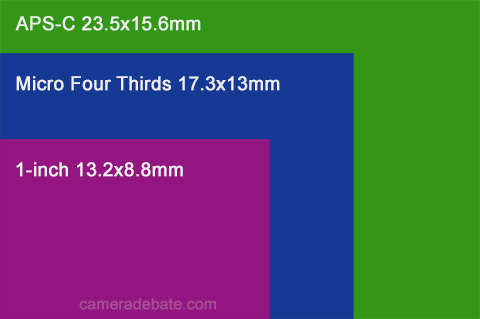
Adam, you are missing something. A micro 4/3s sensor is significantly larger than a 1" Sony sensor. Your understanding of sensor size theory and the resulting photo quality is correct. However your understanding of what a M4/3 sensor is and its relativity to a 1" sensor is incorrect.

Perhaps this photo will help you understand.M43

Ted E BPL Member
PostedOct 14, 2014 at 3:51 pm

My 2 cents worth

I shoot a Ricoh GR for TrailGroove Magazine. I absolutely love it. After comparing the photos i get from it to the photos i got from my original RX100, the GR always wins.

Would i still get the GR over the other newer cameras that have come out this year, yes. I think the new Canon G7X has a better lens range than the RX100 iii, and its cheaper because it doesn't have an electronic view finder, so if i wanted a pocketable zoom camera, the G7X would be my second pick.

If i had to absolutely have an interchangable lens camera, i would pick up a sony A5100 without the kit lens, and pick up a better lens or two than the powerzoom kit lens.

and if i had the money, i would carry a Sony A7 over everything with either the kit lens or the 24-70 F4 zeiss lens and just deal with carrying a bigger camera in a z packs chest pack.

PostedOct 14, 2014 at 4:04 pm

The LX100 does not use the whole of the MFT sensor, but a circle within it (that's how they kept the lens size down). It's about 50% bigger sensor area in use than the RX100III. It's about 40% less pixels. In practice, it seems the Sony has more detail and the Panasonic has lower noise, as one would expect. They are not vastly different.

Also, watch this: https://www.youtube.com/watch?v=4K7v3IyuMnE&list=UUqpOf_Nl5F4tjwlxOVS6h8A

They are a very reputable review channel.

PostedOct 14, 2014 at 5:31 pm

What you are missing Adam is that there is a LOT more to digital cameras than sensor size.

PostedOct 14, 2014 at 9:11 pm

I’m a diehard RX100 user and have been since version 1.

I also shoot a lot of video, and the RX100 shoots beautiful stuff with good stabilization for handheld shots. Here’s a sample from v1, it’s an old video I shot just to test what it might be able to do. I don’t recall if I did any post processing on it, but probably not. Or maybe I did, and it just sucked :)

RX100 Vignettes on Vimeo

v2 didn’t markedly improve on v1 in terms of video, but v3 is a big step above the other two, in terms of the extent to which you can manipulate it in post.

Panny’s new u4/3 compacts look great, too. I really like the u4/3 sensor for video as well, it will be neat to see results as these cameras’ customer bases’ grow.

My big gripes with the RX100 are the awful UI (yay Ricoh GR!) and *of course* its lack of weather sealing!! :D

Yohei Aoyagi BPL Member
PostedOct 15, 2014 at 12:58 am

This camera dose not have best image quality.
But has very good balance in small body. Good for backpacking.

– 1 inch sensor is not best, But pretty good.
– zoom lens(28-100mm / F1.8-4.9)
– Pretty good video
– Night shot
– Small, lightweight
– Can recharge battery within camera by USB

PostedOct 15, 2014 at 1:25 am

Also, get some sort of mini tripod thing that you can fix to trees or the top of a guyed out trekking pole, or put on a ledge in a museum, and set off with the timer. If you want to shoot in lower light with high depth of field (everything in focus), this counts far more than the camera.

And handle both cameras in a store. With gloves on.

Ian BPL Member
PostedOct 28, 2014 at 1:23 pm

LX100 appears to be a great camera that I have no intention of buying so I'm not really sure why I continue to read up on it and watch YT reviews.

One of the major selling features for this camera is the m4/3 sensor but by all accounts the LX100 is incapable of using all of the sensor. One of the results (again my understanding so correct me if I'm wrong) is that the glass does not project an image onto the full sensor is that this camera is closer to 13 megapixel in reality.

It seems that Panasonic tried to pack a m4/3 into this camera for marketing reasons but the end user will not get the full benefit of the larger sensor. Flip side of that may (may) result in sharper images from corner to corner.

4K video to SD card will be important to many people which this camera offers.

I do like the retro dials on the LX100.

https://www.youtube.com/watch?v=XPpIkGBOqg0

Mark Fowler BPL Member
PostedOct 28, 2014 at 2:12 pm

An alternative to the Sony RX100 M3 is the new Canon G7X. Same size and weight, better zoom – 24-100 f1.8-2.8 and uses the Sony 1" sensor. It even got a better DxOMark Score 71 compared to 67 for the RX100 M3.

Matthew Reese BPL Member
PostedOct 29, 2014 at 6:41 am

Another consideration is the ability to use a camera one-handed. I had a Panasonic GM, and while it took great photos, it was impossible to use one handed with the, (Very nice), kit lens. Also, it was very difficult to see the screen icons without glasses, and the egos were just not very good for me, especially if wearing gloves, etc. I sold it and got a Sony Rx100III and love it. It's easy to use one-handed for those quick trail snaps, and I LOVE the EVF for those more precise, composed shots. It easily fits in a pouch on my shoulder strap, and did great on my week at Glacier a few months back. I also have used the tilting screen a lot more than I thought. I don't miss the touch screen of the GM1.

I think sometimes we get too caught up in image quality, (Pixel peeping). The reality is most any modern, higher end camera will take great photos if we do our part. For me it comes down more to egos, and how well a camera fits my shooting style.

That said, I'm waiting for the day some camera manufacturer figures out that there is a significant market for a weatherproof high end compact…

Until then my iPhone in a Lifeproof case is my bad weather camera.

Ian BPL Member
PostedOct 29, 2014 at 6:48 am

"That said, I'm waiting for the day some camera manufacturer figures out that there is a significant market for a weatherproof high end compact…"

The RX100iii is getting pretty close to perfect for me but a weatherproof version would be great. I'd also like to see a fixed viewfinder on it instead of the pop-up. The design is probably fine but I'm concerned that it'll break from overuse.

A7 is weatherproof but sadly not compact. Hopefully they'll make a weatherproof version of the A6000 in the future but I'll be out of luck as none of my current e Mount lenses are.

Anton Solovyev BPL Member
PostedOct 29, 2014 at 2:39 pm

"I'm looking to replace my Panasonic LX5, and would love to hear some feedback about what other people are using (or considering) for a backpacking camera."

I use Panasonic GX7 with Panasonic f/2.5 14mm prime (pancake) or Panasonic 7-14mm F/4 (zoom). The former lens makes a light and small combination which I take on regular backpacks where photography is not a significant goal. The latter lens makes a much larger system which I take on hikes where I expect a lot of great visuals.

I use a Zipshot tripod which works fine for 7mm prime lens. The 7-14mm wide zoom is too heavy and I am yet to get a good tripod for that. ND filters for the 7mm prime are easy, but the 7-14 requires to jump a lot of hoops to get filters on the front end and it only goes to ~10mm with filters.

I use Lowepro Dashpoint 30 camera case for the smaller lens. I use a Tamrac 514 or some similar for the larger lens. I have a small drybag inside the case for the cases when I risk a swim or it's raining hard. I use a length of bungie cord with 2 hooks around my back to hold the camera bag tight to my stomach, so it never bounces or moves.

The main areas of improvement I would be looking for is the dynamic range and image sharpness. A larger and better sensor would be a priority for me.

Viewing 23 posts - 51 through 73 (of 73 total)
Loading...