Topic

Cuben Ground = Sieve

  • This topic is empty.
Viewing 19 posts - 1 through 19 (of 19 total)
PostedSep 19, 2014 at 1:55 pm

This .75 Cuben ground cloth has seen about 20 nights on the JMT, and maybe 10 nights in Colorado, and maybe 10 in the Grand Canyon.

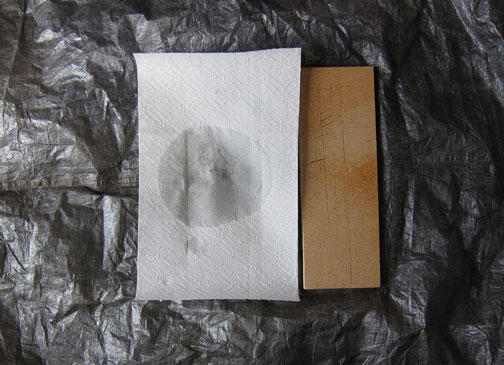
I placed a bath towel on the floor, soaked it, laid the Cuben on top, added some paper towels, a 5"x15" board, and a 50# weight.

I waited 15 minutes and removed the weight and board –

Cuben Sieve

YMMV

Ryan Smith BPL Member
PostedSep 19, 2014 at 2:38 pm

That's what I would expect from .08mil mylar and that kind of terrain. Would be interesting to see how rainproof it was now.

Ryan

PostedSep 19, 2014 at 2:39 pm

50# = 22.67kg

Waterproof measurements are based off a 1×1" square test space and how many mm of standing water it will support. Let's assume you put all 50# on 1"x1", which is obviously not true but neither is the 50# the exact weight before water was forced through. Large grains of salt here.

So if we assume there was a 50# water column before it started leaking through a 1in^2 section, that's 22.67L water, or 22,670,000 cubic mm. Now we remove the 1in^2 part of that cubic numeral to get the height of the water column:

1in = 25.4mm

25.4mm^2 = 645.16mm^2

Xmm (waterproof rating) * 645.16mm^2 (fabric test area) = 22,670,000mm^3

X = 22,670,000mm^3/645.16mm^2

X = 35,138.5mm

That puts it about a little more waterproof than eVent based on some numbers I gathered a long time ago.
(http://mitchchesney.tumblr.com/post/23514043641/the-rain-shell-lie)

If you want the exact waterproofiness you need to know A) the exact weight when water seeps through and B) the planar area of the weight applied to the fabric (>1in^2)

edit: you say you used a 5×15" board but the wet spot looks circular, so I suspect you have a pinhole or microtear. But for grins and giggles 468.5mm is the recalculated value based on your board size. Obviously this is NOT the correct waterproof rating because that's the equivalent of a couple coffee filters :)

Ryan Smith BPL Member
PostedSep 19, 2014 at 2:44 pm

Geez Mitch. Where were you in my college algebra classes? (Thanks by the way)

Ryan

PostedSep 19, 2014 at 2:45 pm

Greg,
have you tried holding it up to a light or the sun to identify holes/cuts?
Try that, patch with cuben tape, then try your test again.

I have always felt Cuben was suspect for anything that touches the ground or abrades against sticker bushes, etc.

Billy

Valerie E BPL Member
PostedSep 19, 2014 at 3:13 pm

Wow, that must be a very high price-per-night! Do you think a thicker cuben would've been more durable, or do you think that cuben is just not the right choice for a groundsheet that will last?

M B BPL Member
PostedSep 19, 2014 at 6:36 pm

Camped near a woman on the JMT one night who had bought a zpacks tent on here used, with .75 groundcloth. We waited out a shower in the afternoon. She said water came thru her floor. I had a 1.0 with close to 70 nights on it, I had no problems.

I think there is a reason Joes groundcloths are 1.0 cuben. He makes 0.75 for people who insist on them on request. From what Ive heard so far, its not a very good idea. Some tent makers have 0.75 floor with similar complaints.

PostedSep 19, 2014 at 6:48 pm

I found two more holes with this technique, but the one shown above is originates from the seam.

I head out tomorrow, so it will be about three weeks before I can do a comprehensive check.

Bob Gross BPL Member
PostedSep 19, 2014 at 6:53 pm

Yes, I find that durability boundary to be 0.75 to 1.0 ounces in cuben fiber. 1.0 material seems plenty durable enough.

However, when I am setting up a camp, I often rake the bare ground a little with my boot, just to make sure that I am not going to be resting on top of a sharp rock.

–B.G.–

PostedSep 19, 2014 at 7:17 pm

" if we assume there was a 50# water column before it started leaking…..its a little more waterproof than eVent"

Why would we assume this? There's no reason to think it was super waterproof and then just barely failed, when all we know is that it failed.

Thin cuben fails quick as a floor and goes downhill fast once it starts to fail. A floor is a very niche application for 0.7oz cuben.

Bob Gross BPL Member
PostedSep 19, 2014 at 7:47 pm

"Bob, you wear boots!??!"

Yes, some low-cut Vasque ones. Nothing unusual about that.

–B.G.–

PostedSep 19, 2014 at 8:00 pm

I agree with Dan. That paper towel might have gotten wet with a five pound weight on top. And it might be that a weight would only be necessary for observation of leakage because it squeezes water out of the underlying towel, not because the hole(s) are small enough to resist penetration of water at low pressures. Further, hydrostatic head calculations are only meaningful for microporous materials. I don't know what a hydrostatic head value for a material with a pinhole in it would mean.

PostedSep 19, 2014 at 9:21 pm

Another issue with that quick analysis is that the towel would have been supporting much of the weight applied, so the actual pressure applied to the water would have been far less than the total weight applied.

Cuben pretty much either has actual holes, or it doesn't. If it has holes, it leaks easily. Tiny holes that only leak under moderate pressure do exist, but that's not the major source of eventual leakage (unlike most other WP fabrics). As we see here, light <0.7oz cuben develops pinholes fairly rapidly. In my experience this occurs fairly rapidly despite careful usage. These holes often don't matter if you're camped on good terrain (ie. loamy forest floor that absorbs water).

Here's a challenge: If you have a 0.7oz cuben floor with 10+ nights of usage, hold part of the floor in an elevated manner that creates a bag and pour a few liters of water in. I bet in ~90% of cases it'll be dripping out of numerous small holes far more rapidly that you'd expect. I've done this with very gently used cuben stuff sacks and been blown away how substantial the leakage was.

Adam BPL Member
PostedSep 19, 2014 at 9:49 pm

I now have a metric metre of .75 cuben, the lighter spectra but .18 mylar variety. My plan is to use it for the outer bottom section of the footbox of a MYOG cuben quilt. I picked the .18 mylar version for this reason, to prolong HH as long as possible. Normally I'll have something underneath the footbox-pack, spare gear, mat, groundsheet, but sometimes I won't when using a Torso length matt. Site selection ^3!

The .18 mylar cuben in ~.75 is not easy to find unless you go through cubic tech directly (I bought the last metre that Tier Gear in Aus had, I think they might order more though).

PostedSep 20, 2014 at 12:45 am

"Why would we assume this?". Because Greg only gave two measurements. Perhaps you didn't see the giant grains of salt with which these measurements must be taken?

Nick Gatel BPL Member
PostedSep 21, 2014 at 7:32 am

"These holes often don't matter if you're camped on good terrain (ie. loamy forest floor that absorbs water)."

I have posted too many times about my zPacks poncho/groundsheet. I have mentioned that I rarely use it as a ground sheet, because it wouldn't last. I need the poncho to be waterproof. Ground sheets are really for keeping the area under your roof clean. Rain falls down from the sky, not up from the ground. Nowadays I rarely use a groundsheet, my foam pad is waterproof. Sometimes I bring a polycro sheet to keep things clean. And I can usually find a spot that is dry enough — I guess that is the experience/skill factor?

Below is a picture from a June trip in Ohio. This flooding happened in 10 minutes. I was able to find a spot and stay dry in my Hexamid sans groundsheet.

Buckeye trail

DGoggins BPL Member
PostedSep 21, 2014 at 9:06 am

Just to confirm….did you use your .74 oz cuben ground sheet directly on the ground and after 40 nights you did that test?

I just bought a cuben supermid innernet from MLD with a .74oz cuben floor, but I plan to always use a polycryo sheet underneath the innernet for protection. I assume this would greatly increase the life of the cuben?

PostedSep 21, 2014 at 10:32 am

Mitch, no "grains of salt" disclaimer can make hydrostatic head calculations appropriate for punctured cuben.

Viewing 19 posts - 1 through 19 (of 19 total)
Loading...