"As I read it, each is a BoPET, or Mylar (biaxially oriented PE) laminated to fibers–High Molecular Weight PE, in the case of Cuben. Aluminization involved for SBs. If you didn't care much about the stretch/strength benefit of the HMWPE fibers, would you say that my experience with the puncture resistance of my space blanket would be a good gauge of what I'd experience with Cuben? Since I could get Cuben thicker, could I expect vastly superior puncture resistance?"
Charley, I would recommend doing more reading on this forums and elsewhere about Cuben and space blankets before you make a decision about what material to use for your project. No condescension intended; I just think this site has a lot of good archived forum material about cuben and space blankets, and it will help you to avoid wasting any money on the wrong material.
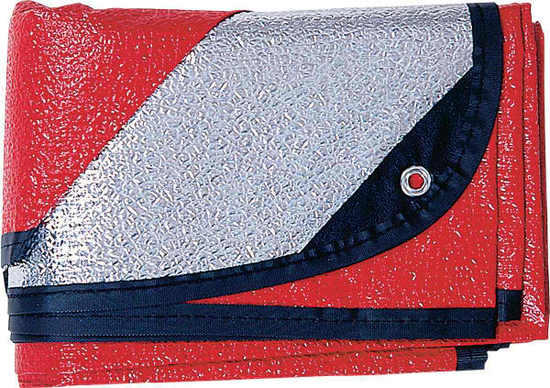
For starters, mylar is not biaxially oriented PE (polyethylene). It's biaxially oriented PET (polyester). The properties of those two materials are very different. There are three basic classes of "space blankets": conventional aluminized mylar ones, aluminized PE ("Heatsheets" type), and heavy-duty ones that are an aluminized film laminated to a layer of nonwoven PP gauze. As far as I know, there are no fiber-reinforced space blankets that are at all similar in their construction to Cuben. A typical crinkly mylar conventional space blanket is made with film about 0.5 mil in thickness. The newer "Heatsheets" type space blankets are made with thicker PE film (1-2 mil), and their softer film tends to stretch and deform like a trash bag rather than tear into ribbons like mylar when they fail.
The usual kind of Cuben that backpacking gear is made from is a laminate in which a grid of straight Dyneema (UHMWPE) fibers is sandwiched between two layers of mylar film (each 0.08 or 0.18 mil in thickness). The UHMWPE fibers in the laminate are tremendously strong and have near-zero stretch. The specific (weight-relative) tensile strength of Cuben far surpasses space blankets of any kind and woven fabrics. Cuben has poor puncture resistance because pointy things can penetrate the thin mylar and push aside (pass between) the reinforcing fibers. The abrasion resistance of Cuben is poor because the mylar on the surface is 1/6 to 1/3 the thickness of space blanket mylar, and tears easily. Once abrasion has torn the mylar face of the material, the reinforcing fibers can fuzz and pull away from the opposite layer of mylar, which is fragile and easily tears, leaving a shaggy little wound in the material. The more abrasion-resistant styles of Cuben have thicker mylar.
Most styles of Cuben are substantially more puncture resistant than a mylar space blanket. People who use space blankets for groundsheets typically just toss and replace them when they get shredded, but cuben is expensive, so people using cuben groundsheets usually choose a heavier (0.18 mil mylar) type that will last a few seasons. Consequently, the typical cuben groundsheet is much heavier (and tougher) than a space blanket. For a poncho, many people use cuben materials in the 0.5 – 0.75 oz/yd range.
Hope this helps.