Topic

Stake techniques

  • This topic is empty.
Viewing 20 posts - 1 through 20 (of 20 total)
Nick Smolinske BPL Member
PostedSep 2, 2014 at 3:21 pm

So I have a couple of "tricks" for using stakes that I've always assumed aren't tricks at all; too obvious. But I've noticed a lot of folks not using them lately, so I guess not. Maybe this will help someone.

One is to put the stakes in perpendicular to the direction of force that will act on them. Not just "a little to one side", as a post I just read mentioned (impetus for starting this thread). Usually at a 76-75 degree angle to the ground, depending on the tent. Seems obvious, yet I see tons of people put stakes straight down in the ground.

Another is clearing off loose soil and digging down a few inches before you stake down, in sand or other soft soils. I carry some skinny stakes that aren't much wider than shepard Ti stakes and I've never needed anything else, because I always do this. Just put the soil back when you leave.

And lastly, using your guylines as a handle to pull the stakes out of the ground.

Anyone have any other little staking tricks? Maybe there's something that's obvious to other folks but I've never thought of it.

Jerry Adams BPL Member
PostedSep 2, 2014 at 4:01 pm

If there are too many rocks to get a stake fully in the ground then put a few big rocks on it.

David Thomas BPL Member
PostedSep 2, 2014 at 5:05 pm

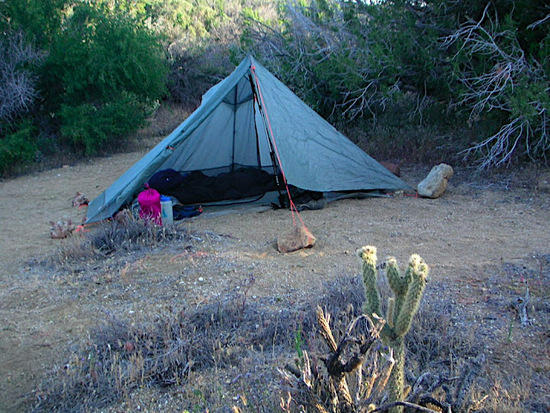
A large rock placed over the stake or on the line just tent-ward of the stake helps a lot. With big enough rocks, you don't need any stakes at all. Same with logs.

Then there are "dead-men" – buried sticks perpendicular to the line or buried, sand-filled stuff sacks – that are your best solution in sand. Because the sand doesn't hold tent pegs, but it is easy to dig in.

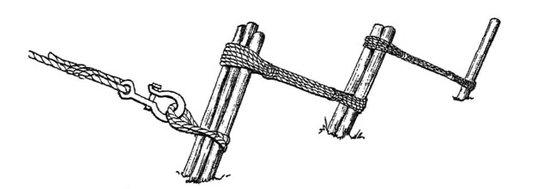
In really high winds, poor ground, or with minimal stakes, you can back up one stake with another. I'd never done more than two for a tent, but have used three for a Scout monkey bridge where you could have a 1000 pounds of force on a line:tripled stakes

David Thomas BPL Member
PostedSep 2, 2014 at 5:08 pm

If you carry a multi-tool or even a SAK Classic whose nail file can be used as a screwdriver, a few sheet-rock screws are very light but gives tremendous flexibility if there are trees, logs or tent platforms around.

PostedSep 2, 2014 at 5:51 pm

With most tents there is a "best" tie-out direction.
That is, if you want to pull the tent (or tarp) panels taut the guyline needs to be pointing in a certain direction.
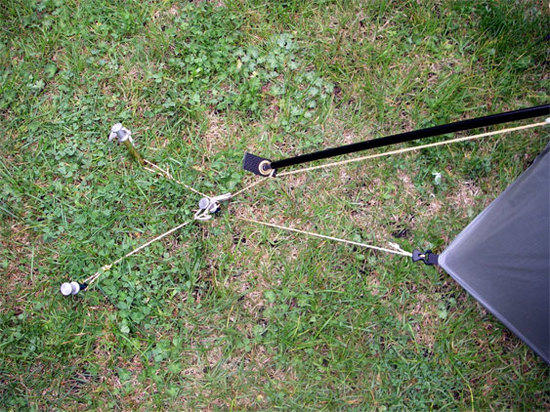
If, in the ideal spot, you can't insert a stake, you can then do this :
More stake
ignoring the stake that is in the ideal spot.
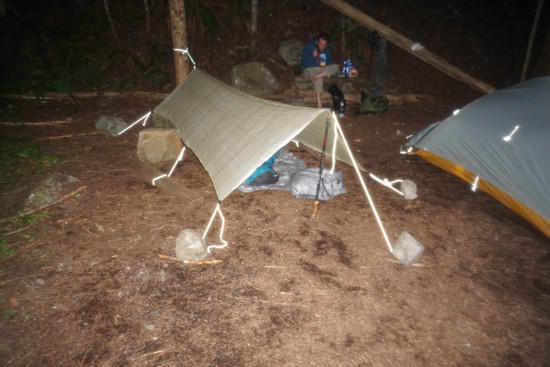
Or as David suggested you can use the other two stakes for extra support.
Usually you can find some ballast to do that (logs/rocks/sand bags over the stake) but just in case…

PostedSep 2, 2014 at 8:33 pm

I know how we feel about "extra" things here, but I carry two extra ti hooks, and man have they been worth the extra 0.38oz in a couple of situations. Call it blasphemy.

Also, when you don't have a big rock, looping around a stick (or trekking pole), laying it flat, and piling a ton of smaller rocks on it can be pretty sturdy.

Roger Caffin BPL Member
PostedSep 7, 2014 at 2:25 pm

> a few sheet-rock screws are very light but gives tremendous flexibility
Cup hooks about 10 mm across also work well in many situations – also as supports for clothes lines in huts…

Of course, this being BPL, I have to point out that in many situations, like sand, snow and very soft soil, 'found sticks' are the lightest possible solution.

Cheers

David Thomas BPL Member
PostedSep 7, 2014 at 3:14 pm

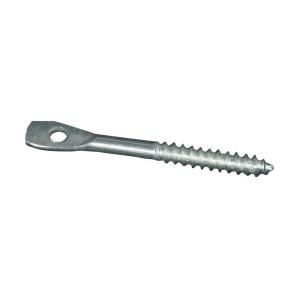
3 in. x 1/4 in. Eye Lag Screws for Drop Ceiling Grid with Wood Joists would be overkill but bomber. 7 cents each at Home Depot. Install with a 16d nail. Ought to hold a hundred pounds of tension if there's a log, tree or platform around. There might be even smaller versions.

screw lag

David Thomas BPL Member
PostedSep 7, 2014 at 3:24 pm

I searched the web for a fair bit and couldn't find anyone who's doing a UL option for backpacking level tents. So here's a marketing opportunity for you cottage guys and gals:

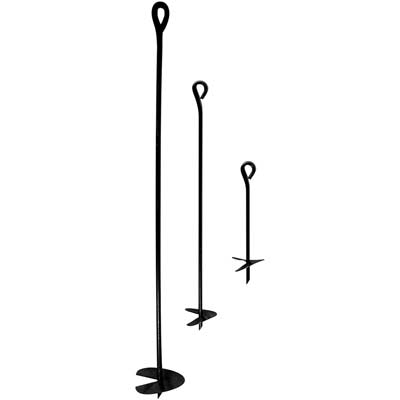
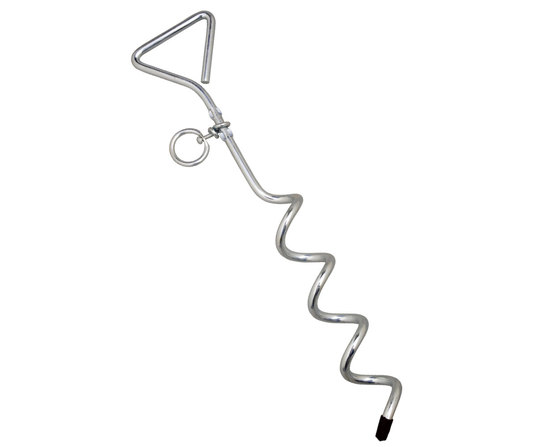
Helical screws offer amazing holding strength for their size and weight. Instead of installing them perpendicular to the tensioned line, you install in line with the line. These are the anchors to the guy lines you see on power poles and guyed antennas. There are variations, but basically:helical screw

It's 3/4 to a full flight of a thread. They are awesome in clay, silt, and loam. They work fine in sand, but in sand, you have the SUL option of deadmen anchors. They cost as little at $2 in huge lots for the smallest size, but those are still too large. And steel.

Then there's the variation in which the shaft is the screw, but then the shaft needs to be pretty large diameter:screw anchor

Walmart has them for $3 each, but again, those are overkill, too heavy and $3 each.

Either technology in a much smaller size fabricated from Al or Ti could be a really handy solution to high-wind and poor-soil conditions.

PostedSep 12, 2014 at 9:41 pm

I too have "belayed" my tent stakes with other stakes. It does work.

I like the V pattern in the photo B/C it spreads the strain better.

David Thomas BPL Member
PostedSep 14, 2014 at 8:21 am

Piper's title of "Big Rocks" reminds me: you can use old rock-climbing techniques on top of a granite surface or along vertical granite. A pebble in a loop of string can function as a chock. A stick can be wedged in a crack. Etc. One of the most bomber bear-bagging hangs we ever did was on a vertical granite face – leaned over the face as far as we could, placed pro and hung the food bag from that.

Ian BPL Member
PostedSep 14, 2014 at 10:10 am

I find myself using sticks and ballast as dry deadmans on a fairly regular basis.

.Rocks

M B BPL Member
PostedSep 17, 2014 at 6:52 pm

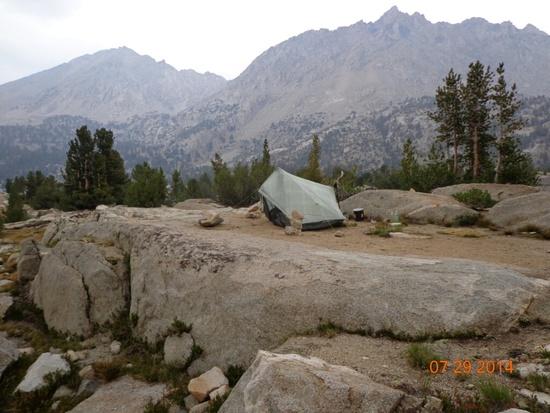
Sometimes you need more than 1 rock. Use stick on line so it won't drag under rocks.rae lakes

Jim H BPL Member
PostedSep 18, 2014 at 9:47 am

I had my 10×10 tarp pitched on granite near Thousand Island Lake last week, in a thunderstorm. In my haste to setup my tarp I'd put the lines around rocks, but quickly discovered that the z-line sheathing can't handle much abrasion from granite during wind gusts. The braided core was fine, but the wind tore through the sheathing on two of my lines overnight.

The next night I tried the anchor tactic I read about here and it worked great. I carry a few DAC j-stakes in addition to my ti hooks. The DAC stakes have a convenient hole in the stake head that I fed the ti hook through, forming a T. It made a very nice anchor to pile rock onto.

I did something similar later in the week when on soft ground. I made a T with the two stakes, and sank the j-stake into the ground until the hook was flush with the ground. This allowed me to pitch the tarp to the ground at the edges and still be able to pile rocks onto the ti hook without having rocks on the tarp fabric.

Maybe this double-stake tactic is old hat, but I was proud of myself in the moment. :)

PostedSep 18, 2014 at 10:05 am

" I made a T with the two stakes, and sank the j-stake into the ground until the hook was flush with the ground. This allowed me to pitch the tarp to the ground at the edges and still be able to pile rocks onto the ti hook without having rocks on the tarp fabric."

I went with longer lines all around. I don't like have a rock pile within "striking distance" of the tent.

Dave @ Oware BPL Member
PostedSep 18, 2014 at 10:33 am

"One is to put the stakes in perpendicular to the direction of force that will act on them. Not just "a little to one side", as a post I just read mentioned (impetus for starting this thread). Usually at a 76-75 degree angle to the ground, depending on the tent. Seems obvious, yet I see tons of people put stakes straight down in the ground."

Depends on soil type and anchor type. The old cut wood stakes of large surface area, driven into soil that is looser on top, stay put better with a negative angle (leaning toward the tent).

Some parallels (pun intended) can be drawn from Ice screw placement.

"I heard that ice screws should be angled slightly down to maximize the strength of the threads. If this is true, why don’t the threads run the full length of the screw, rather than just the first couple of inches?

Like the existence of life after death or true love, the jury is still out on that one. Limited testing by Chris Harmston of Black Diamond and Craig Luebben about 10 years ago showed that ice screws with the hanger end angled down (negative angle) up to 20 degrees were stronger than screws with the hanger parallel to the ice or angled slightly up (positive angle). A negative angle does not, however, increase the strength of the threads; rather, it decreases the chance that the ice will blow out from under the screw."

http://www.rockandice.com/lates-news/should-i-angle-ice-screws-down

PostedSep 18, 2014 at 11:37 am

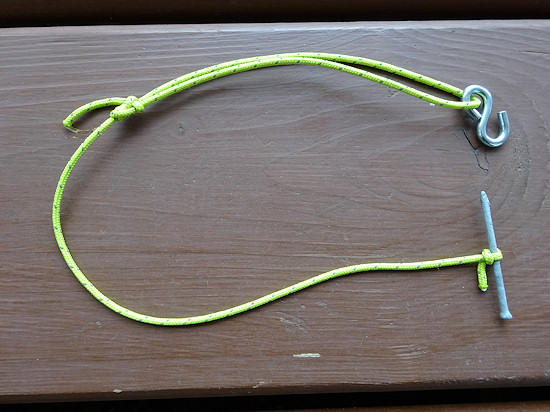
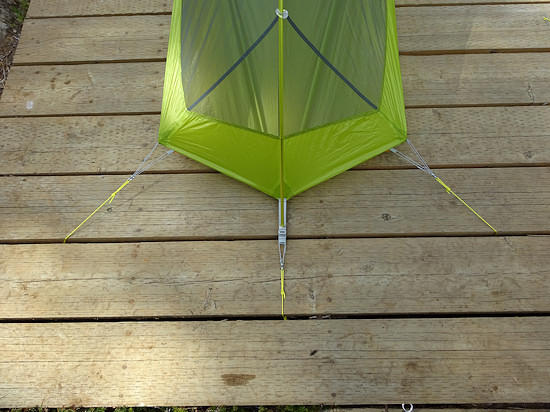
For platforms. Small S hook. Galvanized 1.75" nail. Rough texture on nail holds well. File (blunt) tips on nails. Adjustable grip hitch. Reflective line. Simple loop on the nail. Assorted lengths (~8" to 20") for different boards. No damage to platform. Weight: 5-6g each. Big Agnes Fly Creek 1 Platinum shown.
linetent

Viewing 20 posts - 1 through 20 (of 20 total)
Loading...