Topic

battery pack vs solar panel

  • This topic is empty.
Viewing 24 posts - 1 through 24 (of 24 total)
Alok Karnik BPL Member
PostedAug 25, 2014 at 7:26 pm

Hey guys,

for charging an iPhone would it be better to just go with a battery pack that could hold about 11000 mAH (4 cycles) or go with one of the goal zero solar power + smaller battery pack combos?

Any suggestions from people who have gone through this same question?

David Thomas BPL Member
PostedAug 25, 2014 at 8:05 pm

I ordered a battery pack purported to be 11,000 mAH off of eBay and then tested it. Repeatedly. It was nowhere close. Instead of providing 4 iPhone charges, it gave somewhat more than 1. And far less than one recharge of an iPad.

So, I'd think about your return options before ordering or consider if it would still be a good deal if it was vastly over-rated.

I do use auxiliary batteries on my iPhone – by doing so, I keep them useable for an extra year before indulging in the next upgrade cycle. But it's never quite as good as promised.

What I do like, and have done on many makes and models of digital cameras is to forego the solar charger options and just buy multiple extra batteries off of eBay out of Shanghai. For $1.50 to $3 instead of $29-$39 from Nikon or Pentax. I get several, depending on trip length. Then I charge them up in advance and bring them along (or mail them in a drop box). At that price, you could throw them away as you go, if you wish.

PostedAug 25, 2014 at 8:12 pm

For normal trekking, even thru hikes with semi-frequent town stops, I'd say a 10,000+ mAh battery is the way to go. I'm charging my nexus 5 with it now… a half dozen refills while phone is in use.

For altitude where you will be exposed to a lot more sun (glacial, alpine pursuits) it's solar all the way! Mind you, the thin panels will rapidly degrade with use… Microcracks and all… So your 80watt may soon become a 45watt. There's also a power loss while trickled charging a device directly… A lot of the more efficient solar charges are rigid panels with a build-in battery.

Mike In Socal BPL Member
PostedAug 25, 2014 at 10:28 pm

For 2-3 days, you could probably get away with an external battery pack and some good power conserving habits. I used a Goal Zero Nomad 7 and a 4-cell AA rechargeable pack on a couple of trips last year and it worked well. I'd charge the battery pack during the day then charged my phone at night. I used my phone for maps, reading at night, camera, and to keep notes.

Bob Gross BPL Member
PostedAug 26, 2014 at 12:09 am

It seems like we go through this same question, again and again.

It can't be answered directly because there are too many variables. We don't know where you are located. We don't know if you are moving every day, or which direction you are moving.

For example, solar panels can work pretty good at a remote base camp. You can set one up, optimize it for the sun angle, and then accumulate some sun for several days. Solar panels are a lot trickier if you are moving along the trail every day. Some people will attach the solar panel to the back of a backpack so that it is oriented toward the sun, but if you are headed the wrong direction or underneath trees, it doesn't work so good. When and if solar panels create too much hassle, you need to switch over to a rechargeable battery supply or else a primary battery supply.

–B.G.–

Adam BPL Member
PostedAug 26, 2014 at 12:35 am

ebay battery packs are a big risk.

Adafruit is an online store with a good reputation. They test everything the sell extensively.

Daniel D BPL Member
PostedAug 26, 2014 at 1:26 am

I've got a panel but you need optimum conditions for it to work properly.

I've bought a few battery packs off ebay and they've mostly been substandard. I'm looking at the Anker Astro pack, seems to get good reviews, I might go for the 9000mAh pack.

Matt Dirksen BPL Member
PostedAug 26, 2014 at 6:27 am

+1 to "it depends".

I have this thing: http://www.amazon.com/gp/product/B003ZBZ64Q/ref=oh_aui_detailpage_o03_s00?ie=UTF8&psc=1

which worked pretty well on it's own. I also have a Goal Zero solar panel. I used both on a 12 day trip this summer in New Mexico but the iCarrier decided to stop charging halfway thru the trip. Fortunately, I had a battery case on my iPhone, so I was able to charge that up during the day.

I have since returned the iCarrier for a new one, and has seemed to work well sofar.

As to why it failed? I wondered at the time if it didn't like being charged by the solar panel.

PostedAug 26, 2014 at 7:17 am

An iPhone plugged in to a solar panel while you are moving through partial sun/shade will continually flash the screen, letting you know it's "charging" every time you step into a bright spot. This drains the battery faster than the sun refills it. Turning the phone off does nothing; it turns itself back on.

iPhones are finicky like that when it comes to solar.

PostedAug 26, 2014 at 8:04 am

I am by no means an expert, and haven't even tried any yet, but for what it's worth, this is the most interesting thing I found in my web surf:

"Energizer Instant Charger for Micro USB Mobile Phones"

I like that it's by Energizer, who presumably know batteries, and that it takes 3 not 4 AA batteries (a better match for target voltage, yes?)

"They say" that you should always use the expensive lithium batteries, to really gain the charge per weight.

PostedAug 26, 2014 at 8:23 am

For my camera I do the same as Dave, bought several Chinese knock-offs of the camera's proprietary battery and charge them up before a long trip.

Where do the pocket-sized hydrogen fuel cell units fit into this discussion? Are they ready for prime time?

David Thomas BPL Member
PostedAug 26, 2014 at 10:32 am

>"Where do the pocket-sized hydrogen fuel cell units fit into this discussion?"

While hydrogen-powered fuel cells have been feasible for decades – if you don't cool the hydrogen down to -423F like NASA does, at ambient temps, it takes about 50 pounds of steel to contain a pound of hydrogen*. So I'm holding out for a methane-powered fuel cell coupled with a menu heavy on the beans.

*so obviously, we'd bring it in a ballon and utilize the added lift to reduce pack weight.

Ryan Smith BPL Member
PostedAug 26, 2014 at 10:50 am

We've had 3-4 really good threads on this lately. Try Google searching BPL under solar or battery pack and look at the most recent threads. As Bob mentioned, there are a lot of variables to consider. Amount of sun, length of trip, power needs, etc. There are battery packs out there which can carry a lot of power for only 5-6oz.

Ryan

Ian BPL Member
PostedAug 26, 2014 at 11:41 am

When I backpacked with an iPhone 4S, I found that if I kept in in airplane mode, only plotted a GPS coordinate (out of airplane mode) a few times per day, took some pictures and a few minutes of video per day, my battery was good for three to four days; possibly five if I pushed it. This was when the iPhone was new.

For me, I only needed to recharge it once per week as I don't go backpacking longer than that so a battery pack was the way to go. I bought one from Fred Meyers for about $20. Can't remember for sure but it's in the neighborhood of 5000 mAh.

I believe the iPhone 4S' battery is roughly 1420 mAh. Overshoot that by 30% to adjust for loss during transfer so, if everything works as advertised, a 2000 mAh battery bank will give you one full recharge plus a little.

I'm sure Solar can be great but external battery banks are simple and cheap. Just test it out a few times before hiking with it.

PostedAug 26, 2014 at 11:58 am

"I believe the iPhone 4S' battery is roughly 1420 mAh. Overshoot that by 30% to adjust for loss during transfer so, if everything works as advertised, a 2000 mAh battery bank will give you one full recharge plus a little. "

That matches my actual usage results. :^)

Andrew Martin BPL Member
PostedAug 26, 2014 at 12:26 pm

I have both a Suntactics s5 charger and a ~6,000mA battery pack (got them in a bundle from Amazon). I took both on the JMT and the battery pack only on a four night trip on the Teton Crest Trail. Here are a few things to note:

Don't get the Goal Zero: As mentioned above, when your walking with the panel on your pack, the power output fluctuates with any change in cover (i.e. trees) or direction (i.e. switchbacks). The Suntactics panel tries to get around this by resetting itself every few minutes so that if you went into shade and are now out in the sun again your phone will probably charge. With this panel I was able to keep my iPhone 5 charged up in the high sierra passes but not on cloudy days or in deep forests. A lot of JMT folks with the GoalZero panels found that they couldn't charge on the move at all though.

With the battery pack, I could keep my phone and camera charged even when there were two or more cloudy days due to the strong monsoon thunderstorms. The panel can trickle charge a battery pack in cloudy weather or forests reasonably well. I would recommend a 3,000mA battery pack as a pairing though to save weight and still hold a full recharge.

So if the panel worked so well why didn't it go to the Tetons? I realized that the battery pack alone could recharge the phone enough to keep me in power for about 6 days if I kept it in airplane mode unless getting coordinates. This saves ~8oz.

In the end, for the weight a battery pack is probably more versatile unless you are charging more than one device or are going to be away from wall power for more than a week in reasonably open country (desert, alpine, etc..).

Nick Gatel BPL Member
PostedAug 28, 2014 at 8:43 pm

"It seems like we go through this same question, again and again."

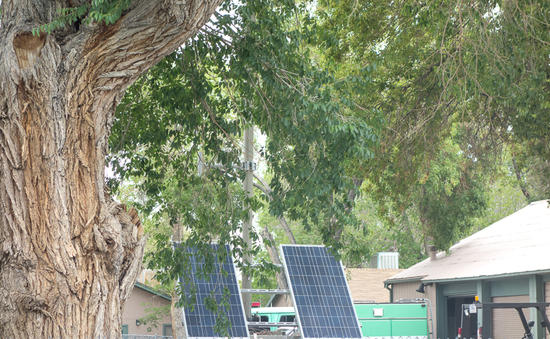
Yeah, but now there is new technology in solar panels. You must have seen these in the back lot of the USFS station in Bishop (behind Burger King).

Yep… it appears the USFS has figured out how to get solar panels to work in the shade.

USFS Solar Panels

They MUST work. I have faith that our government would not install solar panels in direct full shade of trees if they did not function. They would not waste good taxpayer money!

Bob Gross BPL Member
PostedAug 28, 2014 at 9:19 pm

Nick, those aren't solar panels. They are shade panels to absorb darkness.

Besides, the USFS people are government employees. Of course they waste good taxpayer money.

I won't sweat it, though. It's more of your tax money than mine.

–B.G.–

James holden BPL Member
PostedAug 31, 2014 at 11:09 am

there are certain powerbanks that are based off 18650 bats

these have few advantages

– unlike fixed powerpacks, you dont need to worry about the degradation of the powersource over time … you can simply replace the bats

– should you use up all the power on a long trip without the capacity to recharge … simply carry a few extra bats

– as long as your bats are genuine and of good quality, you dont meet to worry about exaggerated mAH ratings … with good quaity bats you know exactly what you are getting

– if you are one of those folks who use some of those chinese zebralights, sparks and other such 18650 lamps … you already use the same bats

heres a few examples

http://www.fasttech.com/category/1424/battery-banks-mobile-power-stations

;)

rick . BPL Member
PostedAug 31, 2014 at 11:29 am

@ daniel d.

Anker brand is good, judging by my single datapoint. I bought spare batts and charger for my phone. Out of the box they were about 80% as good as stock new battery, for waaay less.

PostedSep 2, 2014 at 9:19 am

I just finished a PCT thru and used the Suntactics s5 through California and it worked absolutely great with my iPhone 5s.

Sent it home in Oregon and switched to 2 medium capacity battery packs because I met more than 1 hiker who had external batteries that decided to quit working and also because you can charge 2 medium (4200mAh) batteries faster than 1 large capacity battery.

Where I live in the southern Appalachians on the AT, a solar charger isn't practical.

Viewing 24 posts - 1 through 24 (of 24 total)
Loading...