Topic

How to hike with a dog and trekking poles?

  • This topic is empty.
Viewing 14 posts - 1 through 14 (of 14 total)
PostedAug 18, 2014 at 8:24 am

So my dog typically accompanies me on trips – he's a 35 lb mutt that was built to hike. I'd like to try trekking poles for an upcoming hike that'll have lots of up and downs, but I'm not sure how to balance the two. My dog is light enough and good enough on a leash that I think I can tie him to my waist without any danger, but it seems like he'd get tangled.

Does anyone have experience with this? Is there a way to jury rig some sort of connection to my pack, or is it just difficult no matter what?

Bill Law BPL Member
PostedAug 18, 2014 at 8:53 am

I used to hike with my dog. Usually I used just one pole. That might be a good way to start off to simplify things. I fastened his leash to a large carabiner on my waist belt. That made it easy to unhook when necessary. A friend used a bungee cord around his waist to add a little shock absorption.

Getting tangled wasn't the hardest part for me (but my dog was real smart about making sure he passed to the same side of trees). Avoiding getting thrown off balance on steep downhills was the trickiest. Off trail I would unhook him and we'd each find our own route.

J-L BPL Member
PostedAug 18, 2014 at 9:18 am

I would recommend try using just 1 pole. I've been using 1 pole in hand with leash in the other for a few years now. It's kind of nice because you can switch off what hand you use the pole with. I can't say I miss using a 2nd pole

I would personally not want my dog tethered to my waist, but maybe it depends on your dog's weight, prey drive, tendency to wander, etc

Nico . BPL Member
PostedAug 18, 2014 at 9:50 am

With a smaller dog, you might be able to get away with rigging the leash to your hipbelt.

With my 100 lb lab, it just becomes a mess to try to manage him on a leash and deal with trekking poles. More often than not, I leave the trekking poles at home if he's with me.

I have occasionally brought one pole with me… as it can be helpful on climbs and descents, tricky creek crossings, etc. but I really like having both hands available for controlling the dog (in the event something comes up, e.g., snake, deer, etc.).

PostedAug 18, 2014 at 10:15 am

I like the one pole idea…I might try that first. I really think if he was lashed to my waist I'd do okay – he's fast and agile but not the strongest little guy. I might bring a biner and try both methods and just experiment on this trip.

And on the downhills, well really, all the time I'd love to keep him off leash but I have been on the opposite end of meeting an unfamiliar dog on trail and I just hate to do that to people. He'll come to me when I call with other people but he WILL bolt after animals like deer. I'm done with the "chasing blindly into woods after my dog" thing haha…so he stays next to me now.

Thanks to everyone for the advice!

PostedAug 18, 2014 at 10:19 am

I hike with my dog all the time and have found that using 1 pole is much better than two. I also have the dog attached to my waist at all times. She's a strong puller and it's way easier to have her attached to my waist than try to hold the leash with my hand.

Here's my set-up:

For day-hikes I have a skijor belt that I use, but for backpacking I added 4mm accessory cord through my hip belt with bowlines at each end. I attach a carabiner through the bowlines and the leash through the carabiner.

I think it's really important, especially if you have a dog that pulls, to have a length of bungee cord as well. My set-up includes a 4 foot section of bungee cord that's attached to another 3 foot section of regular poly rope. That way, when the dog pulls it doesn't jerk either one of us around as much. Do a quick search for skijor lines and you'll see what I'm talking about, and can probably order a line from one of the sites for cheap.

As I said, my dog is a strong puller, so generally the line is taught and we can just walk along comfortably and I use the one trekking pole for support. When she starts sniffing around, is about to get tangled up, or when we are on steep descents I hold the line with my free hand which gives me added support and control. It's been a great system for me and I highly recommend it.

If you do a search on the site I posted a few pictures last winter that show what the set-up looks like. And here is a picture of the set-up in action on the Chilkoot Trail last week:

Dog

Edited: To reiterate, having a section of bungee eliminates risk of jerking and throwing you off balance when attached at the waist, even with a dog that pulls hard.

Dena Kelley BPL Member
PostedAug 18, 2014 at 11:17 am

I also use just one pole when hiking with my dog. I generally hold her leash in 1 hand.

Mary D BPL Member
PostedAug 18, 2014 at 12:20 pm

First of all, obedience training for the dog. A dog that pulls on the leash is not a properly trained dog anyway. A Premier Pet Products Gentle Leader, properly used, is great for teaching the dog to always keep the leash slack. One important maneuver to teach your dog is often referred to as a "flip finish" and you can find examples on youtube. This move gets the dog from an unwanted position for continuing on the trail (like facing you) to a "heel" position on your left side without wrapping you or your poles up in the leash. Training the dog to walk behind you on the trail helps, too. My late lamented Hysson, when walking in front of me, whether on or off leash, would keep stopping dead a few inches in front of me whenever he found an enticing smell. I don't know how I avoided tripping over him!

Second, lots of practice. Use your trekking poles for your daily walks with the dog. Rubber cups on the pole tips protect the tips, the sidewalks, and your dog's paddy paws. I put my left wrist through the trekking pole loop and then through the loop at the end of the leash. Your dog will soon learn to avoid the poles and to anticipate their movement. Unfortunately, that means he'll "heel" farther away from you than is desirable for obedience competitions, so if showing the dog is important to you, use only one pole in your right hand. Using trekking poles for exercise walking turns this activity into a whole body exercise that works your core muscles as well as your legs!

The dog I have now, a Jack Russell whom I'm caring for for a year while his human backpackier "parents" are in Germany, obviously already knows all about trekking poles, so I haven't had to teach him anything.

Lori P BPL Member
PostedAug 18, 2014 at 7:03 pm

A Ruffwear Roamer does the trick for me. Converts from a hand held to waist leash, long bungee section in the middle.

PostedAug 18, 2014 at 7:27 pm

Mary, I agree that obedience training is important. I don't think it's fair to say a dog isn't trained properly if it pulls on a leash, though. We worked hard at training our dog to pull for skijoring, bikejoring, and running. No she doesn't heel, but she has gee and haw mastered, she knows to ignore distractions while she is working, and will stop on a dime when I say whoa. I get that most people want a dog that heels and behaves like a proper city dog, instead of a country bumpkin like ours, but we've worked hard at training her to be a competent, strong, and hardworking dog.

Personally, I enjoy her pulling when we hike. She knows to keep the line straight and taught and to always be moving forward. The bond we've created traveling hundreds of kilometers attached to one another like this has created trust and comradarie, and I'm happy with how well she's been trained, despite the shortcomings.

Have fun hiking with the Jack Russell. I've yet to meet a dog who doesn't love the trails.

Happy hiking…

Randy Nelson BPL Member
PostedAug 19, 2014 at 7:46 am

I use a retractable leash. I clip my waist belt through the handle and the other end to their pack. It's a little heavy but you don't have to worry about slack in the lead. You can also lock it in a place with a flick of your thumb when you want the dog kept closer to you. Even with the leash, it's helpful to teach the dog some trail commands like lead, follow, wait, slow, OK, etc.

I like him to lead on flat or gentle slopes.

Buddy on CT

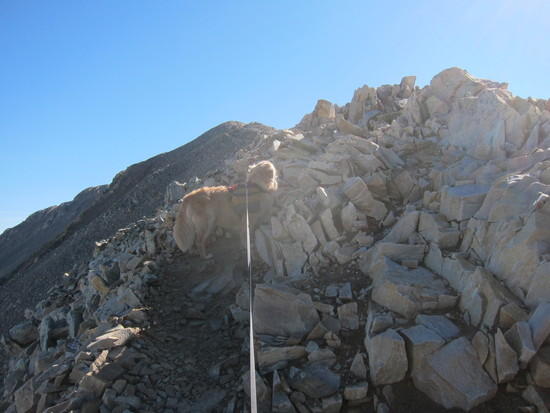
On steeper stuff, like this 14er, I like him to follow or use the slow/wait/OK commands if he's in front.

Butddy climbing Sherman

In both those pics, he's on a wait. It's not formal like a stay. He can move around just not go forward.

Dale Wambaugh BPL Member
PostedAug 19, 2014 at 8:24 am

+1 on classic obedience training, not only for walking with a slack lead, but also basic behavior and commands, like "leave it" for small animals and the like, sit, stay etc. If you can't voice command your dog, it doesn't belong on the trail and is both a nuisance and a liability.

Head collars have worked well for us. I could see a waist belt setup with the right dog, but I prefer one pole and leash in hand. If there is a kit of trail traffic, I can direct my dog off to the side, etc.

We use a pack too, which doubles as a grab handle for managing obstacles and stream crossings.

PostedAug 19, 2014 at 8:41 am

Great tips everyone, thanks. To a few of the points being made…my dog is very obedient on-leash, responsive to the heel command, etc. He is on a Gentle Leader 99% of the time – it was a great training tool when he was a pup and we've just stuck with it.

Off leash he'd run rampant after wildlife of course but that's why he's never allowed offleash anymore – at least not on the trail. At home I play fetch with him in the front yard and he only has eyes for the frisbee. Will come to me everytime I call unless there's another dog around.

Still thinking hiking with his leash in one hand and a trekking pole in the other will work best for my needs. Might try him around my waist a bit as well – he pulls so little that I think it would work.

Edit, since we're talking about him so much, here's a pic of Boone wondering why we've stopped moving:boone in snp

tim byrne BPL Member
PostedAug 23, 2014 at 6:20 am

All great tips, as I just got a dog and was wondering this very topic this am! My dog is still a pup at 9 months but does well on a leash so far, but to ensure a trail worthy dog I enrolled him in obedience training at landhiem training. They train all sorts of police dogs and such. Since I already have a big investment I thought this would be a wise decision. Besides my work schedule it would require a lot longer to train. He is part australian cattle dog and coon dog.

Viewing 14 posts - 1 through 14 (of 14 total)
Loading...