Topic

SNEAK PEEK: 2015 Sierra Designs TENSEGRITY ShelterS

  • This topic is empty.
Viewing 25 posts - 1 through 25 (of 72 total)
PostedJul 25, 2014 at 3:12 pm

I received several IM's requesting more information on the new 2015 shelter we will reveal on Wednesday night. I'll post the teaser here and follow up with full details after the LIVE event. Click this link to sign up for the LIVE event:

http://sierradesigns.yourbrandlive.com/c/designone/

NOTE THAT I WORK FOR SIERRA DESIGNS, AND THIS POST INCLUDES A SHAMELESS SALES PITCH!

Here is the sales teaser I sent to retailers, with spec details at the bottom:

Tensegrity Proto 2

Q: Where's the easy-to-trip-over guy-line holding up this trekking pole tent?
A: Hanging out with the Backcountry Bed zipper……patents forthcoming…..

Q: Wait, forget about the guy-line for a minute, where are the poles?
A: They are there, just not where you would expect it.

Q: I don't use trekking pole tents for my shelter because I have light, fixed length trekking poles that do not adjust. Can I use those?
A: Yes

Q: ANY length?
A: ANY length 120cm or longer, up to, theoretically, infinity.

Q: I NEVER need to adjust them?
A: Never. That hassle is now obsolete.

Q: Is this going to be the lightest SD shelter offering?
A: Yes.

Q: The smallest, too?
A: No, in fact it is quite the opposite.

Q: Does it have awning coverage?
A: Yes, 12" of awning coverage.

Q: Accessible storage away from the door?
A: Of course.

Q: Stargazing on clear nights?
A: You Betcha.

Q: Does it have 270 degrees of mesh for venting?
A: No, it has 360 degrees of open venting mesh, even in the rain.

Q: Are the sidewalls vertical, offering the "best possible" interior space?
A: No, they are WAY better than that. (see drawing)

Q: Does this tent redefine what is possible in the space/ weight relationship of a shelter, obsoleting the dome tent?
A: Yes, but only if you believe that "non-freestanding" is better (hint: it IS better).

Q: Who should NOT buy this tent?
A: Anyone who hates living comfortably in large spaces, even in poor weather. Also anyone who likes carrying heavy loads.

Q: Does this shelter fundamentally redefine the camping experience like all the other SD tents?

A: Yes, just like those. Its just bigger. AND lighter.
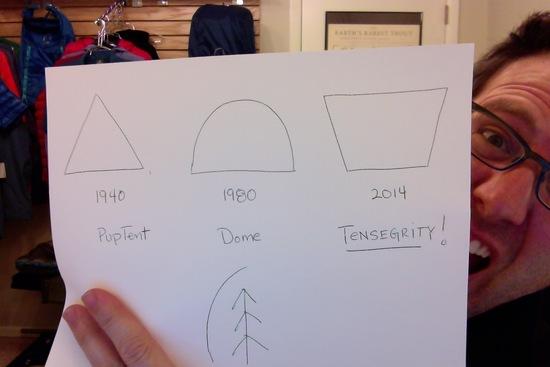
Tensegrity!

Additional Info:

The Tensegrity shelters will be available in 1 and 2 person versions, and in two builds. The FL build uses 30D floors and 20D Flys with a 1800mm (fly)/3000mm (floor) PU coatings, fully taped. The ELITE versions use 20D nylon impregnated with Silicone (1400mm (fly) /3000mm (floor) and are not taped. The ELITE tents do not meet CPAI-84 fire retardancy standards and will not be available in states that enforce that standard. They also require user seam sealing. But they also have 4 times the tear resistance, dramatically improved UV resistance, and by eliminating urethane and the associated toxic FR chemicals, they eliminate the main fabric failure point and will truly last a lifetime with normal care.

The shelters require trekking poles, not included in the enclosed minimum weights:

Tensegrity 1 FL: 1, 15
Tensegrity 2 FL: 2, 8
Tensegrity 1 ELITE: 1, 10
Tensegrity 2 ELITE: 2, 2

Background:

The goal of the Tensegrity shelters is to build shelters that prove that comfort and livability features can go hand in hand with lightweight. Like all SD tents, they lack traditional vestibules (which block doors with gear, trap condensation, provide poor cooking options, require two zippers to enter or exit, and block external viewing in poor weather) and instead use awnings over drop doors (which create a huge vent to allow maximum ventilation in poor weather, safe cooking, single zipper access, and a window to the great outdoors even in rainy weather). They also have dry gear storage that is accessible from inside and out, but does not block the door. Finally, they include a tarp that can be configured a couple different ways to create the gear closet, an external shade area or can be completely rolled away for stargazing.

But the big feature is that they are, well, BIG! Here is a Graphic that compares the interior space to comparably weighted freestanding shelters, both of which lack all of the features above. Yes, it is true that this compares freestanding vs. non-freestanding, and that the weight of the trekking poles in not included. But that's the point: we want to encourage the use of non-freestanding trekking pole shelters, because they are lighter AND more comfortable….
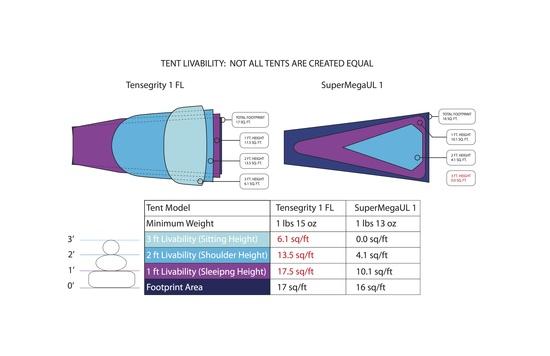
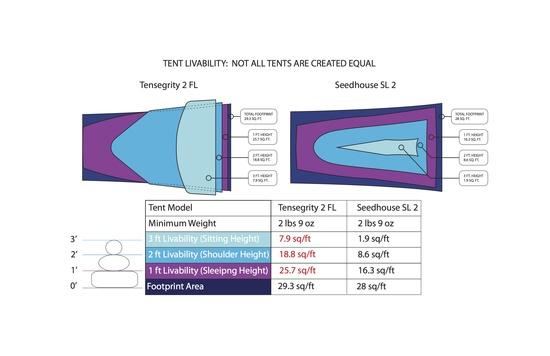
1P Tent Livability Graphic

tent livability graphic

Jonathon Self BPL Member
PostedJul 25, 2014 at 5:48 pm

I admit I'm somewhat interested.

Didn't think I would be, but I am. Looking forward to the presentation.

Jeffs Eleven BPL Member
PostedJul 25, 2014 at 6:36 pm

All it takes to get Doug's attention is a feather on a stick.

It's like a tenkara setup to catch idesters

John Vance BPL Member
PostedJul 26, 2014 at 7:28 am

Will there be any other current shelters that will get the option of the "elite" fabric?

Jesse Anderson BPL Member
PostedJul 26, 2014 at 9:58 am

I imagine it's just a new name for what they are already doing. In the Flashlight, Lightning, and Flash you can buy the regular model with inexpensive fabrics or you can buy the UL model with lighter, more expensive fabrics. When I bought my Flashlight 2 it was $100 difference for 4 oz. so I chose to cut that weight somewhere else.

John Vance BPL Member
PostedJul 26, 2014 at 11:53 am

I think it's different since it isn't seam sealed and doesn't comply with flame retardant standards – both things the current UL versions have. My guess is that it is sil-nylon with no other coating.

Jesse Anderson BPL Member
PostedJul 26, 2014 at 12:23 pm

Ahh you are correct, I missed that as I was scanning through all of the info in the OP. That makes a bit more sense than the original standard/ul method. Before you got a choice between urethane/nylon and a light urethane/nylon, one being 4 oz lighter and $100 more expensive (in my case it would have increased cost by almost 40%). With the new standard vs Elite, you get a much better value proposition. Nearly the same waterproofness but in a lighter and stronger material. Plus the 5-6 oz weight reduction. I love my Flashlight, but these new models appear very interesting.

PostedJul 26, 2014 at 2:49 pm

To clarify:

2014 3 season tents had two builds: (fly/floor)

Standard Build: 75d poly PU1500mm / 70d nylon PU3000MM
UL Build: 30d nylon PU 1500mm / 40d nylon PU3000mm

For 2015, we are offering two new builds:

FL Build: 20d poly PE1800mm / 30d nylon PE3000mm
ELITE Build: 20d sil/nylon 1400mm / 20d sil/nylon 3000mm

Note that ELITE build will ONLY be available in the Tensegrity shelters. Yes, the ELITE build is 20d Sil/Nylon, not unlike other fabrics you may be familiar with. Our silicone impregnation process is allowing us to offer PU-free floors with 3000mm of water entry pressure. These are definitely ELITE builds: they will require hand seam sealing and the process will not be easy, due to the complex construction of the shelter. I did a Tensegrity 1 for my personal shelter and it took about 2.5 hours, though you could go faster by using more sealant. Others contend that these fabrics do not require sealing, but they do if you want it to be bomber. We chose this build because this fabrication is both extremely light AND extremely strong. They are WAY stronger than the FL build (if memory serves, the 20d sil/nylon has a 9 pound tear strength and compared to less than 2 pounds on the 20d with PU.

If I could convince the whole world to ditch PU coatings I would do it. Yes, they allow taping, and they give a way to add FR (fire retardant) chemicals, but they really destroy the longevity and durability of the shelters. And these are some pretty expensive shelters.

The reason is that the PU holds the yarns in place so that they cannot stretch before failure, so very light fabrics with PU have far less tear strength that with the PU. In addition, the PU degrades over time (especially with FR chemicals) and is susceptible to UV. If a tent wears out, it is usually do to PU degradation. We are mitigating this with our PE coatings on our FL versions (though don't be confused, PE is still Polyurethane, not Polyethylene). These improve matters somewhat, but still I HATE these coatings.

Silicone, on the other hand is just awesome. It lubricates the yarns and allows them to slip and slide, dramatically improving tear resistance. Plus they totally impregnate the fabric with UV resistance, while being PERMANENTLY waterproof. And because silicone impregnates rather than coats, it lasts forever. I honestly expect that my Tensegrity 1 ELITE will last the rest of my life, and longer. You can certainly go with lighter fabrics like Cuban, but the sacrifice in durability is severe and the cost astronomical: a poor combination in my opinion.

Finally, I will say that the Tensegrity shelters are, in my biased opinion, the finest UL backpacking shelters I have ever seen. Ever since we stumbled upon the MSR Missing link 13 years ago, I have been convinced that "tarp/tents" suspended with trekking poles offer the best possible combination of lightweight and space/comfort. It has been a long time solving the problems of "trippy" guy lines, difficult "tarpy" set up, non-adjustable lightweight trekking poles, etc. Plus, to be a "quiver of one" solution (which for $400+ I think it should be), a shelter needs to work effectively in rain, which surprisingly few shelters do. If you can't cook, get in and out, set up dry and SEE OUTSIDE in the rain, to me the shelter is a FAIL. Yes, I am a NW guy and see a lot of rain, but every tent works fine when it is not rainy; poor weather separates the best from the rest.

PostedJul 27, 2014 at 7:29 am

Michael, I have to say I really, really appreciate your participation in this forum. One of the things that I've gotten from this group over the years is a tremendous respect for smaller companies that care about connecting with the customers – that TRULY consider the customer as a stakeholder that matters.

I don't mind one bit spending a bit extra if I know it goes to a company that cares about what I think – being introduced to cottage gear makers has literally changed my entire way of thinking and doing business.

It's nice to see a "larger" company like Sierra Designs participate on a level such as this. So for that – thanks!

PostedJul 27, 2014 at 8:51 am

Michael–This is only a suggestion, but it would be great if you would put your Elite 1 up on 'zenbivy' in the same manner as the Flashlight UL. Also get a sample over to Philip Werner at 'SectionHiker' for a preview. He has a large following and is highly regarded in the 'light gear 'community. . Your 'zenbivy' feature and Philip's review of the pre-production and final versions of the Flashlight UL convinced me to 'pull the trigger' on my visit to the US this fall (not avail. in Canada due to fire retardant regulations). Everything is now on hold till I see this baby. If the posted 'spy' photo is correct, I'm in. Still keeping my Scarp 1 with x-poles for late fall and winter outings.

Joe S BPL Member
PostedJul 27, 2014 at 9:17 am

As a tall stomach sleeper, let me congratulate you on the outward sloping walls. There are 90 inch floor lengths in many models that don't work for me because of the functional space limit of inward sloping walls. A few Marmot tents have a "reverse foot box" but are not UL. From the outdoor retail article linked above, it looks like several manufacturers age trying to get walls vertical, too.

PostedJul 27, 2014 at 9:34 am

This is it.

SNEWS articles are supposed to be locked by subscription, but this one is viewable without a subscription.

While you are looking at it, let me plug another cool new shelter on that SNEWS list: The MSR FlyLite. They finally fixed the awkward sleeping arrangement from the Missing Link/Fast Stash, and this geometry (the one that for me, started it all) has come into its own. It still has the "triply" guy lines, but keeps the KEY feature of AWNING OVER DROP DOOR.

The original was named the "Missing Link" because I saw it as the evolution between traditional heavy "double wall dome tents" and tarp shelters. Indeed, it was the first "tarp tent". It is worth noting that EVERY shelter in the Sierra Designs line is a descendent of the Missing Link, which was a monumentally influential design:

–It hybridized the single/double wall approach, albeit minimally. Prior, virtually every tent was either single, or double wall.
–It blew apart the space/weight relationship available at the time (just like Tensegrity is about to do again)
–Most importantly, it incorporated an AWNING OVER DROP DOOR that fundamentally changed the livability and ventilation of the shelter

If you attend the LIVE event on Wednesday, you will hear a lot about AWNINGS OVER DROP DOORS, and why we believe they fundamentally change how you camp, and the livability of the shelter. People ask me a lot about what I think about the cottage shelters like TarpTent and 6MoonDesigns and the many others. I honestly really like a lot of these designs, but for some reason the cottage industry has not yet pursued designs that have AWNINGS, even though that is what makes tarp living so awesome. The beauty of tarps is that unlike most integrated shelters, they are BIGGER at the top than the bottom. ALL SD tents are bigger at the top, over the door, than the bottom. It changes everything.

By the way, for you tent geeks out there, we stumbled upon the awning in the original Missing Link completely by accident. The Missing Link was actually being prototyped as an avalanche shelter. Previously, on large steep faces, mountaineers would carve out a ledge and place their dome tent on the ledge (like a Bibler I tent). As spindrift came down the mountain, it would pile up behind the tent and force the tent off the ledge. The idea was to fill the triangle in the snow, then bury a snow flap uphill to carry spindrift over the shelter. This design would also allow for elimination of poles and commensurate weight reduction. When we got the original prototype back, we had to figure out some way to pitch it, so we put trekking poles under the peaks and guyed out the snow flap to make it stand up. The result was the "awning", which I immediately saw since I was a dedicated tarp camper (there was no door underneath it at this point). I envisioned the door and the tarp-like camping that it would provide, but also keeping out the bugs and critters and providing a dry floor, like a tent. And the Missing Link, ugly as it was, was born…..

PostedJul 27, 2014 at 9:54 am

Joe:

I hear you. The fact is, the pursuit of lightweight and winning the spec battle has made shelters too freaking small. I can't believe what some manufacturers who I will not name (Big Agnes….oops, I named them) call a 2 person shelter. It is ridiculous.

If you look at the livability charts in the thread (very small, but you can zoom and make them out), both shelters get bigger at the 1 foot sleeping level than at the floor (the 2P trims at the footbox a bit because of the wider footboy pole). Then they get bigger yet above that for more shoulder and head height. They actually fit today's 3" mattresses with enough head room.

I am not kidding when I tell you more than half the people who get in the Tensegrity 1 after hearing about it think it could get SMALLER. It really feels that big. The floor is 30 inches wide, and it is 46 inches wide at the top interior, and 54 inches wide including the awning (for 12" awning overhang on each side). If you flipped it over, it would be bigger than most UL "2P" tents, The ELITE version, shown in the picture (actually that is the 2P in the picture) is 1, 11 and the 2P is 2, 6. The doors and side panels are 100% convertible at this weight. You can zip down the side panels and it is a 360 degree mesh room under a tarp on hot days, venting like nothing before. I geek out on these things, but to me it is really mind blowing. Chase Schofield designed these tents and I really feel like they realize the vision of the Missing Link that has been irking me for over a dozen years.

Will Newton BPL Member
PostedJul 27, 2014 at 1:50 pm

I'd like to second everything Jen said — I've been very impressed with your presence in the forums over the past while, and I can only hope that SD's reboot is a harbinger of things to come with 'big' companies actually listening to users.

Re your builds post — do I understand this to mean that there will now be 3 builds (Standard, UL, FL) available for all tents in the 2015 line? Lightning and Flash included?

Joe S BPL Member
PostedJul 28, 2014 at 9:36 am

Michael, was your observation on the better awning on the Flylite vs Missing link awning mostly on the door orientation, i.e., the length/positioning of the door for use by two people. As a solo shelter, (which is how I'd use it) the missing link would be huge length and headroom-wise, and you wouldn't need to worry about the rear sleeper having door access and headroom issues. Looking at the Flylite, it seems like the 42" height drops pretty quickly moving to the rear and, more worrisome, the floor length is only 82". As a 6'3" stomach sleeper with size 13 feet pointing back, I would use up the whole 82". Bummer.

PostedJul 28, 2014 at 9:56 am

Funny. I used my missing link primarily as a solo shelter too. I am 6'2" and a stomach sleeper, and like the length. The extra length also allowed for "less intimate" head to toe sleeping, but the sleeping arrangement was always awkward.

I have not actually seen the FlyLite from MSR yet, but the 82" length is really short. So short I wonder if it is accurate. Even diagonally, it will likely be a tight fit for a single person (I also heard it was 40" in width, but can't confirm). If 40×82 is correct, I would hardly call it a 2P……

There is a tendency to chase weight numbers and skimp on performance. I understand it: we face the same battle every day. The FlyLite weighs the same for a 2P as the Tensgegrity 1P. Makes our tent look heavy. Since most tent shopping is done online, being roomier is a hard benefit to convey. So tents get smaller and smaller. But someone needs to "man up" and actually build these shelters for the intended number of occupants. So we are trying to break the mold and hit the specs while maintaining basic comfort features of tarp living. I think Tensegrity does it.

The whole joy of tarp living is that it is spacious and open and connects you with nature, without weighing you down on the trail. Most of my camping has been done under a tarp of one sort or another. As a result, I have learned to hate mosquitoes, all other bugs, mice, slugs, raccoons, deer (believe it or not) and most recently frogs, all of which have intruded under my tarp at one time or another to keep me awake. I think a tarp tent should protect from these intrusions while maintaining the spacious, open connection with nature.

P.S. If you are a stomach sleeper, you need to check out the Backcountry Bed. It obsoletes the mummy for everyone, but especially for the stomach sleepers who have no possible chance of a good night's sleep in a mummy…..

PostedJul 28, 2014 at 10:48 am

Michael–The netting under the fly end, is it like the side entrances with full zip and do the ends of the fly configure to close up the ends like the gear closets on the Flashlight? I can't quite tell from the photo.

PostedJul 28, 2014 at 11:07 am

I don't fully understand your question, but the gear closet does not configure to be fully closed like the Flashlight. There is a zipper on the "head" panel to access gear under the tarp.

Tune in Wednesday and I will show you….

Joe S BPL Member
PostedJul 29, 2014 at 6:33 am

For this configuration: ELITE Build: 20d sil/nylon 1400mm / 20d sil/nylon 3000mm

Is there a difference between "impregnated" sil/nylon and the usual sil/nylon used in UL builds? I've seen photos of significant stretching of some sil/nylon when wet and that would not seem to be what you want in a tent, but I can live with in a tarp, where is it super easy to cinch up the guys.

PostedJul 29, 2014 at 8:32 am

There is not a difference between silicone impregnated nylon and what is generally referred to as "sil nylon". Note that there are some silicone treated nylons with PU on one side of the fabric, which is different.

Nylon stretches when wet, since unlike polyester, the yarns do absorb water. Silicone treatments mitigate this somewhat, but it still happens. This is why our new FL builds use high strength polyester instead of nylon. Sometimes polyester gets a bad rap because it is considered cheaper and less durable than nylon, but that is not always the case.

Tensegrity will tension like a tarp, not a fixed tent. In fact, it is a tarp with a body hanging below and a separately tensioned dormer above. If you look closely you will see the tension line goes from stake to stake like a tarp, cutting right through the tent body. This is how the shelter works without a guy line. Longitudinal tension creates outward tension on the top seam. Long story short: The two awning tension lines and the single dormer tension line will remove any water sag.

Viewing 25 posts - 1 through 25 (of 72 total)
Loading...