Topic

there’s FAT in my JERKY!!

  • This topic is empty.
Viewing 15 posts - 1 through 15 (of 15 total)
PostedJul 10, 2014 at 3:38 pm

So the butcher strongly recommended that I use a flank steak for my jerky (this is Texas – I figure these guys know their jerky!). I bought a nice piece that looked lean, and sliced all the visible fat off of it.

But when I sliced it, there was a strip of fat in the middle of the cut of meat that I just couldn't get rid of no matter how hard I tried – it was pretty much marbled in.

I am using liquid smoke in the marinade, other than that soy sauce, teriyaki, worchestershire, red pepper flakes, garlic. Will it be preserved enough to put in a resupply bucket? Or will I need to try another round with a piece of meat that doesn't have this fat in it (I've since purchased two other flank steaks – all of them seem to have some internal marbling)?

Any thoughts??

Tony Wong BPL Member
PostedJul 10, 2014 at 4:09 pm

Jennifer,

I have used my dehydrator only twice to make jerky and used flank steak.

I had read to partially freeze the meat to make it firm enough to slice into thin strips, which is easier when firm when slightly frozen.

Anyway, I don't think that a little fat will be an issue for you unless you are storing your jerky in very hot temperatures for a long time.

Once you make it, you can simply store your jerky in your frig or freezer to keep it fresh for as long as possible and then ship it off.

If you have Food Saver vac sealer, that will help too.

Unless you have a ton of fat, I don't think a little bit of marbling of the meat will be an issue.

The answer to your question is a matter of how much fat is in the flank you are using.

Hope that helps, but no idea of what other cut of meat you would use.

Tony

Dylan Atkinson BPL Member
PostedJul 10, 2014 at 4:55 pm

Jennifer,

I recently made a batch of jerky using round top steak (top round steak?) and it turned out perfect. The cut is lean – usually very thin with no fat.

The recipe I followed told me to freeze the meat to make it easier to cut but with the round top that step was completely unnecessary. Just cut into strips, marinate and put in the dehydrator. Also because the cut is so lean it dehydrates super quick, about 5-6 hours.

PostedJul 10, 2014 at 4:58 pm

I haven't eaten meat in a long time, but when I did my favorite jerky was full of fat. The only big issue with fat (once dehydrated) is oxidation that will make it go rancid, presuming you keep it free of moisture. The bags of "jerky chunks" I used to eat had an oxygen absorber pack in them, this may have helped keep the obvious fat from reacting with oxygen. The above recommendations are good, especially using a vacuum system, but I would add to that suggestion and get a set of O2 absorbers to put in right before you vacu-seal it. Those things are really cheap (less than 30 cents a piece for a small batch when I was looking in to them ten years ago) and might make you feel more at ease. (note: you have to remove one from its sealed pouch immediately before putting it in the bag, time is of the essence, as they will use up their potential to sequester oxygen quickly)
Side note: dehydrated rancid fat carries few risks, the nly one I am aware of off the top of my head is an increase in stomach cancer. Also, rancid fat tastes bad. Rancid does not equal infested.

Stephen Barber BPL Member
PostedJul 10, 2014 at 4:59 pm

I always use eye of the round, sliced across the grain. Very, very little fat if any in the meat, normally any fat is on the outside and easily removed. My favorite no-salt (doc's orders) is whiskey, garlic and Tabasco.

Dylan Atkinson BPL Member
PostedJul 10, 2014 at 5:55 pm

Stephen,

You described my diet perfectly: whisky, something with a 'g', and spicy.

If only I could get my doctor behind my diet…

PostedJul 10, 2014 at 8:22 pm

Do yourself a favor and order venision online if you are not a hunter able to acquire it yourself.

Venison, (deer or elk) are very lean with the fat on the outside of the muscle groups where it is easily to remove completely, not ingrained in the meat itself (beef has all those little white specs in the meat, thats fat, plus whats on the outside)

Elk is the most mild of meats with very little to no "gamey" taste. I make batches of it each year after a successful hunting trip.

Many online resources to acquire elk from game farms, so no need to hunt "bambi" if you don't want to….

PostedJul 11, 2014 at 3:45 pm

Roger – that was VERY helpful! I kept looking for things like "london broil" etc instead, because the first two flank steaks I bought were riddled with fat. But at the second grocery store I went to all they had that was close was labeled flank steak, and this one had no visible fat.

Until I sliced into it…

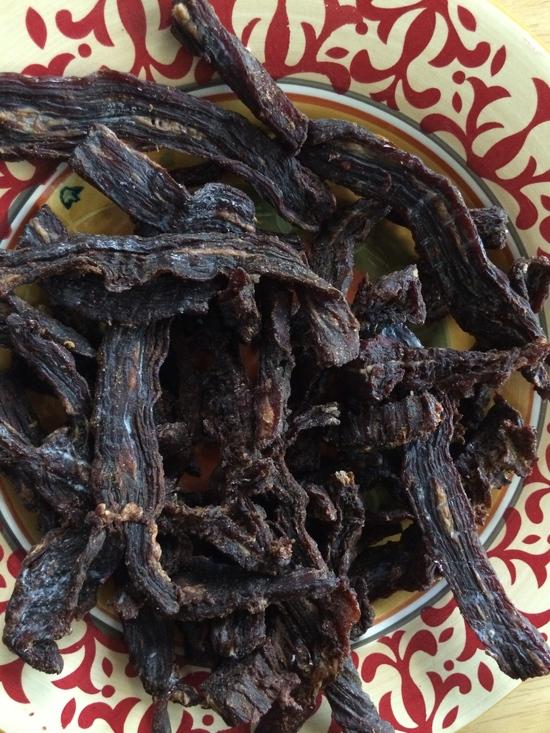
Here is what my jerky looks like:

jerky

It tastes great! But I'm concerned that all that fat on there (and there is a lot of fat – the stuff is bone dry, but it's still kind of greasy to handle) is just not going to make it sitting around in a Home Depot bucket at MTR for a month. My gut tells me to leave it in the fridge and just enjoy it – and try again to make jerky I can send in my resupplies.

Thoughts?

PostedJul 11, 2014 at 5:56 pm

Listen to 'your gut' Jen.

If you don't, you'll feel bad about that jerky all the way trough your hike and it won't taste too good (even if it is okay)… mind tricks, you know…

Billy

David Moreno BPL Member
PostedJul 12, 2014 at 2:07 am

I've been making jerky regularly for about 15 years (up to 100 lbs per year wet weight). I make 6 different recipes and give it out as gifts because everyone pesters me for it all the time.

I regularly store the jerky for up to 3 weeks in a vacuum sealed bag.

Two schools of thought here:

1) Get the leanest meat you can from just about any part of the cow, remove all the fat humanly possible, marinate and dehydrate. While it's dehydrating, use paper towels to blot off the grease bubbles that form a few times. Half way through the dehydrating process, flip them and then blot the other side the same way until done. Then vacuum seal into bags and keep in the freezer until you need it put into your food resupply. You can add a desiccant pack if you'd like, but it's not normally necessary.

2) Once all the possible fat is cut away, use a hand crank grinding machine to make ground beef. Dehydrate / blot / flip as in example (1) without marinade. Then put it into a colander and run under hot water while stirring it. This will remove most of the residual fat. Then put it into your marinade until it reconstitutes. Then put into the dehydrator again until done. Once done, vacuum seal it and place into the freezer until you need it put into your food resupply. Again you can add a desiccant packet if you'd like.

With the first method, I've had it packed away in a resupply box for 2 1/2 weeks before use in summer weather with no problems. This was without desiccant. It has a harder texture as you would expect.

With the second method, I've also had it packed away in a resupply box for 3 weeks before use in summer weather with no problems. Again without desiccant. It has a softer, chewier texture as you would expect. It also has more marinade flavoring because of being ground beef and being reconstituted in the marinade before the second dehydrating.

I have never had a problem with it going rancid with any of my recipes.

Hope this helps.

Edit: P.S. It's less expensive and more effective removing the fat yourself. Only you truly know and care about how thorough the fat removal is.

PostedJul 12, 2014 at 5:48 am

Jen — looks pretty typical flank steak to me. It usually has a layer of fat running though it.
Sometimes I cut it out.

You can always try salmon. Slice at an angle, it holds together better fish!

Monty Montana BPL Member
PostedAug 2, 2014 at 8:00 pm

Story: Back in the day, my uncle Avalino, who lived in adobe and had no electricity, would cut up a deer he had shot into strips…fat, connective tissue and all. Then he'd marinate in in plain brine overnight. After that, he'd hang the strips outside on the clothesline. With clothespins! And the strips would hang in the hot wind, sun and flies of the Arizona desert for several days until they were stiff as a board. I gar un tee, that was the best jerky I've ever had! And it lasted all winter without getting rancid.

Story: Back in the day, after moving to Montana, we'd get pemmican from the Blackfoot Indian Reservation just outside Glacier National Park. Now pemmican (real pemmican, that is) is made from ground venison jerky or bison, bear grease and serviceberries (Amelanchier alunifolia). At first glance, you just might think they were road apples. But they were the ambrosia of the gods, and so rich, because of the fat, that they sustained the plains Indians through thousands of Montana's brutal winters.

Now: So I make jerky. To honor my heritage I use lamb. City people get all pissed if you shoot a bison. And it's greasier than all get out. Which is the point. Jerky made from lean beef will have a composition of about 13g of protean and 1.5g of fat. Not a whole lot of calories. My lamb jerky probably has 10 x the amount of calories. Really saves the day on a frigid winter slog. And that's really the point isn't it? More calories per unit of weight?

Viewing 15 posts - 1 through 15 (of 15 total)
Loading...