Topic

MYOG Kayak Question

  • This topic is empty.
Viewing 13 posts - 1 through 13 (of 13 total)
David Drake BPL Member
PostedJun 15, 2014 at 12:49 pm

I've got it into my head that I want to build a touring kayak. At first, I was thinking of cedar strip construction, but started reading about skin-on-frame boats and was attracted to the lightness and overall aesthetic, combined with relative low cost and speed of construction.

Disclaimer: I have very little paddling experience–this would be a project where I'd essentially be building a boat and then learning to use it. However, I'm a pretty fair woodworker, and manage a large, well-equipped shop, including CNC router with 96" x 48" bed. Because of my shop's capabilities (and to serve as a demonstration project for my design students) I'd like to incorporate some elements of digital design and fabrication in the process.

So far, I've picked up a couple of books on the subject, including 'Building the Greenland Kayak' by Chris Cunningham, and 'More Fuselage Frame Boats' by Jeff Horton. Any advice from BPLers with experience in building or paddling a skin-on-frame kayak would be great, including input on the books I already have, others I should be looking at, good web-based resources, etc.

James Marco BPL Member
PostedJun 15, 2014 at 2:58 pm

I build mostly cedar strip boats. That said, I went through the same basic process as you with the learning. I was a novice and still am in many ways. Learning to paddle anything more than quiet water, class 1 and maybe 2 rapids means instruction. One is generally currented water with few obstructions. 2 has some obstructions and maybe some short sections of fast broken water. Stick with the flows and enjoy the ride.

SOF boats are not really designed for faster water anyway. They can be vulnerable to punctures. Small boulders, tree's & logs set up strainers with pointed obsticals, sharp rocks and shale bits can really tear up a SOF boat. Bring plenty of duct tape.

Cedar strip boats are a bit more reliable. It will take a good bang to puncture the hull. But, they scratch easily. Plan on doing at least minor epoxy work every spring. They can also be fairly lightly built. My last one was a canoeyak about 19 pounds including seat, foot brace, spray decks (silnylon & cord) paddle and life vest. I thinned up everything, the strips were 1/8" to start. After fairing inside and out, closer to 1/16 overall. Then I used aircraft grade satin weave cloth, 3.1 or 3.2oz/yd, 1 larger football, 1 smaller football on the bottom, 1 full skin outside, and, 1 full skin inside. The other boats I build have about 700mi-2000mi on them with no problems, other than a new gell coat to remove all the bloody scratches. I also use 1/8" (paracord) as the "skid" plates front and rear to protect the skins. They last about 500-1000mi based on my other boats. The bow and sterns take most of the landing or lining damage, so it really pays.

Overall dimensions are about 13'6" to about 13'9" and 26" to 22" wide…a bit less at the waterline. They are speedy little designs, however, can have a tendancy to wander or yaw with each stroke, because they are shorter and I use a 9'6" paddle. I use about 1/2" of negative rocker to offset this tendancy. They cruise at about 4-6 mph with light touring effort. Normally, I can paddle 4-6 hours nonstop and have put 35 miles a day plus hiked(portaged or carried) about 10mi with them. Say Old Forge, NY to Tioga Point Camp Ground on Raquette Lake, NY in one day. (Getting too old to enjoy that though.) I have crossed Lake Champlain with one. They work.

You can use the Kayak Design Program: http://www.blueheronkayaks.com/kayak/software/software.htm

Tim Marshall BPL Member
PostedJun 15, 2014 at 9:03 pm

James,

I'd love to see your boats. I'm currently designing a 13'6"-13'8"/26-29" solo sit on bottom double blade paddle pack canoe. I'm shooting for sub 20# in a composite layup but at 19# in a strip boat my interest is certainly peaked. Gotta show off some pics.

-Tim

James Marco BPL Member
PostedJun 16, 2014 at 2:07 am

Tim, Well, I am leaving this morning for the NPT. I will try to remember to get some, I keep loosing the ones I have…(not really, they never seem appropriate, most are scenery shot from inside the boat.) I will try to remember when I get back in a week or so. If I forget drop me a line at: jdm27@cornell.edu

David Drake BPL Member
PostedJun 17, 2014 at 8:17 am

Thanks, James. I'm actually a little overwhelmed at the amount of information on both SOF and strip kayaks out there. The design software you linked to looks interesting–I plan on downloading it in a few days and trying it out.

I'd also be interested in seeing pictures of the last boat you built.

PostedJun 20, 2014 at 12:04 am

Take this with a grain of salt, but I'd probably try kayaking with a cheap wallyworld kayak before I jumped head first into building one and then learning how to kayak. Been kayaking for a while and it can get a bit scary if you don't know what you're doing. Worst case scenario, you build something beautiful and it ends up as a conversation piece.

PostedJun 24, 2014 at 7:38 pm

Given your wood working experience I'd go for the cedar strip. I've built a cedar strip (nick schade deign Night Heron) and a plywood kit from Pygmy Boats (arctic turn). Both are easy to build and great boats. I would NOT design your own boat. Kayaks are more complicated than you think and he designers that I mentioned have decades of experience get fora hills that perform well in real world conditions. Naval architecture is a field unto itself. Good luck.

PostedJun 28, 2014 at 9:10 am

If you build it, you will learn to paddle it. DO NOT buy one from costco, wallmart, or home depot, for your soul will forever be scared.

As a lifelong and uber-elite paddler, I would just caution you to consider your athleticism: if you are a super athlete, use any dimensions that you want, but if you are a weekend warrior, make it fat and short. Wide boats are stable, and short boats are easy to turn (lots of rocker, not a flat bottom tip-to-tip, also helps with easy turns).

Also, Skin on frame boats are tougher to learn to paddle in because the materials are not as forgiving as a solid boat would be.

Sounds like you have access to an amazing shop, HAVE AT IT!!!

James Marco BPL Member
PostedJun 28, 2014 at 9:20 am

OK. I got back last Monday but the weather was pretty lousy. Nice day today so I will dig out the boats and take a few pics for you guys.

James Marco BPL Member
PostedJun 28, 2014 at 9:53 am

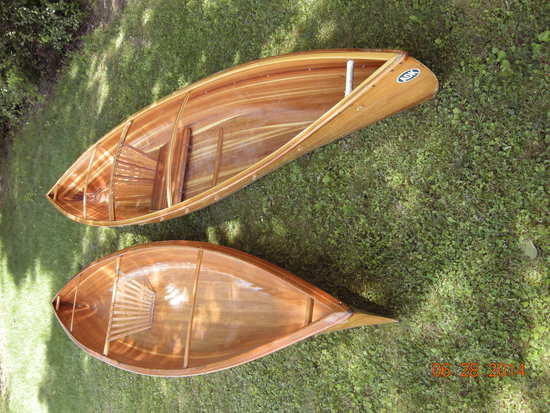
OK, Here are two pics:
Two Boats, 12'6 and 13'6

Note that the older one has a LOT of miles on it. It went on the NFCT with me and was across Lake Champlain. This is the one without a seat. It is 28" at the gunnel and 23" at the waterline. This one is fairly stable with the paddler sitting on a 1" cushion on the bottom.

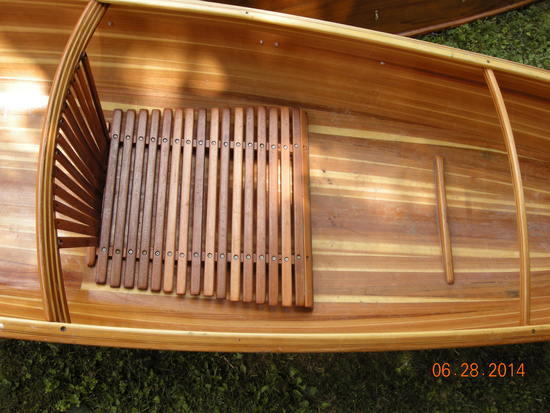
The other boat is my latest. It is 26" wide at the Gunnel and about 19" wide at the waterline. That one goes like hell. Only the bottom seat makes it stable enough to paddle. It has a small "heel" foot brace. I use a 9'6" double-paddle with it.

Seat and Foot Brace

Both have been down class 2 whitewater and have a fair ruggedness.

PostedJul 3, 2014 at 6:10 pm

Beautiful Indeed!

Works of Art.

And that you are willing and able to take them into the woods is outstanding.

Viewing 13 posts - 1 through 13 (of 13 total)
Loading...