A friend urged me to post my recent experience of a dog injury requiring medical attention while in a remote wilderness location. I am apprehensive about doing so because I know there are a lot of people who don't like dogs, many more who like dogs but won't backpack with them, and a good many who love dogs and take them backpacking, but keep them leashed at all times. I am sure to hear criticism for this post.
But for those who hike with a dog off leash in remote regions … this story is intended to help you learn from my experience, and my mistakes.
First, I would like to explain why my dog was off leash, as this led to her injury. She is nearly always off leash in the back country. I hike over rocky, mountainous terrain with significant changes in elevation and use trekking poles to reduce joint strain. With both hands filled, and a pack on my back, I don't compromise my balance any further with a leashed dog. She comes when called and doesn't chase deer, the usual wildlife we see. A buck charged her once on our rural property and she now leaves deer alone. I carry a leash but rarely use it.
Second, for those who wonder, my base pack is 9 pounds which includes a rather generous first aid kit. My dog's underarms chafe with her Ruffwear pack, so when she goes I carry another couple pounds of dog gear and several pounds of kibble, so for this 3-day trek, I was packing a total of 17 pounds when the injury occurred.
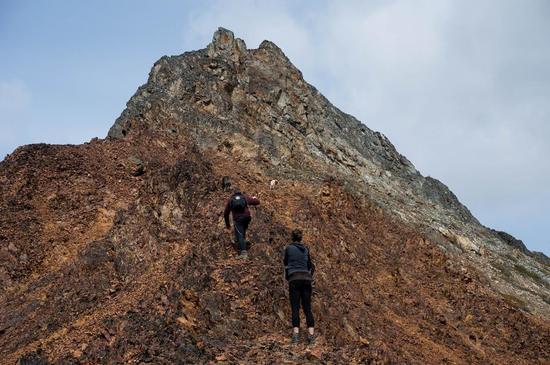
Our destination was beautiful Emerald Lake in southwest Colorado, pictured below. My dog and I hiked in 7 miles the afternoon before and camped that night near the Emerald Lake trailhead, 8 miles and 2000 feet below our destination, to get an early start. The trail up is exposed and by mid morning promised to be hot and sunny, with a sketchy water supply for about half its route. Although I can knock back a liter or two of water before setting off, my dog won't. We got up early and hit the trail by 6 am.
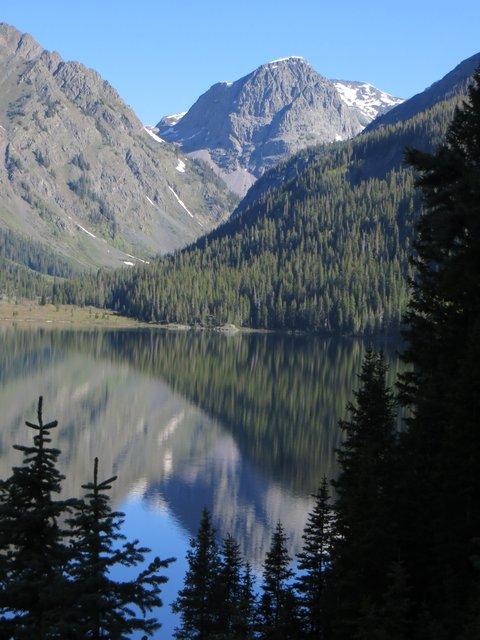
We stopped for a morning snack at 8:45. By then we had reached the summit of the trail and overlooked the lake below, but were still three miles short of our campsite. Camping is allowed only before the lake or a half mile beyond it, and I chose the more distant camp. As we sat, a bald eagle soared overhead hunting for the cagey trout this lake is famous for among local fishermen. I scanned the surface for signs of an insect hatch or circular ripples from trout feeding. I planned to hike back to the lakeshore in the afternoon with my fly pole.
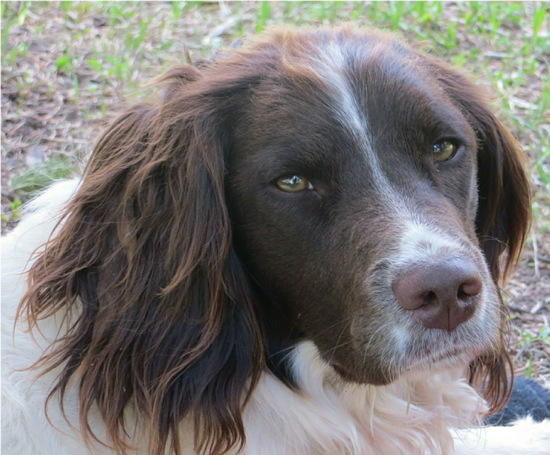
The woodlands along the lake had a tremendous number of snowshoe hare wearing their gray summer coats, with large velvet black ears and white stockings. I had never seen so many. And neither had my dog, Heidi, a 42-pound, two-year-old English Springer Spaniel bred to flush small game. She took off several times wild with scent, but always came back when called. After one jaunt she came back with a short whine and held up her left paw. I inspected the paw on both sides but saw no injury and put it down again. She immediately padded off without a limp so we continued on.
Ten minutes later she turned to face me and I saw blood on her chest. We stopped for a better look. She had a hole in her upper chest, so deep I could not see the bottom of it, with an apparent organ exposed, glistening in the dappled sunlight under the pine trees. This was surely a puncture wound from a fallen log. Impalement injuries are common among dogs that hunt or run in fallen timber and are very often fatal. But in this case, my dog was still very much alive and still hiking.
The trail was steep and muddy from overflowing side streams. It was too dirty a spot to treat the wound. A meadow was in veiw about 1/4 mile ahead so we pressed on before starting treatment.
Just before the meadow, we came to a 20-foot wide stream crossing, about 18 inches deep of slow moving water. Without thinking I climbed on a log to cross but Heidi had no choice but to swim. She cried as the cold water flushed her wound, and I was filled with sudden remorse for not carrying her across. I later learned this stream crossing was a blessing but didn't know it then. I carried her over the next two stream crossings, getting shoes and socks wet, until we came to a clean, dry grassy opening.
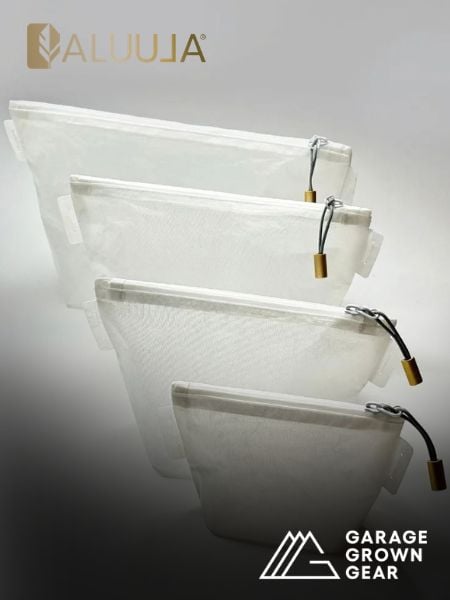
On the meadow, I opened my ditty bag and pulled out supplies. An antibiotic pill I carry for bladder infections, an 800 mg ibuprofen from which I broke off one quarter, a summer sausage to stuff the pills in, antibiotic ointment, sterile wipes, a cuben fiber sink with a sliver of bar soap, a small nailbrush, a clean kerchief, a clean water bottle, a small sewing needle, a small pair of scissors, and a length of Gutterman Tera 60 "unbreakable" polyester thread I carry for backpack repairs.
The pills were stuffed into chunks of summer sausage. Heidi eagerly took the first chunk into her mouth and before she could think about sorting out its contents, I offered a second bite of empty sausage to chase the first one. In this manner both the antibiotic and 1/4 ibuprofen pills went down quickly. She was then served a bowl of water which she lapped up.
By the way, I now know dogs shouldn't take ibuprofen at all, as they easily ulcer. The pain med prescribed for her by the vet when we got home was Tramadol, 50 mg 3x a day. Tramadol is a bit worriesome too as it is a narcotic similar to morphine and dogs should not chew into the pills, as the rapid release of this narcrotic could kill a dog. If you carry Tramadol, be sure your pet (or human patient) swallows it whole. I gave the ibuprofen believing it would help her relax during the treatment, and rest later, both of which were probably true, but that choice of pain relief meant she had to take additional medication to prevent an ulcer when she got home.
While she sat down beside me, I scrubbed up by pouring clean water into the cuben fiber sink I carry for toileting. I scrubbed my nails, then rinsed, and poured a second batch of clean water in the sink to soak the clean handkerchief. The soaked kerchief was then pressed against my dog's wound repeatedly while she stood upright, so that it drained downwards away from the wound. I feared her "bottomless" wound exposed her chest cavity and I did not want to introduce fluids into this space.
I now know it was not a chest cavity puncture, and how to tell the difference. A chest cavity puncture would have wheezed as the lungs filled and emptied and air escaped the from the wrong hole. Since her wound did not make any sound, it was probably (and actually) a deep muscle tissue wound instead, and therefore should have been thoroughly flushed out. With rare exception, a wound should be thoroughly flushed in the field with clean filtered or treated water.
There are, by the way, several good ways to irrigate a wound in the field. I could have flushed it out using my Sawyer pump backwash syringe. Or I could have filled a clean ziploc bag with water, snipped a corner, and the squeezed the water into the wound with a forceful stream. I also carry a water bottle cap with holes punched in it for a back country shower, and it would have worked too, screwed onto a soft plastic bottle or bladder. In this case, Heidi's painful stream crossing was, in hindsight, fortunate, as it was the only deep wound washing she really got.
I made sure the needle was threaded and knotted. Then lubricated the needle and thread with antibiotic ointment to help it glide more easily through the flesh.
I now know I should not have put a knot in the thread. I am not a medic of any sort and had never sutured before and did not know how to tie a suture knot. My plan was to sew her up with an overcast stitch, sometimes used to hem a skirt. I hope that readers of this post will, instead, visit youtube and search for "how to tie suture knots" – the Snareman videos on "interrupted sutures" and "running sutures" are both very useful for treating deep cuts in the field. After watching that video, I found I could replicate the suture method using tweezers I always carry, and it was also possible to tie the same knots with fingers only, if the thread is long enough.
It was time to sew up my dog.
I put my supplies within arm's reach, got down on my knees, and seated Heidi on her rump between my thighs and knees, belly facing slightly upward, and her back pinned snugly agains my chest with my left arm. I inspected the wound more closely.
The break in her skin was about as round as a golf ball. Inside on the left side of the gape, near the midline of her chest, was a deep puncture about 3/4 inches across that appeared bottomless, and on the right side of the wound, bubbly tissue that the vet later told me was subcutenaceous fat and not, after all, an organ. Hers was a deep puncture of the chest muscle.
My breath was shallow and fast, a sound my dog must have associated with "this means business" for she lay her head on my right shoulder and remained motionless during the entire stitching procedure.
I clipped the hair around the wound with a small pair of nail scissors. I have often thought my inventory of sharp objects is excessive for light backpacking – a small pocketknife, single edge razor blade, and these 0.3 oz scissors, but in this case I was very grateful for the familiar action of the scissors while snipping hair and suture thread so close to her wound.
I used a couple sterile wipes to wipe down the flesh and hair stubble outside the wound. I contemplated using some alcohol from my stove kit, but feared it would sting, and my dog might fight free. I now know that neither the chemically treated sterile wipes nor alcohol were particularlyy good choices as they might get inside the wound, and any additional washing should have involved only clean water. Alcohol can kill the very cells needed to heal the wound on the inside, and could result in dead tissue around the sutures. So I'm glad I did not get out the stove kit.
I lifted the needle and thread with my right hand. My left arm still pinned Heidi near my chest but my left fingers were free. My left fingers lifted the skin on the right side of the cut perpendicular to her chest. I held my breath, then pushed the needle in. She didn't wince.
I pushed the needle all the way through, but it caught about 1/4 inch down the thread. I hadn't noticed a very tiny knot in the thread close to the needle. I clipped the thread off, removed the needle, rethreaded, and started over. While it was a bad start, I did learn that a small knot was likely to hold.
The running stitches went in fairly cleanly and evenly over the next 15 minutes. I put a few stitches in and gave the thread a slight tug to pull the skin just close enough together to meet in the middle without bunching up. All the while my dog lay motionless, head tipped back over my right shoulder. She seemed to have dozed off except I once muttered the word "okay" to myself out loud, and she thought that was a release to scramble up. I had to tell her "no, not yet" and she lay backwards again.
When I came to the end of the wound, about an inch and half of stitches later, I had no idea how to tie off. I tried and tried to tie an overhand knot, but the knot didn't cinch up against her skin. So I finally tied about 20 overhand knots and they eventually bunched up enough for skin contact. Again, look at the suture videos on youtube for the proper tie-off method.
I swabbed the entire wound area heavily with antibiotic ointment and released her. I didn't try to put a bandage on her as I doubted it would stick to her hair anyway.
She was ready to hike again. I put my supplies away and we walked the last 1/4 mile beyond the no-camping area to set camp. I carried her over three more streams to keep the wound dry. By 11:30 our camp was set and she was sleeping on a silk bag liner under a pine tree. I pulled out my first aid instructions from my kit and read that, for shock, I ought to keep her warm. So I put a dog coat on her and pressed a sticky-backed maxi-pad inside the dog coat to soak up small amounts of blood still oozing from the wound. I carry a couple maxi-pads in my first aid kit just for blood wounds.
At this campsite we were about 16 miles from the parking lot.
We rested two hours and I began to get cold feet about camping out a second night. What if the antibiotics were no longer effective? I didn't remember how old they were. What if she were too sore the next day and unable to walk out? I couldn't carry her. What if I sent a Spot signal to my husband asking for help? I knew he would send out rescue troops who don't do dog rescues, and that such operations often result in $50,000 or more in charges.
About 1:30 pm gray clouds formed overhead and strands of precipitation trailed down from them. If the thunderstorms forecasted for the weekend arrived a day early, then my dog might get soaked, and she would be in worse condition. I decided we had to head home. We broke camp and by 2:15 began a slow hike out, this time with Heidi leashed the entire route and my trekking poles folded into my backpack. She acted perky but frustrated by the restraint when a grouse came in view, and then another hare, and countless butterflies.
Hiking out, I met a surgical nurse who inspected the wound and said the stitching was a good job. He commended most of the treatment except the ibuprofen, and urged me to get to a vet as soon as possible. I made Heidi drink at every stream crossing and fed her more summer sausage to keep her strength up during the long walk home. She refused her dry kibble, and I was afraid filling up on dry dog food might dehydrate her anyway.
I kept trying to count off the miles from one landmark to the next. We picked up our pace when the trail leveled off. We reached the car at 8:30, just about dusk. I didn't have cell service at the remote trailhead, but at home again 45 minutes later, made arrangements with a 24-hour vet service. Heidi was in the vet's office by 9:45 p.m. There the doctor told me her heart was fine, her lungs were fine, she was properly hydrated, and she didn't even have a fever! He explained she did not, after all, have a chest cavity puncture as I had feared. He explained that in about 25-50% of such wounds, there is wood debris left inside if the wound hasn't been thoroughly irrigated, which will result in an abscess after the antibiotics expire. But he said the stitches were fine and the wound looked clean. She was in remarkably good shape given the depth of the injury, the first-timer's suture effort, and the long hike home after injury. He didn't see any clear reason to take the stitches out and start over. He prescribed a 14-day course of strong antibiotics (Clavomox), the pain killer Tramadol (see precautions about this drug mentioned above), and an anti-ulcer course of Famotidine (Peptic AC) because I gave her the pain reliever ibuprofen. He told me to take out the stitches in 10 days. Thankfully there is a youtube about suture removal too.
A couple days later that first improperly tied knot came undone. I tried to retie it but the tail of thread was just too short, and as the wound became bruised and swollen on Day 2, my dog wasn't any longer keen on me working it over. Fortunately the wound had closed and did not reopen. I kept the loose end of the string matted down into her fur with twice daily rubs of antibiotic ointment so she can't pull at it. The wound is drying now and looks healthy. She is off the Tramadol and has resumed her domestic duties. We won't know if any wood chips were left in until the antibiotic course finishes in another week.
I hope this long story helps someone else hiking with their canine friend learn from my experience and mistakes. For my part, Heidi is out of commission for backpacking for another 6 weeks. In the future, I will put on the leash when temptation strikes, even if it means slowing down the hike and putting my trekking poles away. A dog pack is also useful by providing some chest protection against sharp sticks and by slowing down a dog eager to flush game. I've learned a brand of dog pack called Wolf Packs is not as likely to chafe her underarms. There are other products used expressly for hunting dogs that more resemble chest armour which can be used also to avoid impalement injuries.
_____________
(Edit – One Week Later) Heidi has been to her regular vet now. He said the wound is healing nicely. A good analgesic for dogs on the trail is Rymadil, although I believe it is still a prescription med for which you will need your vet's recommended dosage. He also said … if it is possible to keep a wound clean and if you are within 18 hours of medical treatment, then the wound suturing can wait until you get home, as the delay won't affect the suturing results. Suturing in the field, if the pet allows it and if the wound is clean, is fine and what most medics would do with their own dog. However suturing up your friend's face is a different matter, as you are likely to do a poor job of it, and that wound is better off left open. He explained that impalement wounds to the chest from sticks aren't classified as the same sort of injury as a puncture wound caused by a nail or bite. The former wide-diameter wound may be stitched up but the latter wound should be left open to drain. Finally I asked about suture thread. I had used the same thread I carry for backpack repairs, a stout polyester thread purchased from DIY Gear Supply called Gutermann Tera Tx 50. It is an acceptable "non-absorbale" suture thread that must be clipped out later, but because it isn't sterile, the antibiotic ointment used as a lubricant was a workable solution.