Topic

Aqua Mira Recanting Numbers – about 5 drop with the USP droppers

Viewing 24 posts - 1 through 24 (of 24 total)
Marko Botsaris BPL Member
PostedJun 9, 2014 at 7:06 pm

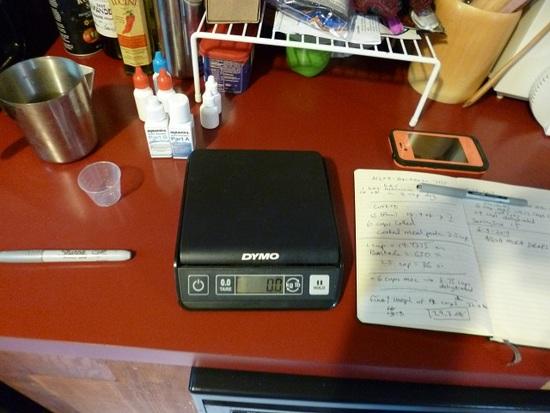
Someone probably figured this out before, but I couldn't find any references here. I was noticing some inconsistencies between the drops per oz I was getting from my US plastics dropper bottles and what Aqua Mira was claiming. I was pretty sure the explanation was that drops from the Aqua Mira bottle were smaller. It would have been much less time consuming if I simply had a pipette, but I determined that 1 oz has approximately 880 drops from the Aqua Mira bottles and 680 from the US plastics bottle. So that makes AM's assertion of 30 gallons = 120 quarts per set of 1 fluid oz AM container about right. So the amount you need to recant can be based on this. More importantly this mean that the instructions for using AM with the US plastic should be NOT to use not 7 drops of A and B but 5.4 drops (I plan to use 5 in the Sierra). Anyway, since I am actually going to get a decent pipette now, it should be pretty easy to decant and use AM depending on how many quart you plan to purify during your trip.
am

M B BPL Member
PostedJun 9, 2014 at 7:22 pm

Very interesting.

Because your #s are opposite mine, and others.

I found about 10-11 drops/liter needed of each for AM recipe. From MLDs website (who resells the bottles), they found the same:

"NOTE
The mini bottle drop volume is different from the stock Aquamira bottles. (7 drops per Liter is recommended for the heavier stock AM bottles.) These smaller bottles produce a smaller drop than AM bottles. About 11 to 12 drops for these smaller mini bottles is needed per liter. You should test your mini dropper bottles drop volume VS the stock bottles and make the volume conversion yourself. We do not warrant the exact dropper size.

May depend on your bottle size. Im talking about 10ml bottles. The 3ml is about the same.

Marko Botsaris BPL Member
PostedJun 9, 2014 at 7:34 pm

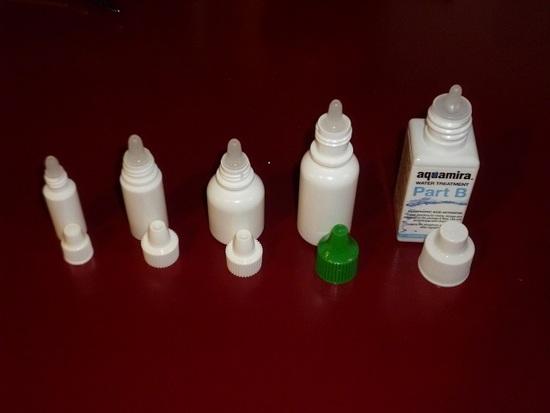
As you can see from the picture I am using the larger USP dropper bottles, but is not a subtle thing when you pay attention – the hole in the USP bottles I am using are obviously bigger than the AM bottles – all you have to do is look. If you look at the holes in the bottles you are referring to I'm sure they are smaller.

I wouldn't even put it past USP for different lots to have different dropper parts. I have some of the smaller ones, but the ones I bought have hole bigger (not smaller) than the AM bottles as well. As I recall I had to buy the dropper parts separately and put them together.

I bought mine directly from USP. MLD maybe bought different parts, or possibly from an entirely different company. Anyway, "easy" enough (though boring) to check yourself for a given type of bottle.

PostedJun 9, 2014 at 7:57 pm

Way back when…. I was trying AM, I used a scale that measured hundredths of a gram ($10 on Amazon).

It was easy to measure out 28 AM drops, then count drops from the new bottles to get the same weight, and divide by 4 to get the drop count for a liter.

PostedJun 9, 2014 at 8:42 pm

You noted that your drop sizes are larger from the USP bottles, but what size are you using? They make a 3cc, 6cc, and 10cc. My order, containing 2 of each size, comes tomorrow, so I'm very interested in your answer.

PostedJun 9, 2014 at 9:21 pm

When I did tests on drop comparisons between the US Plastic mini-droppers and the stock AM bottles it came out to be the same as the BPL article recommendations of 7 drops AM dropper = 11 drops from USP. I wonder if they have changed their manufacturing specs? Keep us posted on what your final conclusions are, thanks!

PostedJun 9, 2014 at 9:28 pm

IMHO, if you are serious about your water treatment, you need to calibrate your bottle set, especially from a bulk vendor.

If you are of the "30 minutes is good enough" group, it probably doesn't matter.

HYOH, YMMV, etc….

Marko Botsaris BPL Member
PostedJun 10, 2014 at 1:02 am

"Way back when…. I was trying AM, I used a scale that measured hundredths of a gram ($10 on Amazon)."

I would gladly pay the $9.95 on amazon to get back the time I spent counting drops. Thanks for the tip. The super accurate scale I had in my lab back when I was doing biophysics cost about $4k so it never occurred to me to look for a cheap one. Nice.

Unless you had some way to measure the diameter of the holes in your droppers – and I'm sure if there was one it would be way more expensive – I think that is the quickest way.

Marko Botsaris BPL Member
PostedJun 10, 2014 at 1:08 am

"You noted that your drop sizes are larger from the USP bottles, but what size are you using? They make a 3cc, 6cc, and 10cc. My order, containing 2 of each size, comes tomorrow, so I'm very interested in your answer."

The ones I tested are all bigger than that. Closer to 1/2 oz and 1 oz. They have a lot of dropper bottles and options on the USP website.

A lot.

M B BPL Member
PostedJun 10, 2014 at 3:26 am

I dont think its the hole size that matters really, its the dropper tip size and shape.
Surface tension keeps it adhered until the droplet weight overcomes it.

If you tilt the bottle to the side , you can get a slightly different result than if you keep it vertical as well.

I use half the AM recommended amount most of the time. Im not worried about treating, as much as I am not running out prematurely.

The larger bottles have much larger tips I believe. Always test your setup.

PostedJun 10, 2014 at 5:53 am

I had one of those duh-oh moments last night after re measuring my AM kit! You add 7 drops of each AM, part A 'AND' part B, so the ratio is 14 drops total from the original AM bottles to 11 drops from the USP. I did it with 3cc and 6cc bottle. I don't have anything extremely precise, so I just count drops and use the gradients on a very small medicine dispenser cup I saved for the purpose.

Marko Botsaris BPL Member
PostedJun 10, 2014 at 8:30 am

"so the ratio is 14 drops total from the original AM bottles to 11 drops from the USP."

Ah, OK! The way I measured it was 5.4 EACH part. Especially exact if you premix the chemicals Mike Clelland style in the morning:

https://www.youtube.com/watch?v=BAoy3VC3uy8

Then you would use 11 of the MIXED using my droppers, so looks like we are on the same page after all.

"I dont think its the hole size that matters really, its the dropper tip size and shape.
Surface tension keeps it adhered until the droplet weight overcomes it."

Yes. It depends on all those things and more, and you would need to test the actual drop from a bottle to get the answer. But all other things being equal the larger holes will have bigger droplet, especially if it is the same type of plastic. Its not the flow rate per say but the boundary conditions on the 2D surface of the droplet at the hole/tip. The larger the ring at the tip the heavier the drop can be before it overcomes the surface tension with the tip. Based on that I'd guesstimate that the volume of the drops is about proportional to the diameter of the hole/tip. For certain shapes of tip the drop may form on the tip more that the edge of the hole, as you pointed out.

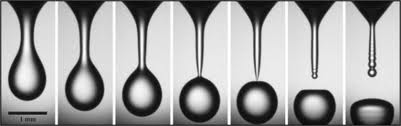
It is a complicated business – a colleague of mine many years ago published a paper in "Science" on the mathematical singularities created in the fluid during drop formulation. (LOL, too much time on his hands? Maybe.) When the drop snaps off slow enough then there is the big drop and a series of tiny little drops that will form in its wake when its "tail" breaks off. Hopefully we at BPL will not need to account for this effect. :-)

d

PostedJun 10, 2014 at 9:55 am

"…a series of tiny little drops that will form in its wake when its "tail" breaks off. Hopefully we at BPL will not need to account for this effect. :-)"

The partial vacuum created in the dropper bottle as the liquid volume is decreased will draw the "tail" back up the tip to be incorporated into the next drop. So, nothing to worry about.

Caution: Hip boots advised to navigate this post…..

Gary Dunckel BPL Member
PostedJun 10, 2014 at 10:48 am

I would think there would be differences in drop sizes for different bottles. Your particular bottles should be calibrated individually. A pretty easy way to do this is to count the number of drops of AM-A it takes to fill your smaller bottle to the neck of the bottle (which allows you to re-insert the dropper tip without spilling any on the counter). Then count the number of drops it takes to squirt it back into the original AM-A bottle. Do the same exercise for the AM-B. When I did mine a few years ago, I learned that it took 190 drops from the original AM bottle to fill up my smaller bottle (which were the ones BPL sold in the Gear Shop, I think). It took 245 drops to empty the little bottle back into the AM bottle. The numbers were almost exactly the same for both the AM-A and AM-B liquids, which was handy. Maybe 1-2 drops different, if I remember correctly. Unfortunately, I can't find that super-detailed official document now–it seems to have gone the way of many of my errant/wandering sticky notes.

So for me, the 190:245 ratio of drops translates very closely to 7:9. 9 drops from the small bottles equals 7 from the original ones. It's pretty easy for me to go from there, and mix up a day's worth for 6 liters in a third small bottle–6 x 9 = 54 drops of each liquid. Then each individual liter will require 18 drops of the mix. Done.

Bob Bankhead BPL Member
PostedJun 10, 2014 at 11:50 am

Respectfully, why make it so hard on yourself? We don't need no stinking science experiments!

You have decided to use Aqua Mira to treat your water, so just carry the little square AM bottles.

Mix as required.

While you're waiting for the mix to react in the little cup, sit down, take off your shoes and socks, put your feet up, and relax.

After the 5 minutes (or when the strong yellow color appears), treat your water.

Repeat if you're treating more than one liter. Otherwise, continue your rest break. Have a snack or a full meal.

When done, put on your spare, cleaner socks and your shoes.

Before leaving, rinse out your dirty socks (but not in the water source). Alternatively, rinse them once, then put them in a ziplock bag with water and 2 drops of Dr Bonner's soap. Seal and shake ( aka trailside washing machine). Empty and rinse well away from the water source.

Tie them to your pack (aka trailside dryer) and continue on your way.

Repeat as needed.

Marko Botsaris BPL Member
PostedJun 21, 2014 at 4:23 pm

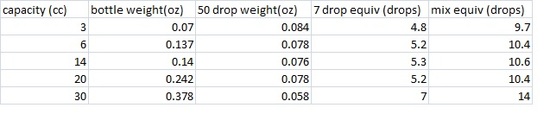
FWIW, here is a table of the results on 4 different dropper bottles from US Plastics and the comparison with the Aqua Mira bottles, and purification instructions. Here are the bottles:

b

And here is the table:

c

Left to right on the picture is top to bottom on the table. You can convert the units to your preferences as desired.

Long story short, when using the decanted A and B use 5 drops per each, not the 7 you would use using the original AM bottle as per instructions, and if you premix use 10 or 11 drop of the mixed rather than 14 of the mix made using the original bottles.

One last useful conversion factor to know might be this: Amount of A and B (each) required to purify 1 liter 0.00812 oz/liter or 0.25 cc/liter. You can use that to help fill your bottles before a trip, either using a scale or by volume with a syringe.

Happy to contribute one more drop of anal retentiveness to the sea of anal retentiveness on here. Not sure what the conversion factor on that is. :-)

Edit: for those wishing to "wing it", at least in comparison to getting it down to the right number of cc, assuming 5 liters per person per day, the number of days (per person) you would be covered with a pair of bottles of each type would be 2.4, 4.8, 11.2, 16, and 24 days respectively. You're welcome.

Bob Gross BPL Member
PostedJun 21, 2014 at 4:36 pm

Within one microliter, how many angels can dance on the head of a pin?

After you mix, and after you pour that into the raw water and shake it and let it stand, you finally drink it. Do you taste the chemicals?

In the old, old days, we used to use iodine crystals. Then that got objectionable with some people. I've owned and used a half-dozen pump filters. Now a gravity filter seems to work fine, and I only carry a few Chlorine Dioxide pills as a backup (which I never seem to need).

–B.G.–

Marko Botsaris BPL Member
PostedJun 21, 2014 at 4:43 pm

Short answer: it only matters when you are trying to divide up 2 orders of Aquamira into 6 different unequal resupply packages in such a way as to make reasonably sure you don't run out on any segment.

As to the why of that…who knows.
Because I can,
I suppose.

I have somehow managed just fine for the last decade or more with AM without knowing any of this – or caring. But now that I have it down to an art it must be time to abandon AM altogether and switch methods. :-o

Randy Nelson BPL Member
PostedJun 27, 2014 at 8:30 pm

"While you're waiting for the mix to react in the little cup, sit down, take off your shoes and socks, put your feet up, and relax.

After the 5 minutes (or when the strong yellow color appears), treat your water.

Repeat if you're treating more than one liter. Otherwise, continue your rest break. Have a snack or a full meal.

When done, put on your spare, cleaner socks and your shoes.

Before leaving, rinse out your dirty socks (but not in the water source). Alternatively, rinse them once, then put them in a ziplock bag with water and 2 drops of Dr Bonner's soap. Seal and shake ( aka trailside washing machine). Empty and rinse well away from the water source."

Or I could just dunk my water bottle in the stream, take the mini-bottle of pre-mixed (I mixed that morning) Aquamira from my pocket, squeeze in the drops, and be on my way. Since it takes the same amount of time to get to the stream and get the water in the bottle no matter what way you fill (except pump filters), I'm curious as to how much faster your method is than squeezing 10 or 15 drops into a bottle? 10 seconds? You must change socks fast! :)

M B BPL Member
PostedJun 28, 2014 at 3:23 pm

To muddy the waters,

AM changed the dropper tip on their bottles recently, as seen in the picture above. That is different from the old dropper tip. The old one was solid white and had a squared off tip with a tiny hole. Sometimes it took some real squeezing to get drops out because the bottles were stiff.

Ive been buying larger 2oz bottles and havent noticed this before. I gave my daughter my last 1oz set to take to Honduras with her on a mission trip, so I just ordered another to have enough for a trip. Bought last fall, it had the old tips.

But they did not change the # of drops recommended.

The problem is, their new tip, is apparently producing smaller drops . It now is essentially the same # of drops as the boston bottles, or close enough. For 40 drops of each I got basically the same wt, 1.4 g.

It USED TO take 10-11 drops from the boston dropper to equal 7 from the AM.

So, either AM changed the concentrations (doubtful), or their newer dropper tips will be undercharging by about 1/3, or their older tips were overcharging without their knowledge or concern.

Such are the reasons AM liquid is not an EPA certified water purifier.

PostedJun 28, 2014 at 3:49 pm

M B (livingontheroad) said above –

Such are the reasons AM liquid is not an EPA certified water purifier.

From the AM web site:
“EPA Registered Water Treatment….. Aquamira Water Treatment (EPA Reg. # 717660-1)

Did they lose their registration?

M B BPL Member
PostedJun 28, 2014 at 6:04 pm

You will notice that it makes no mention of viruses, and cysts like giardia and crypto. As far as I know, it still does not meet EPA qualifications for a water "purifier" as the tablets are. compare the wording between the two. If my memory is correct, controlling dosage accurately was part of the difficulty in getting it certified as a purifier.

Bob Gross BPL Member
PostedJun 28, 2014 at 6:22 pm

"compare the wording between the two."

Do you discern any difference between qualification, certification, and registration?

The whole chemical treatment of water is kind of a statistical crapshoot, anyway.

–B.G.–

Cristina L BPL Member
PostedMay 9, 2026 at 2:25 pm

What an excellent and thorough analysis! Perfect for the biochemist in me. Thank you so much!

Viewing 24 posts - 1 through 24 (of 24 total)
Loading...