Topic

New Product: Vectrawire Cord-Introductory Sale

  • This topic is empty.
Viewing 17 posts - 1 through 17 (of 17 total)
Lawson Kline BPL Member
PostedJun 5, 2014 at 3:14 pm

I recently introduced a new cord called Vectrawire. It is a 2.5 mm 16 strand single braided cord that’s is made from super strong low stretch Vectran Fiber. This cord is suitable for all types of applications including bear bagging, tent guy lines, tarp ridge lines, and anything else you can can think of. Vectran is not slippery like Dyneema/Spectra so it does a better job of holding knots. Other features include its much higher melting temp (625F), yarn on yarn abrasion resistance that is 10x more than Kevlar and 2x more than Dyneema, as well as cut resistance that is 3x more than Dyneema and Kevlar. Its basically the super fiber no one has ever heard of… Well I am sure everyone on BPL has, but most “normal” folks haven’t… If your not familiar with it NASA uses it in spacesuits, on rovers for airbag landings, and in all sorts of cables.. The only downside is the ends cannot melt together so its best to use a knot, heat shrink tubing or dip them in wax.. The cord has a break strength of 850 lbs, weighs 1.60oz per 50′ and like all of my products its proudly made in the USA. I am are offering the cord at introductory pricing of $12.50 for 50′ and $20.00 for 100′. Once this first batch is gone the pricing will jump up to normal. I didn’t make a ton of it as I wanted to see how it sold.

Thanks,
Lawson

LawsonEquipment.com

vectrawire

Rick Reno BPL Member
PostedJun 5, 2014 at 4:26 pm

Just can't have enough rope, knives, and lights, eh?

I'll report when I've actually touched it.

Roger Caffin BPL Member
PostedJun 5, 2014 at 5:03 pm

> How do you cut it?
I find ceramic scissors work reasonable well.
Failing that, really heavy and sharp fabric shears – I mean with a really heavy blade and pivot.

Two words of warning about this stuff:
First, it is very strong and very thin, but hanging on to it under load can be painful on the hands! It can cut! For this reason it is NOT usd for climbing: you could not belay with it.
Second, it has a higher UV susceptibility than nylon for the first few hundred hours. Protect it from extended harsh sunlight and you are fine.

Cheers

Lawson Kline BPL Member
PostedJun 5, 2014 at 5:28 pm

Yeah its pretty tough stuff… As far as cutting goes. A sharp knife will work just fine. I can cut it with both my factory edge benchmade and spyderco.. So a knife with a good factory edge or one you sharpened yourself will have no sweat.. Sharp scissors also work fine. But I own some sharp high quality ones… No ceramic. Never even tried those. I mean after all I had to cut it into 50' and 100' hanks : ) They say a hot knife will melt it, but mine doesn't get hot enough. So I guess in theory you might be able to melt the ends on the metal on like a grill or something like that….

As far as cutting your hands….While I am sure this is possible with these small super cords I make, this cord is 2.5mm in diameter so its pretty "thick".. Atleast thicker than my glowire and irownire. I have been using it for over a month now with no issues at all and have hauled some heavy bags up a tree..

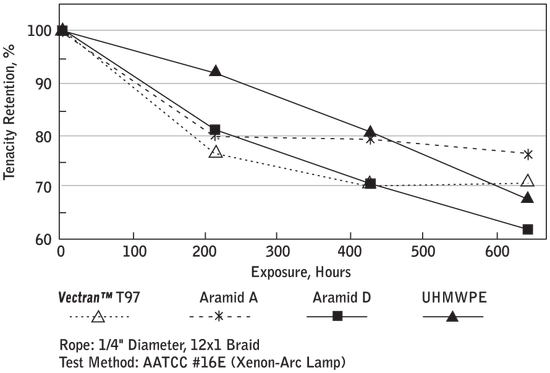
As far as UV goes. Roger is right. It drops off pretty quick like other aramids but over the long run, it levels off and then stays the same forever…. According to Vectran Company the UV is better than Dyneema/Spectra after extended use..

Here is a graph..vectran uv

Bob Gross BPL Member
PostedJun 5, 2014 at 5:38 pm

Some cords have no stretch. Others have a lot of stretch. Some are resistant to UV light. Some are slick, and some aren't. Some are easy to hold a knot. Some are hard to cut. Some are subject to fraying. Some are heavier than others. Some are reflective.

For what application do you think that this cord seems perfect?

–B.G.–

Lawson Kline BPL Member
PostedJun 5, 2014 at 8:19 pm

I would say any application that requires high strength and low stretch. Basically anything you would use the Ironwire for..

PostedJun 5, 2014 at 8:40 pm

Any possibility of getting some cord with Vectran core and polyester outer? Seems like it might solve some of the issues.

Lawson Kline BPL Member
PostedJun 5, 2014 at 10:33 pm

Yes. I agree. It solves some issues. Only problem is, it also adds cost and weight and really doesn't add much strength. I am loosing about 350lbs in the braiding process so if I could get the braid where the poly works with the vectran then maybe it could be stronger using the same amount of fiber. Problem is, if you want to call it that, Vectran has almost no stretch. Less than Dyneema and also no creep. Polyester on the other hand has about 10-13% stretch so the fibers don't really work together. Its the reason climbing ropes are made from 100% nylon or 100% poly. It helps the fibers to work together. Be a team so to speak. For instance. If I were to braid my Glowire out of 100% Polyester using the same denier fibers it would actually be stronger than the nylon jacket/dyneema core I am currently using. But it would have more stretch… Is this a bad thing? Some say yes, some say no…. That said, I am working on making a few more prototypes of a Poly Jacket/Vectran Core. Kernmantle construction like my glowire.. So we will see how it pans out. I hope good as it would be a really awesome cord as well. But there will be tradoffs with this cord as well so it wouldn't replace this one. Just merely be another product/version.. I hope all this makes sense.

Matt Dirksen BPL Member
PostedJun 6, 2014 at 7:01 am

Hi Lawson,

Since you also sell the Ironwire, what do you see as a primary advantage of Vectrawire over the Ironwire?

I would assume one might be a better tool for a certain kind of use than the other, but at this point, I cant "see" the difference between the two. And Ironwire is lighter, right?

thanks,

Matt

Ryan Smith BPL Member
PostedJun 6, 2014 at 9:04 am

Vectran is some mean stuff, but I didn't know it stacked up so well against dyneema.. That's impressive. If it's easier to tie knots with Vectran that is certainly a plus over dyneema for me.

P.S. – A lot of hammock hangers use Amsteel. I wonder if they might find some good uses for this.

Ryan

PostedJun 6, 2014 at 10:53 am

I think Amsteel is like dyneema and spectra, made out of UHMWPE material.

So it's properties should be very similar to dyneema and spectra.

Ryan Smith BPL Member
PostedJun 6, 2014 at 10:56 am

"I think Amsteel is like dyneema and spectra, made out of UHMWPE material. "

Correct.

Ryan

PostedJun 6, 2014 at 11:22 am

Amsteel-Blue is Dyneema, with a proprietary urethane-type coating from Samson. It now comes in other colors. "Blue" is sort of like branding.

The coating reduces snagging and helps with knots.

PostedJun 20, 2014 at 4:16 pm

Anyone try this stuff out? How well did it hold a taut-line hitch for you?

Lawson Kline BPL Member
PostedJun 23, 2014 at 3:49 pm

Hey Tim,

I just sent you this as a PM but figured I would post it to the form too so other people could make use of it. Basically the problem with a tautline hitch has less to do with the slipperiness of the cord than its construction as Vectran is far less slippery than Dyneema.. Coreless cords like the Vectrawire are hard to do a tautline hitch with since the cord has nothing in the core to stop the compression and they are less knobby or more smooth because of the looser braid pattern so it just compresses and lets the whole thing slide. I have found that you can throw an extra loop up top and down below and it can help out a bit… Give it a try and let me know.

Thanks,
Lawson

Viewing 17 posts - 1 through 17 (of 17 total)
Loading...