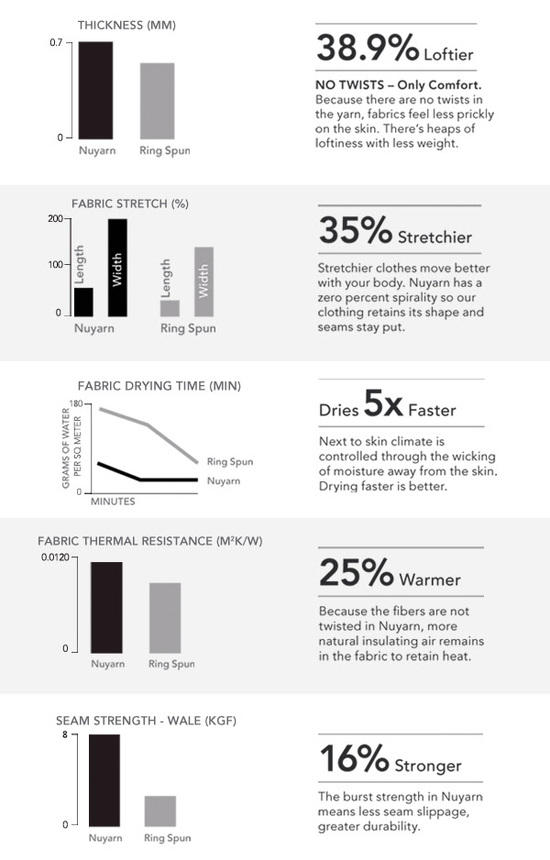
Seems like all the downsides of merino have been fixed with this Nuyarn technology by The Merino Company. Its nice to finally see it land stateside.
Topic
Become a member to post in the forums.
Seems like all the downsides of merino have been fixed with this Nuyarn technology by The Merino Company. Its nice to finally see it land stateside.
A nylon core, wrapped with small caliber merino wool.
Lots of claims. Who's testing? What brand is this compared to? Smartwool and Ibex and Icebreaker all use different weaves.
Sounds a bit like P T Barnum to me.
Apart from that, it's just another wool blend – but with LOTS of spin.
Cheers
The only downside of standard merino is it's cost.
Will this stuff be less expensive?
I thought not.

I disagree. Full merino is crap in several significant ways. The extent merino blends have had widely variable success, and even the best (meco 120) still haven't kept the benefits of wool without un-ideal durability. I'm glad someone is still trying.
I understand the skepticism. But did any of you watch the video or read the independent test results from Agresearch.
Here is a PDF of those test results.
Stuart thats the great thing about Kuiu’s business model. They are able to keep the prices down due to being consumer direct. I think if you took a look at the prices you would be pleasantly surprised.
Would be nice if all the product images on the website weren't broken … :-)
Else we have no cool merchandise graphics to offset our clinical skepticism.
EDIT: looks like this was my own issue, DNS related. All better now. Cool graphics are offsetting.
> the independent test results from Agresearch.
Forgive me, but the idea that a company with a name like Ag(ricultural) Research would generate genuinely independent results for Kuiu over an agricultural product is a stretch of the imagination.
But then the drug companies have all these wonderful test results for their latest drugs too. Well, the tests they disclose look good, anyhow.
Lipstick …
Cheers

I have mixed thoughts. I think they are moving in the right direction but… 15% nylon isn't going to add that much durability to a predominantly wool garment, nor speed up the drying time much. Also, the whole thing about not twisting the wool fibers.. that probably would speed up the drying time some, but it certainly will decrease the durability of the wool fibers. Twisting wool fibers is one of the main ways of how you get wool to become more durable because an individual fiber is fairly weak, especially so when wet.
If they really want to increase durability and dry time they should take the above yarn with a nylon core/wrapped in merino, and then combine that with polyester, polypropylene or a combo in an intimate weave. Say something like 25% polypropylene and 15% polyester, or 40% polyester, or 40% polypropylene, or any similar mix or singular synthetic provided it's in a similar ratio of total synthetic.
So you end up with a fabric that will have a ratio mix of 45% total Merino to 55% total synthetic (including the 15% of nylon core).
Based on reviews of OR's Lumen balaclava and ubertube, which uses 35% Merino to rest synthetic, or some initial reviews of Alpacor products (17% Alpaca mixed with some tencel and predominate synthetic), it seems you don't need a lot of Merino (or Alpaca) fiber to get some of the benefits of animal protein based fibers (odor reduction and warmer while wet).
45% Merino should be enough, and if the rest is synthetic, and the Merino has a nylon core, should significantly increase the overall durability and better the dry time. If they did something like that, would buy one of their baselayers in a heart beat. But personally, if one isn't going to twist the wool fibers, then they are better off using Alpaca fibers which have a higher tensile strength per individual fiber. Alpaca seems to be also a bit warmer and dry a bit faster and wick a bit better (probably because of the noticeable pockets of trapped air in the fiber).
Become a member to post in the forums.
 © Beartooth Media Group Inc.
 Loading...