Topic

Knees hate me going downhill

  • This topic is empty.
Viewing 25 posts - 1 through 25 (of 30 total)
Ian BPL Member
PostedMay 12, 2014 at 6:12 pm

(Looking at you Jen… get in here)

I don't have any old knee injuries to speak of. I've found that my knees feel fine going uphill and on the flats regardless of mileage. Downhill, not so much.

Part of the problem is that I'm overweight which I'm addressing with diet and exercise with much success. I also hike with trekking poles.

Yesterday I felt great climbing a bit under 6k' but coming back down (3k' of which was glissading), my knees were screaming at me. This problem took me off the Wonderland early last year as I descended to Indian Bar from Cowlitz divide; a mere 900' if memory serves.

I'm trying to think of knee strengthening exercises above and beyond extensions, curls, squats, and leg presses.

Dale Wambaugh BPL Member
PostedMay 12, 2014 at 6:40 pm

See a physical therapist with a sports orientation. That way you will get good balanced exercise and avoid doing more damage than good. It's worth every penny. Your doctor may be able to prescribe it and your insurance can help pick up the tab.

+1 on getting the weight off and using trekking poles. Keep it up!

PostedMay 12, 2014 at 6:43 pm

Ian, you have a muscle imbalance. Specifically weak hamstrings. I had the same issue a few years ago.

Weighted squats and leg curls.

PostedMay 12, 2014 at 6:54 pm

"See a physical therapist with a sports orientation."

+1, cause they will look at everything.

We, here at BPL, will just tell you what was wrong with us ;-)

So, give us something to do…

Pain where?
Tapping on your patella?
Below your patella?
On the outside side of your knee below the joint?
On the inside above the joint, and maybe under the top inside edge of the patella?

By the way – you got these?

VMO2

M B BPL Member
PostedMay 12, 2014 at 6:56 pm

I got to a point where I had quit running (got lazy) , and just did cardio machines for a while. It was a good workout. Note that I have lifted weights continuously since I was abut 16. I have no weak muscles.

Then eventually I had knee pain and ITB issues that caused me to bail out of a trip after 87 miles,. I sensed my knee tendons were weakended, so I started running again. That and doing ITB stretches. I know I have lost elasticity and can strain muscles easier as I have gotten older.

At first, running hurt my knees (tendons around them). First confirmation that this was the problem, they werent used to the repetitive stress anymore. I had to rest them several days after running a mile or two. After a few months, I had worked back up to running on daily basis, no knee pain. No problems hiking high miles since either.

Im still careful on downhills though, lower wt slowly onto downhill foot, dont drop it.

Ian BPL Member
PostedMay 12, 2014 at 7:10 pm

Greg,

Can't really say and fortunately the pain was gone before lunch today (even without Advil as the bottle is lost in my mess of a truck) but the pain was all over both knees and it'd be difficult to say one portion of the knee hurt the most. As far as to what you're pointing to on your knee, yes.

Right now I feel great to go out and do it all over again but am worried about taking on a multi day adventure that includes 4-6k' of elevation loss per day which is where I want to be.

Dave,

Thanks I'll start working on those more.

Dale and MB,

Also thanks. Edit to add: I've been running 5 miles, three times a week without any joint pain whatsoever. Slowly adding to the mileage over time.

PostedMay 12, 2014 at 7:46 pm

Okie Dokie Ian…

when it hurts your knees to go down more than up, then the problem DEFINITELY lies in your hips and your ability to control what your femur is doing during a complicated loading process. When you go DOWN, you have to contract your muscles (which should shorten them…), but by going down you are actually lengthening them. Think of lowering a heavy box and what your biceps are doing.

The little rotator muscles in your butt help control how much your femur collapses inward during this downward stepping.

Your kneecap is actually embedded in your quad, so it isn't going anywhere. The problem actually lies in the femur rotating UNDER the kneecap…thus leading to a ton of bad loading through the patella and into the groove of your femur.

SO….

The key here is to strengthen primarily the abductors and external rotators of your hip. How do you do this? you ask…

Well – I've written a grand total of like 2 articles on my blog (backpackerPT.com), and one of them happens to have the best exercises to do for such a condition. It's super common, but the big giveaway is the downhill complaint.

Let me know if you have any questions…….

Ian BPL Member
PostedMay 12, 2014 at 7:54 pm

Awesomeness! I'll start adding that to my exercise regimen. Other than lunges, most of those exercises will be new to me.

PostedMay 12, 2014 at 8:07 pm

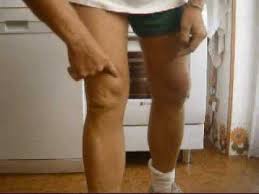
Here's a great photo that illustrates what happens when your hip muscles aren't strong enough to control the rotation and frontal plane stability of the pelvis during the very demanding eccentric step down. Pay attention to what's happening at the knee:
step down

What makes this so important is that the compression forces generated at your patellofemoral joint (the kneecap's articulation with the femoral groove) are astronomical in this bent-knee position when you are standing up. So couple the completely wrong alignment of the kneecap with the huge compression force – ta-da. Serious pain under the kneecap and eventually a wearing away of the cartilage underneath.

Bob Gross BPL Member
PostedMay 12, 2014 at 8:25 pm

I've told this story before, but it looks like it is time for it again. Once in 1983, I was doing the Mount Everest Basecamp trek. Back in those early days, trekkers did not fly into Lukla and then start walking. Back then, we had to start walking overland about seven or eight days before we passed Lukla, so we had to go over five river drainages and five high ridges. By the second or third day, some of the trekkers had very sore knees. They were in a lot of pain, plus they were slowing down the entire group progress. Our wise Sherpa leader talked to us. He pointed out the typical way that Americans walk down a hill. They go too fast, with their knees extended fully at the point of heel impact. The impact force is transmitted directly through the knee joints, and the knee starts to swell after that. So, our Sherpa told us to walk like a Sherpa. The Sherpa people have been walking those hills almost since birth, and they don't get much in the way of knee problems because they have adapted their downhill gait. First, they flex their knees slightly, and this lowers their center of gravity to improve balance. They walk in a wider stance (slightly bowlegged) and this also improves balance. They walk with a shorter stride length, but with a quicker cadence. The shorter stride length is kind of offset by the quicker cadence, so you still get down the hill in a timely fashion. By having your knees flexed slightly, more of the impact is onto the quadriceps instead of the knee joint. Well, muscles can get sore also, but they will recover faster than a sore knee joint. Muscles will get stronger.

We practiced walking like a Sherpa for a while and then took off again going downhill. By the fourth or fifth day, there were no more knee complaints. The trick is in knowing or feeling how deep to go into this. If the hill is gradual, you don't need to adjust much. As the hill gets steeper, you go deeper and deeper into the Sherpa walk. Try it.

–B.G.–

Ian BPL Member
PostedMay 12, 2014 at 9:49 pm

Great stuff Bob! I'll try it next time.

Bob Gross BPL Member
PostedMay 12, 2014 at 9:58 pm

Ian, for some walkers, the Sherpa walk is very easy to slide into. For others, it is not natural at all. If you practice it enough, you will remember to use it for the steep downhills, and the depth that you use it will become automatic.

–B.G.–

Ian BPL Member
PostedMay 12, 2014 at 10:07 pm

Apples to oranges but I'm trying to run striking the ground with my mid-foot after running for years with a heel strike. I'm all for whatever works and am not opposed to trying something new. I believe one of my problems last year in the 900' descent to Indian Bar was the stairs. The run of them was long enough that I couldn't walk down them in a normal cadence so I ended up doing a step-shuffle-step where, without thinking about it, I kept stepping down with my left foot. My right knee was the one that crapped out on me. I've had sore knees before from overexertion but it never rose to a level where I had to adjust my plans so the Wonderland incident really caught me by surprise. I'll put all this advice to good use and hopefully avoid a similar situation in the future.

Jennifer,

Thanks again and really appreciate your second response as well.

PostedMay 13, 2014 at 2:30 am

For Ian and anyone else trying to improve their running form or learn a more mid foot strike, one of the easiest ways to do that is to increase your cadence to 90 strides/minute (single foot contact…or 180 foot strikes if you count L and R). What this does is shorten your stride, minimize contact with the ground (and avoid your knee collapsing in like that nasty photo above), and leads to a more natural mid foot strike.

Quite a few studies on this…we use it all the time in the clinic to rehab runners.

That'll be $475 from each of you, please.

PostedMay 13, 2014 at 4:02 am

I’m certainly no PT expert, but it seems to me that long days of hiking, whether up hills or down, is more of an endurance exercise than a sprint. So muscle building would seem to lean more towards building slow twitch fibres, rather than fast twitch. Strength training with heavy weight for low reps is how to increase fast twich fibres, so it would stand to reason that high rep/low weight training would be better for hiking. Endurance begets endurance.

I always see squats mentioned as a common leg training methodology, but it’s always with weight. Seldom do I see the 100-squat-a-day method mentioned. I could ramble on about the benefits of doing even 50 “proper” squats a day, but I’d encourage just trying it and see for yourself. Stamina, ROM, flexibility, endurance, etc. And no cheating! No weight, just stay flat footed and get your butt down well below your knees! Squatting on your toes is actually called a “western” squat, because we lack flexibility from sedentary lifestyles, although I’m sure no-one here has that problem ;-)

Graduating to doing them with a full pack is the next logical step of course, then upping the reps to 200, 500, or more… or so goes the claims of the movement. Me? I’m still aiming for the full 100 fast squats in a row. I’m getting close now, but it’s a lot harder than I’d imagined it’d be!

PostedMay 13, 2014 at 4:17 am

Or if you'd prefer dubious advice to professional advice…I happened to run across a site last night on hiking with arthritis that recommends sticking to loop routes instead of out and back because that way you can plan things to be going up more than down.

Presumably the author is stranded on top of a mountain somewhere now.

PostedMay 13, 2014 at 6:47 am

"So muscle building would seem to lean more towards building slow twitch fibres, rather than fast twitch."

You can enhance what you've got, but it is Really hard to change the ratio of Fast vs Slow.

Marko Botsaris BPL Member
PostedMay 13, 2014 at 7:01 am

Wow Mike! Its amazing the great ideas you can get surfing the net. Please let us know if you find any loop routes like that. Going gently down hill the whole way would be AWESOME! ;-)

But on the cadenced thing – I'm usually about 60 per single foot, but I have noticed in videos of Andrew Skurka that he take really fast seemingly shortish steps. I wasn't even at all interested in his gate, it just seemed to pop out a few times.
Or maybe it just seems fast to me.


@Bob
I had never head that story so actually thanks for telling it again. I have one surgically fused ankle, apparently with leftover parts since my right leg a bit shorter that the left, and have been designing and redesigning the lift shape and height on that side for years. Recently I have been trying different shape rocker to relive some stress on my not-so-flexible foot, but I was just noticing the past week that this design causes that knee to tend to lock – bad. I have noticed over the years that the one really great rule for that lift (for my knees as well as my ankle) is that it needs to insure that knee is a bit bent through the stride, even to the extent that the lift is a bit too high. I guess I will try to mod them back a bit, and then additionally try to channel my inner Sherpa as you suggest.

PostedMay 13, 2014 at 9:01 am

Was just about to start a smimilar thread myself, my knees have been sore all spring after a long ice climbing trip in January. Been seeing a PT a couple of times but haven't seen any real improvement. Lots of the advices here seem to target the hip and back of the leg muscles instead of the quadriceps which I was to told to train mainly through excentric contractions. Will try that instead and hopefully see some improvements.

Jannifer: How often do you recommend doing the excersises you outline on your blog? And should they be done to failure like normal strength training? I currently train ~3-5 days a week at the gym and run and climb a couple of times a week in addition if that makes any difference.

PostedMay 13, 2014 at 9:18 am

Bob, that's both great advice and a great story to follow!
Would you say that this 'Sherpa step' uses a more mid foot stride when going downhill, or heel-toe? It seems like mid foot is often the better option, but I am just curious for this particular method of going downhill.

Bob Gross BPL Member
PostedMay 13, 2014 at 9:38 am

Mid-? Heel-?

I don't know.

When I walk that way, my toes point slightly outward, not straight ahead. I think my feet hit kind of flat.

I guess each individual needs to adapt it to individual needs.

Sherpa people tend to be somewhat smaller than Americans, yet they are stronger. They spend their lives carrying loads up and down steep trails that would cripple an average lazy American.

–B.G.–

Jerry Adams BPL Member
PostedMay 13, 2014 at 9:49 am

Or maybe keep your feet flat? Land on middle and take off on middle? Do not rotate your foot?

Bob Gross BPL Member
PostedMay 13, 2014 at 9:57 am

Jerry, all I know is that I don't want to take off on the bottom and land on the top.

–B.G.–

PostedMay 13, 2014 at 1:45 pm

It's pretty old school to train the quads – all I know is that unless you just had surgery or some kind of frank nerve damage, your quads are totally fine. Most of us are quad dominant and have super weak hamstrings and gluteals…when people have knee problems, or ITB, or ankle, etc we try to de-emphasize the quads and work almost exclusively on the hamstrings and the glutes. Even squats are done trying to preferentially recruit the hamstrings and glutes.

of course, like any medical specialty, you'll have plenty of folks stuck in the 1980s and want you to strengthen quads, or VMO (vastus medialis obliquus), but study after study has long ago debunked such things. But practice patterns are slow to die and people are loathe to give them up – BECAUSE THEY KNOW IT WORKS!

But I digress….

Those exercises on my blog can be done daily, or at least every other day. Try to exercise to fatigue…then do 2 more.

Viewing 25 posts - 1 through 25 (of 30 total)
Loading...