Topic

Clothing for desert hiking

  • This topic is empty.
Viewing 25 posts - 26 through 50 (of 52 total)
PostedMay 14, 2014 at 4:51 am

"Buy white and size up."

"So why do the Bedouin wear black in the desert?"

Interesting points. I did search for this and both for white and black there's an explanation, but no single explanation that does put the arguments for white and black against eachother and explains which is the most important one. So, anybody ?

One thing that I already can make up: choose something loose and airy.

jscott Blocked
PostedMay 14, 2014 at 9:37 am

Sun Precautions–I think I have that right–makes clothing from Solumbra; lightweight and 100% spf. They make a great drape hat that works terrific for mosquitoes as well. It's larger than the usual drape hat and can be easily adjusted on the go to cover more or less of your face–that's why it's great for skeeters, you can cover up over your nose if you enter a cloud and then 'unzip' it completely off of your face if you want. Again, 100% spf. And loose and airy.

Cotton alone–like a bandana–isn't that good for keeping sun off; it pretty much just penetrates. But this last is a surprisingly controversial assertion. So YMMV.

PostedMay 14, 2014 at 10:52 am

"So why do the Bedouin wear black in the desert?"

Not all wear black, some wear lighter colors. Perhaps it's more a matter of social/tribal distinction, rather than sheer practicality?

Humans in general are not known for sheer, or holistic practicality in all things we do or don't do. You can see this in many different cultures in many different ways.

Our western culture is filled with such examples, like high heels for women. Why on Source's earth, would any one subject themselves to such a convention that causes damage and discomfort to the body? Not practical in the least bit.

What i do know is that, there has been a HUGE difference when i've worn very dark and very light colors in the Sun during a hot day. Perhaps you would feel it less with more insulation underneath, but no thanks either way. What i could see as being more practical in the desert is to wear a thin, breathable black layer next to the body out of cotton that hugs same, and then over same some white or light colored, loose, flowing linen clothes. This would provide a lot of Solar UV and heat protection, as well as minimize moisture loss.

Many modern day Islamic men whose ancestors come from more desert like conditions, tend to wear a lot of linen or cotton that is long, flowing and loose, and often lighter colored. Just check out one of these online clothing stores that cater solely to people of the Islamic faith.

Linen use to be popular among ancient Egyptians, as well as ancient Hebrews. Sure the latter like other Middle Easterners wore wool often, but linen was especially commonly used by royalty, the wealthy, and the priesthood.

If we look at only one section, we get a limited view.

Nick Gatel BPL Member
PostedMay 14, 2014 at 10:54 am

"So why do the Bedouin wear black in the desert?"

Who knows, and why would we assume it is for weather protection. Might be tradition, ancient beliefs, the only dye available, doesn't show dirt, easy to locate lost people in the desert, etc. Why do Americans drive on the right side of the road and many other countries on the left?

Marko Botsaris BPL Member
PostedMay 14, 2014 at 11:58 am

With all due respect, its not why they "all" wear black. Which they do not. The question was why anyone would EVER wear black under those conditions. Which they DO. Apparently under the right circumstances (loose black robes) it works, contrary to what you might think on first blush since black should be a bit more efficient in converting the solar to local heat. I merely pointed out, as an interesting aside, that some nutty physicists had actually analyzed the problem and come to some physics-based conclusions. They could be all wrong, but a set of trite observations about cultural differences doesn't begin to address their conclusions – namely that the whole point might be the heat differentials created in these garments, under the right conditions could suck air flow up the wazoo like a chimney. Or at the very least cause some pleasant convection.

Could very well turn ou to be one of those "birds in a van" type myths however as far as efficacy goes. I mean I read Dune, and that is NOT how stillsuits work! Also can you imagine how much Patagonia would charge for a set of black "desert trekking" robes?

Dave @ Oware BPL Member
PostedMay 14, 2014 at 1:35 pm

Tested this one. Black plastic tarps, given a 3 ft air gap, are cooler than white plastic or the thin space blankets. They make darker shade. However, wearing it near the body wouldn't allow that insulation of air.

Michael L BPL Member
PostedMay 14, 2014 at 1:55 pm

"Why do Engligh and some of their former colonies drive on the right side of the road and nearly everybody else on the left?"

FIFY.

On the desert clothing. I prefer long sleeves/pants for sun protection. But then I hate sun block. Offers more protection from bugs/thorns too.

d k BPL Member
PostedMay 14, 2014 at 2:15 pm

I found to my surprise when trekking in Nepal that a black umbrella blocked WAY more of the sun's rays than a light colored umbrella of similar construction, and was much more comfortable in the sun. I would guess that the loose fitting black robes may work in a similar fashion.

PostedMay 14, 2014 at 2:25 pm

Well, no actually. Black absorbs the heat of the sun … but also that of your body. That heat is then carried away by the wind and that's also the reason why black clothes should be loose and airy.

David Thomas BPL Member
PostedMay 14, 2014 at 2:37 pm

My physicist BIL pondered my Chrome Dome which is silvered on top and black on the inside. While the silvering on top helps keep the umbrella temperature down, the black underneath radiants more of that umbrella's heat to the human than a silver liner would.

It is at this point that everyone starts arguing which factors dominate and tries to apply different heat-exchange formulas to the situation. When really what is needed is a field test of different configurations. My best guess is that the Ray Jardine's space-blanket loose liner in a standard umbrella is the best solution for being cool, although more it's fragile.

I'm happy with my Chrome Dome. It is reasonably light, packable, and it feels noticeably cooler underneath in full sun at 8,000 feet. I'd order another when they next go on sale, but they want more for S&H than for the umbrella.

PostedMay 14, 2014 at 2:37 pm

A test of desert garb was done back in 1980 and published in Nature. The result was “it doesn’t matter”. While the black robes had triple the heat gain of the white, the air temperature underneath the robes remained the same. It was thought that there might be greater convection (bellows/chimney effect) under the black robes to balance out the numbers, and also mentioned that if so this might increase a feeling of comfort as well.

Jerry Adams BPL Member
PostedMay 14, 2014 at 2:42 pm

"Black absorbs the heat of the sun … but also that of your body"

It does absorb the heat of sun, because most of it is in visible wavelength, which makes it seem black to us.

The heat of the body is mostly in IR, because the body is much colder than the sun. Fabric that is white or black in visible wavelengths actually both absorb IR about the same.

I like Greg's theory though, about black fabric absorbing sunlight, so getting warmer, which then causes more air currents, which could also carry away some body heat. You have to have an air space between fabric and body though.

Dark colored fabric tends to provide better sun protection. The dye absorbs UV so it doesn't reach your body. But white zinc or titanium dioxide absorbs UV good so it just depends.

PostedMay 14, 2014 at 3:10 pm

I know that study but it was almost directly critised. And apparantly they asked the wrong question. Black can be a slight disadvantage in heat but, more importantly,is much better in preserving heat e.g. at night or in the winter which can be crucial to survive.

Mark Fowler BPL Member
PostedMay 14, 2014 at 3:24 pm

I am not going down the science route, just personal experience and I don't know any Bedouin to ask. Walking around in temperatures around 35-40 C I find a loose white polycotton business shirt more comfortable than a similar dark coloured one.

PostedMay 14, 2014 at 3:34 pm

Oh, I prefer also a loose, white top, but it's also my nature to try to understand the teoretical side. So I always try to understand the theory and then put it into practice. And if something doesn't work, try to understand why. So it's constantly going back and forth between theory and practice.

Gary Dunckel BPL Member
PostedMay 14, 2014 at 3:58 pm

I asked my Saudi neighbor when I lived there why the men wore white and the women covered themselves with the black abeyas. He told me, "We like it that way."

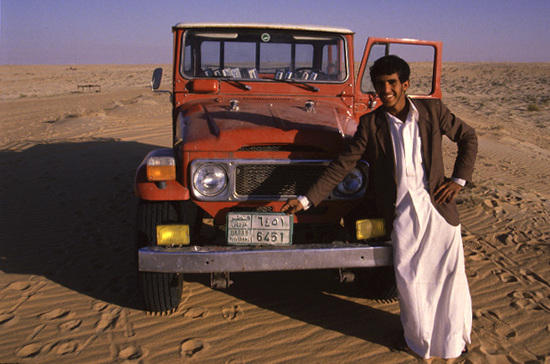
Most Saudi bedu men (and the city guys) wear white, like Abdullah here (it's winter, and he wears a sport jacket over the robe for warmth):

Abdullah

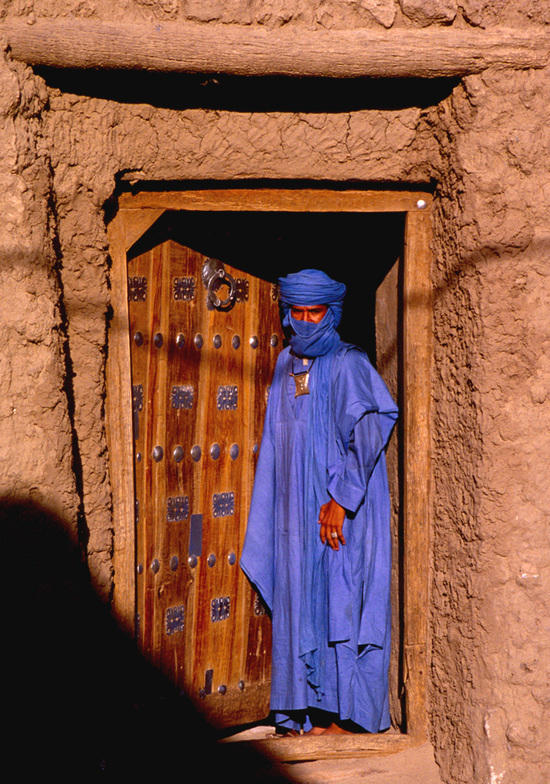
But in other areas of the Middle East, and the Sahara, they choose different colors. Here's a Taureg in Timbuktu, wearing one of their preferred azure robes:

Taureg

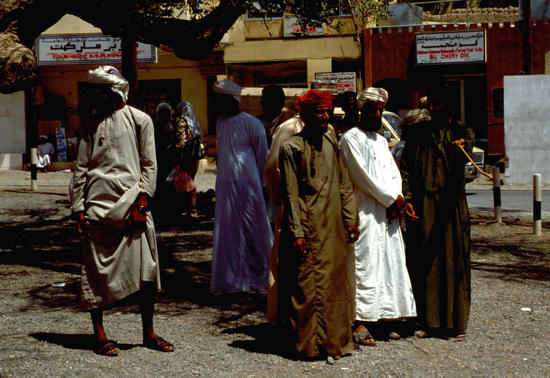
And a group of goat herders in a market in Oman, all wearing a different colored robe:

Omani goat herders

So I think that the choice of clothing color depends on the person, the location, the season, and the culture.

Marko Botsaris BPL Member
PostedMay 14, 2014 at 4:11 pm

"The ones that wear black, do so "in theory" to avoid unwanted attention, in the case of women, and ninjas."

Also very good at hiding stains, as well as slimming. Personally I'd go with the blue Tuareg ones if it were up to me, and if style where the only issue.

We definitely could use some more BPL staff analysis on robe type performance wear. There has to be something cultures that have been in the desert since forever have learned about this that we could profit from.

Nick Gatel BPL Member
PostedMay 14, 2014 at 4:24 pm

Here's the answer…

To get to the other side of the road.

Simple :)

PostedMay 14, 2014 at 8:18 pm

Haha Roger, thought your comment was even funnier. Here's the thing, even if that study has validity, it's more or less a moot point for most of us here at BPL, because i'm assuming that most of us do not don semi thick, coarse woolen robes that pre modern Bedouins traditionally wore. As far as i can observe, it's not currently a BPL fashion trend…

Most of us wear much thinner fabrics, whether cotton, synthetics, linen, sport wools, etc. With such clothes, you WILL feel the extra heat when you are wearing black vs white.

So, theoretic's aside, for us wearing more modern, western clothing, it's more practical to go with lighter colors when in the desert–at least the outside colors. I would like to test my hypothesis about using thin, tight fitting black baselayers made out of cotton in combo with loosely woven, long, flowing loose fitting white or very light colored linen on top–but i don't think i will be able to get to the desert anytime soon. Also, i'm not sure how you would actually test and quantify any possible differences. If there is a difference, it's probably slight. I do know it would offer some extra UV protection, even if both fabrics are not that UV protective to begin with.

Roger Caffin BPL Member
PostedMay 14, 2014 at 9:20 pm

Thanks for all the comments!
We wear fairly dark clothing in the bush, but it is very loose clothing which can flap around lots. So yes, I think the air gap and circulation under the cloting is very important. I think.

Cheers

Brendan S BPL Member
PostedMay 14, 2014 at 9:42 pm

Indeed. Physics are same as black animals in the desert (ravens, black tenebrionid beetles, etc). A raven's feathers can be something like 70 degrees warmer than its skin but the key is a highly convective environment.

Marko Botsaris BPL Member
PostedMay 15, 2014 at 9:46 am

The bird example might be a bad one, especially as the secret of feathers/down is lack of air motion. Also birds do not sweat. Ravens also thrive in the arctic – the only other animal beside man that lives in both places. A thermos might a better analogy for them.

What birds are very adept at doing is fine tuning their insulation layer by adjusting their feathers. Though I have always wondered why black is adaptive for ravens and crows when so many of their corvid relatives are quite colorful.

Viewing 25 posts - 26 through 50 (of 52 total)
Loading...