Topic

Three quilt questions.

  • This topic is empty.
Viewing 9 posts - 1 through 9 (of 9 total)
Jeffrey Wong BPL Member
PostedApr 11, 2014 at 11:35 am

bag design
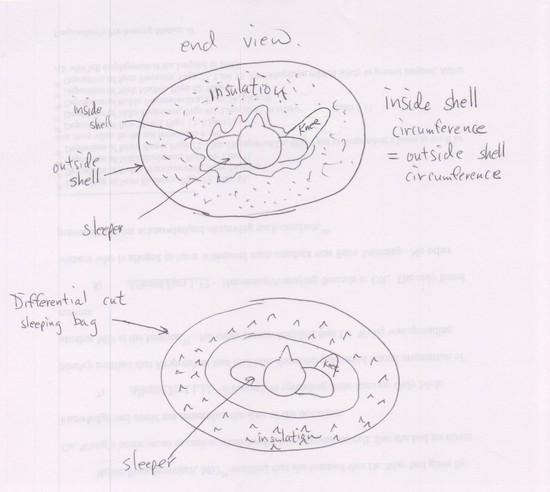
Question 1 is based on the hype I read decades ago that a sleeping bag's inner and outer shells could be cut one of two ways:
1. both shells the same size. This presumed that the material and the insulation (if down) would conform better to the user and reduce free air that one would have to heat. Elbows or knees could push through producing cold spots.
2. the outside shell larger to reduce compression of the insulation and to minimize the cold spots. (differential cut)

As a back and side sleeping quilt user who likes to wrap the sides close to the torso, I plan to sew a climashield quilt using ThruHiker as my source.

Finally, Question 1: Would a differential cut matter in a Climashield quilt?

Question 2: What minimum width of quilt could I get away with, if I keep the edges pulled close? the floor-to-floor measure over my side-lying torso at shoulder level is 37". The same measurement with my hands in front of my face in "prayer" position is 40". Currently, I favor 48" total width.

Question 3: Does your quilt have a drawstring at the neck and a closure to keep the top corners together?

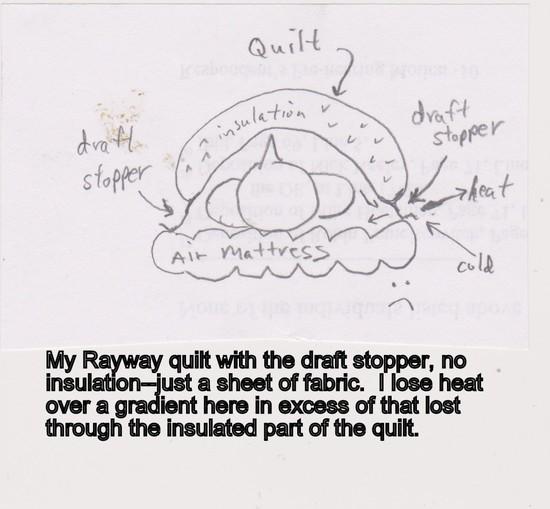
FYI, I made a RayWay quilt (total weight: a ponderous 34 oz) with 1.8" of mystery insulation 53" wide, with straps/clips I added to bring the sides close, but with no neck drawstring/clip. Enlightened equipment's $170 30 degree Climashield bag (Regular/Regular) weighs only 25.8 oz.

Thanks for your patience.
edit: to insert cropped image

Ben H. BPL Member
PostedApr 11, 2014 at 1:10 pm

1) I think differential cut is better, though it probably doesn't make much of a difference unless you have a thick (low temp bag)

2) Width is a personal choice, but the width allows the bag to move with you as you shift and prevents exposing the open side of the quilt and allowing heat to escape.

3) When I first got my EE quilt and tried it out, I thought I wasn't going to like it. Without snapping the top shut, every time I moved, the quilt fell away from me. When closed it up and pulled in the the draw string closure on my enlightened equipment quilt suddenly formed around me. When I moved, it moved with me. The Draw string closure made the quilt.

Jerry Adams BPL Member
PostedApr 11, 2014 at 4:13 pm

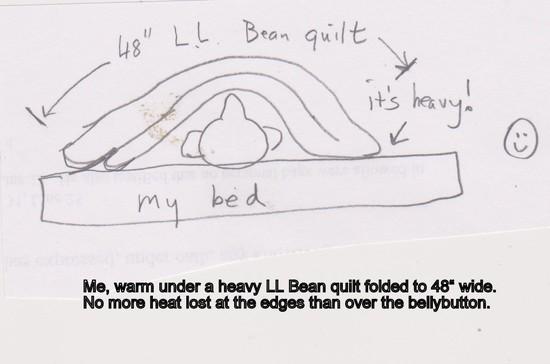
I've wondered the same thing – I like your two diagrams

Maybe with synthetic insulation, it doesn't compress so much so you don't need a differential cut so much.

I've never done differential cut, but maybe if I did a differential I'de find that much better?

It wouldn't be that difficult to do differential – when you sew outer fabric to inner fabric, the outer will be wider but you could just make some folds (gathers) to use up the extra fabric.

Roger Caffin BPL Member
PostedApr 11, 2014 at 4:29 pm

> Question 1: Would a differential cut matter in a Climashield quilt?
Does not matter nearly as much, but it still helps.

> Question 2: What minimum width of quilt could I get away with, if I keep the edges pulled close?
Be GENEROUS! A bit less than an SB opened right out is fine, but be generous! I don't think 48" is enough to allow for turning over in cold weather.

> Question 3: Does your quilt have a drawstring at the neck and a closure to keep the top corners together?
Yes, but I feel they are almost optional. However, their weight is microscopic.

You spend at least 1/3rd of the day under your quilt. Allow weight accordingly.

Cheers

Jeffrey Wong BPL Member
PostedApr 12, 2014 at 10:33 pm

Ben & Jerry thanks for your comments. Thru hiker has shipped–the brainstorming will soon have to give ground to the actual Making Your Own Gear. I will include the draw cord. Differential cut won't take a rocket scientist. Ben's description of the snap and drawstring pretty much sums up my story.

Roger, thank you too. Possibly someone in this wide world has a 48" quilt that works for him/her. I must be one of those people who like to push the envelope a bit. In using my current 53" wide Rayway quilt two nights ago I had cinched the straps under me to where the quilt sides were under me. That likely had the effect of reducing the free air I'd have to heat (vs. the trapped air in the insulation). It also eliminated drafts and put some insulation at the point of contact between me and the pad. Now for a quote from the JacksRBetter website:

"For ground campers, the width of the quilt becomes important to be able to keep the quilt tucked in on both sides to eliminate drafts. Relatively trim back or stomach sleepers achieve good results with our 48 inch wide standard quilts. At 48 inches, the standard quilts work well in a hammock but can be a little narrow for someone sleeping on the ground, especially a restless sleeper or side sleeper. To address the additional tuck issue, we recommend adding Full Length Omni-Tape to our standard quilts and using Quilt Wings to add 7 inches of material to each side of the quilt."

The quilt wings resemble Ray Jardine's draft stoppers on my quilt. For my next trick, I will stitch together the draft stoppers on my quilt, almost turning it into a sleeping bag!

David Drake BPL Member
PostedApr 13, 2014 at 10:39 am

"Possibly someone in this wide world has a 48" quilt that works for him/her."

FWIW, I measure my Golite 1+ season quilt at 49". For comparison, I measure the circumference around my upper arms and chest at 48". The quilt's manageable, esp. when wearing a down jacket to boost the temp, but obviously isn't a quilt for really cold conditions anyway, re: Roger's remarks above.

Upshot: I ordered an 30* EE quilt with 54" girth and am looking forward to the extra warmth and width.

Steve Meier BPL Member
PostedApr 13, 2014 at 10:55 am

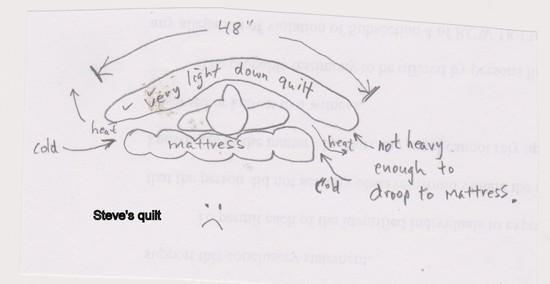
Don't forget to take into account the height of your mattress when configuring how wide you want your quilt. When receiving my quilt and laying on the carpet at home the 48" wide quilt felt adequate. But when I finally used it when hiking and laying on my 2.5" Exped Synmat, the quilt was no longer wide enough and I struggled with drafts all night. It's tough to keep it tucked in all night under your body so having it long enough to reach the tent floor to minimize drafts is important I think.

Jeffrey Wong BPL Member
PostedApr 13, 2014 at 10:42 pm

The lightness of my 53" wide quilt allowed it to lift when I moved during the night creating drafts, despite having 8" inches of a ripstop nylon "draft stopper." The width is less a problem than the lack of weight to keep the quilt down.
Quilt scan 3
Last night I slept under my LL Bean quilt folded to a width of 48"–LL Bean built it with a cover of poly/cotton and it has heft. I move a few times each night and I felt no drafts whatever last night–I ascribe that to the quilt's weight. The temp only dropped to 60 in the house last p.m., but I usually sleep cold.
Quilt scan 2

If I turn in bed without turning the LL Bean quilt, it performs exceptionally. Same deal with my 53" Rayway quilt, whose draft stoppers I sewed together last night. The insulated quilt tucked in where I contact the air mattress helps even more to reduce the heat loss that would occur with only the draft stopper.
Quilt scan 1
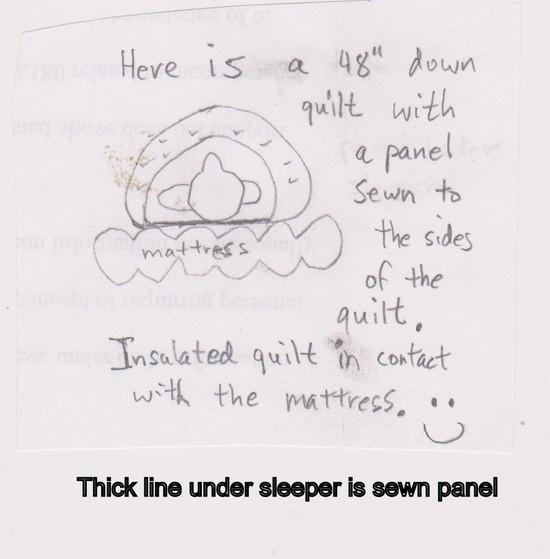
Steve, that leads me to suggest that your quilt performance would vastly improve with the addition of a panel of fabric (you name the material) up to 15" wide joining the sides of your quilt. You would pull your quilt on as if donning a sock, keeping yourself on top of the un-insulated panel at all times, which helps keep a bit of the insulation at the quilt-pad interface. When you roll, the quilt does NOT.Quilt scan 4

I have begun to understand this a bit better, now that I've had some input.
Disclaimer, I thought I understood calculus physics in college, too.

edit: correction of pronoun "his" to "your" above last picture

Jeffrey Wong BPL Member
PostedApr 13, 2014 at 10:50 pm

A differential cut should help the basic quilt's edge better approach the sleeping pad/ground/hammock, though a sleeper's movement will still make more "waves" than a quilt with a sewn panel connecting the sides, as in the last pic.

Viewing 9 posts - 1 through 9 (of 9 total)
Loading...