Topic

Thunderstorms in the wilderness – What to do

  • This topic is empty.
Viewing 25 posts - 1 through 25 (of 33 total)
PostedFeb 26, 2014 at 8:57 am

I’m planning to do the JMT in July and I understand afternoon thunderstorms are quite regular in the sierras during that time of the year.

Since this is backpackinglight I thought I would ask here and add to my kit the lightest and most useful piece of gear which is “knowledge”. What do you folks do before and during thunderstorms while backpacking for extended periods of time on the wilderness?.

I’m particularly concerned as my intended shelter will be a MYOG Pyramid tent which uses hiking poles as main support.

Thanks in advance for your advice,

Mario

PostedFeb 26, 2014 at 9:01 am

"I’m particularly concerned as my intended shelter will be a MYOG Pyramid tent which uses hiking poles as main support. "

That is certainly a suitable shelter.

What is the concern regarding storms?

Art … BPL Member
PostedFeb 26, 2014 at 9:02 am

don't take shelter in the cabin on top of Mt Whitney.

Marko Botsaris BPL Member
PostedFeb 26, 2014 at 9:15 am

"What is the concern regarding storms?"

I guess lightning rod. Golfer are known to get it by lightning a lot. Seriously, haven't you seen Caddyshack? On the other hand if you aren't holding on to the poles at the time it might actually help by channeling the current around you. I suppose you would have to weigh that with the chance that the poles might me more likely to get struck.

General rules are stay away from isolated feature that jut out – don't stand under that lone tree to get out of the rain or by that big boulder. Get away from your pack. Lower you profile (kneel down) while at the same time limit the area of contact with the ground. On you hands and knees is often mentioned – possibly with a hail mary on you lips. :-)

But these are all emergency things you do when things start crackling around you. They obviously aren't anything you can do for an extended period. Being in a forest (preferably at some distance from any tall tree) is safer that being exposed.

Also, goes without saying, if you are anywhere near the top of a mountain or hill and you see one coming flee to lower ground.

The charge on the clouds causes a polarization on the ground beneath it – think of it as a second cloud of charge getting dragged along the ground with the cloud in the sky. When it gets closer it can overcome the gap. Also, irregularities that stick out tend to concentrate the electric field greatly, greatly decreasing the energy gap. So a tree (or structure, or person) sticking out in a flat area is much more Likely to get a direct hit. A structure on the top of a mountain is just asking for it. Though it is has a proper lighting rod in it then it would be the safest place to be since the current would go through the wire, and not your body – also a direct hit would be less likely to cause the building to burst into flames.

Because of this concentration of charge, if things are getting bad you may feel your hair standing on end, or hear crackling or see mini-sparks nearby. If that happens then that is when you should immediately "assume the position". LOL

Long story short, answer to the OP, if there is any chance of inclement weather don't pitch you shelter at the top of a hill, in a large exposed flat area, or near other local things sticking out from a large flat area. Also not right next to a big tree in a forest.

A lot of those rules are good for other reasons as well. :-)

PostedFeb 26, 2014 at 9:49 am

On the other hand if you aren't holding on to the poles at the time it might actually help by channeling the current around you.

I believe "close enough" works just as well for lightning strikes as it does for horseshoes and hand grenades. I also suggest minimizing the distance between contact points with the ground as much as possible (i.e. huddle in a small squat).

Marko Botsaris BPL Member
PostedFeb 26, 2014 at 10:01 am

Agreed, I was pushing it there! Maybe I was just truing to think positive. Probably the pyramid type shelter is also worst design since the pole is in the center. Where ya gonna go? LOL

Better to pitch it somewhere where another (non-shelter) object 30 or so feet away is much more likely to get hit instead. It will scare the bejesus out of you, but you will not get fried.

PostedFeb 26, 2014 at 11:00 am

Electricians stand on Insulating Mats while working in live electrical circuits. I wonder if standing on a CCF sleeping pad (folded a couple of times) would be of any help in a lightening thunderstorm situation.

J-L BPL Member
PostedFeb 26, 2014 at 11:26 am

I've posted this before. It's a good read:

http://www.vaisala.com/Vaisala%20Documents/Scientific%20papers/4.Gookin.pdf

Basically, the amount of electric potential involved in a lightning strike is so enormous that standing on a little bit of insulation or extra height on a tent does not really matter.

Barring any man-made structures, the absolute safest place to be from lightning is at the bottom of a canyon. There have been no reported injuries or fatalities from lightning strikes hitting people at the bottom of the canyon. Balance this risk with flash flooding. The next safest place is in a forest.

Rex Sanders BPL Member
PostedFeb 26, 2014 at 12:07 pm

NOAA Lightning Risk Reduction Outdoors:

There is little you can do to substantially reduce your risk if you are outside in a thunderstorm. The only completely safe action is to get inside a safe building or vehicle.

NOAA points to this more practical advice from NOLS: Backcountry Lightning Safety Guidelines (PDF 5 pages).

Short version:

  • time visits to high risk areas with weather patterns
  • find safer terrain if you hear thunder
  • avoid trees
  • avoid long conductors
  • get in the lightning position

It’s not that simple, read the whole thing

— Rex

Bob Gross BPL Member
PostedFeb 26, 2014 at 12:19 pm

First of all, lightening is what ultralightweight backpackers do to their packs to reduce the weight. Lightning is the electrical phenomenon that can kill you.

I took my first course in lightning engineering in 1975. The rest is history.

There is virtually nothing that a backpacker can do to insulate themselves from a direct lightning strike, shelter or no shelter. As everybody has stated, you simply must get off the high exposed ridgelines and peaks and get down to lower elevation. If you are standing underneath the tallest tree, then there is a good chance that something bad is going to happen. However, if you are camped in the midst of an entire forest and you stay away from those tallest objects, then you have a better chance. The people who understand this very well are the people who work around tall microwave radio towers. Towers get hit so often that they put lightning strike counters on the grounding system.

A side issue is Saint Elmo's Fire. Those are the tiny static discharges that you see when high up in the mountains and the electrical cloud is present. It is sort of like a precursor to the lightning strike. Think of it as your last warning when it is dancing off the metal parts of your ice axe.

–B.G.–

ed hyatt BPL Member
PostedFeb 26, 2014 at 12:26 pm

I pretty much just thought f**k it on the Colorado Trail last summer; storms abounded.

What can you do….not that much above what is detailed here.

Storms are elemental fun – perhaps not so if they result in your demise (but then you would not care)….we walked between two huge thunderstorms one day on the CT – it was interesting to watch the build-up either side of us..

Dale Wambaugh BPL Member
PostedFeb 26, 2014 at 12:30 pm

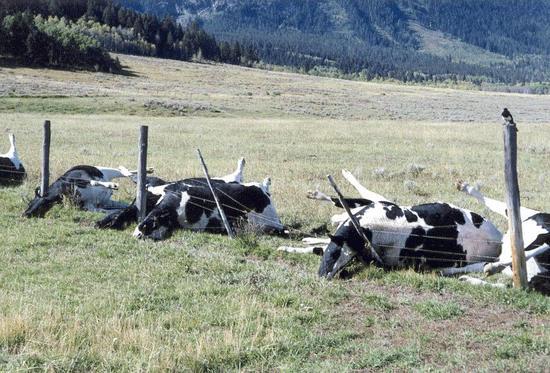
That PDF is handy and I'm passing it on to family. Keep in mind all these techniques are last-ditch-better-than-nothing way to improve the odds. Paying attention to the weather and not pressing on when there is a good chance of thunderstorms is the ounce of prevention for a pound of cure. As with many hiking catastrophes, being too focused on the goal can make us blind to the risks. I'm glad to have the information if I doo find myself in a bad spot.

This photo from the NOAA site really sunk in:
BBQ

PostedFeb 26, 2014 at 12:44 pm

…JMT in July and I understand afternoon thunderstorms are quite regular in the sierras during that time of the year."

Maybe yes, maybe no. Some summers have more thunderstorms than others. It could happen that you do the entire JMT and don't encounter a single thunderstorm. Or… you could have several every week. The main thing: If you hear thunder and the clouds are dark above the pass to which you are headed… Don't go up there. Sit tight and wait until the storm passes. Sometimes that can be just an hour or so. Sometimes it will last until after dark. If it lasts into the night, your next safest passage will likely be first thing in the morning.

Billy

Bob Gross BPL Member
PostedFeb 26, 2014 at 12:44 pm

"I'm glad to have the information if I doo find myself in a bad spot."

Dale, you meant that if you do find yourself in the doo.

–B.G.–

Dale Wambaugh BPL Member
PostedFeb 26, 2014 at 12:53 pm

"Dale, you meant that if you do find yourself in the doo."

My phone was made on the Greek island of Typos, but yes, doo doo is more like it.

J-L BPL Member
PostedFeb 26, 2014 at 12:57 pm

Another thing I have done is camped near the bottom of a tall ridgeline (with the hope being that the ridgeline will attract most of the lightning strikes).

PostedFeb 26, 2014 at 1:01 pm

The JMT is basically a trip consisting of canyon, pass, canyon, pass… etc.
Since thunderstorms usually take place in the afternoon, a good strategy is to get over the next pass by noon if possible. Camping below treeline during a thunderstorm period is the safest. And don't dally in the passes if there are dark clouds approaching.

Billy

M B BPL Member
PostedFeb 26, 2014 at 2:27 pm

Plan to get over high passes before lunch.

Stay off of high passes if it looks threatening

Never ever be the tallest thing around if there is a thunderstorm within several miles.

Trust your deity of choice.

Paul Wagner BPL Member
PostedFeb 26, 2014 at 2:55 pm

I am still recovering from this line:

"Seriously, haven't you seen Caddyshack?"

Seriously,….that's a whole new form of lightening things up!

Marko Botsaris BPL Member
PostedFeb 26, 2014 at 3:01 pm

The pad is a legitimate idea (in theory), provided you have it assessable, and provided it is not already so wet as to make the insulation break down. The main thing that will kill you is the current going though your body – this will typically stop your heart. The burns you might get are less of an issue if you are stone dead because your heart stopped.

I spent some time designing and building medical instruments like ECGs. There are FDA device regulations on minimum leakage impedance to ground. When you zap someone with a defibrillator this is a life and death issue – if the ECG does not have a good enough electrical isolation from ground then it will kill you. In more general setting the regs are there to prevent even such things as sticking your tongue in a light bulb socket while hooked up to said ECG equipment.

So yep, sitting on a pad might theoretically help a lot. The current moving along the ground would tend to route around you better. Potentially you could get struck and, *perhaps*, the charge would leak to ground slowly enough to not stop your heart.

On the other hand (more horseshoes and hand grenades here) for a strike we are talking about HUGE charge, and thus huge voltages. An ECG is supposed to be isolated to 10000 volts, but we could be talking about (briefly) millions of volts. That charge that just hit you came from a voltage difference large enough to cause the dialectric breakdown (3 million volts per meter)of air over macroscopically large distances. At the net charges and voltages involved with a direct lighting strike even the air will turn into a conductor, so I would say the tiny distance between you and the ground is not going to isolate you in such a case. This is probably the kind of advice that comes from people drawing analogies and not understanding the actual values involved, let alone the skin effect of the surface of the (presumably at least damp) pad.

I suppose if you have been sitting on the pad for long enough you would be marginally less likely to get struck in the first place since you might collect less charge. But to paraphrase Richard Prior – "if you get caught out in the open with a lighting storm coming, and all you can pull out is a soaking wet pad … RUN!"

M B BPL Member
PostedFeb 26, 2014 at 4:06 pm

Well, a pad cant hurt.

but you dont want to be sitting on it, you want to be on your toes with your feet close together, touching. Ground current has voltage differential the farther apart your touching points are, the more current will flow thru your body from a strike nearby.

Marko Botsaris BPL Member
PostedFeb 26, 2014 at 4:17 pm

The horizontal (ground) currents getting dragged along by the clouds (and hence potentially through your body), and the vertical ones from a strike (and also through you body) are two different things, and by standing up to reduce the horizontal current you greatly increase the chance of a strike from above, which you will likely not survive, pad or no pad. So I guess choose your poison. At least if you have to go out you can insure you will go out on you feet, with a bang and not a whimper.

Viewing 25 posts - 1 through 25 (of 33 total)
Loading...