


Richard,
Thanks for all the good work and info.
I'm finding that I prefer to refer to the table instead of the graph. Not sure why. It's just the way I think I guess.
Topic
Become a member to post in the forums.
Richard,
Thanks for all the good work and info.
I'm finding that I prefer to refer to the table instead of the graph. Not sure why. It's just the way I think I guess.

"My big problem with windshirts is they aren't rainproof, so I need a rain jacket in addition, in which case there's not much reason to have a windshirt also."
If you think if a windshirt as a shirt, used like you would use a button down shirt, I think it is easier see the uses. If it has a hood and other jacket like features, so much the better, but it is still worn like a shirt. It provides the final seal to my base layer and/or midlayer choices, which provide little or no wind protection. It can also provide sun and insect protection. The DWR features are a great no-weight addition, but I'm always going to be carrying some sort of dedicated rain gear, be it jacket or poncho. BTW, a poncho makes an excellent pairing with a windshirt.
And that the the reason for all the beefing about breathability. If I want waterproof and sweaty, the niche is well covered (no pun).
These discussions do get down the the core principles for UL gear: I want the utmost performance for the weight with as many uses as possible.

I don't want to derail this thread onto windshirt pro/con argument
Richard's chart (or table) does help figure out which items make sense for me to take on different trips

One well known quote of Albert Einstein’s is: “If you can't explain something simply, you don't know enough about it.” Thanks to your constructive comments, I have an opportunity to compare windshirts more simply.


Thanks for the feedback on the RD, Dan. I have a few windshirts I like a lot, but the fit is not great on any of them. The MEC T2 in a medium is the best fitting baselayer I've found for my 6'2" 170 frame, which seems to have the same style fit as the RD.
Thanks for the revamp on the diagram, Richard. I mentioned it in a pm to you, but I'd be glad to lend my rap alpine, made of equilibrium, if there is collective interest. I'd be curious to see what Dave C.'s BD alpine start is as well, but I doubt will be tearing that one away from him anytime soon.
Richard,
Is the regain % of polypropylene similar to Terylene?
Daryl,
Polypropylene, aka polyolefin, has 0.05% regain where the vertical 65% RH line is. In the chart it would be superimposed on top of the x-axis and not visible. The low-cost DriDucks and Frogg Toggs jackets use this material type.

Richard,
is the moisture regain graph the representation of absorption rate/drying time ? Because I read several times that weave/knit type is more important for that then fiber nature.
Woubeir,
Most fabric layers are more air than fiber; so, it is the water in the spaces between the fibers and layers which are the primary determinate of saturated weight gain and inversely, the drying time. If two fabrics are the same weave / thickness but, made with different thread material, then the material with the lower regain will dry only slightly faster.
I think the original text under "mm Thick", your description, and the above alternate description all attempt to convey the same meaning. If you have a suggestion for making "mm Thick" text much clearer without being significantly more verbose, I will change it.
The primary research paper in this area said, "The main fabric property which does determine the amount of water a fabric freely picks up is thickness. Further, the time that it takes a fabric to dry is directly related to the amount of water which is in the fabric initially, the more water it holds initially, the longer it takes to dry. Finally, water evaporates more rapidly from a fabric than from a water drop of equivalent volume. This is because a fabric has a greater surface area from which the water can evaporate."
Richard,
I have to admit that I hadn't read those. For me that's, now I have, clear enough. But, of course, I can't speak for others.
Richard,
"Most fabric layers are more air than fiber; so, it is the water in the spaces between the fibers and layers which are the primary determinate of saturated weight gain and inversely, the drying time"
If I'm understanding this correctly I think it explains why my loosely woven nylon running shorts dry more slowly than my tightly woven uncoated nylon windbreaker……even though both fabrics are about the same weight per square yard.
FYI, a littl
I don't mean to get off subject, but I contacted MEC regarding the RD windshell and they told me the Women's version is discontinued, and all of the Men's colors besides black and Cara Cara (orange) are discontinued. It was unclear if the Men's version will be disco'd altogether but it did seem like it as they mentioned there will be a similar jacket to replace it but couldn't tell me for sure. So act fast… PS only black can be shipped to the US.
NM
The genesis of this analysis originated with Wim Depondt in his thread http://www.backpackinglight.com/cgi-bin/backpackinglight/forums/thread_display.html?forum_thread_id=86498. He used coffee filters to conclude that the RAB Boreas and Pertex Equilibrium fabrics were in the range or 75 CFM or more (single layer coffee filter average).
Subsequently Serge G. said, "I mentioned it in a pm to you, but I'd be glad to lend my RAB Alpine, made of Equilibrium, if there is collective interest." I already had access to a RAB Boreas; so, here is the data. If there are subjective questions on the Alpine, please address them to Serge G. For the Boreas, ask any of the many Boreas users. I am trying to stay objective and not promote or criticize any of the windshirts.


Thanks Richard. Excellent new information regarding the ongoing wind shirt conundrum. I am somehow surprised of the relatively high CFM rating for the RAB Alpine. Though I have to admit anecdotal evidence confirms it: in 95% of situations that necessitate a wind shirt, the RAB Alpine is perfect, including climbing. It’s also breathable enough to belay my rain jacket over it (a big plus in miserable weather conditions). But on a cold windy ridge, it is sometimes insufficient (RE high CFM ratio).
edit: typo

I don't understand how the air permeability that you measured for the Rab Alpine Jacket (111 CFM) can be so off from the spec for the Pertex Equilibrium fabric that it is constructed of (~ 20 CFM). Any thoughts?
i think it just shows that unverified "specs" should be shoved down where the sun dont shine
this isnt climbing gear where specs need to be accurate for safety, or en-rated sleeping bags where EU rules require actual testing standards
quoted manufacturer specs can be wildly inaccurate … and honestly much of the time have more to do with marketing mumbo jumbo
ive always found it quite funny personally when there are whole threads dedicated to arguing how this or that gear is better on paper according to the manufacturer specs, when you dont know if they are even accurate
also remember that a fabric that has seen usage can be quite different from when it is new
;)
Serge
Eric correctly pointed out a variable which we have no information on. All other garments I tested were new.
When was your garment purchased and what was the summary profile of its use / care?
I was curious as to why the “coffee filter” air permeability tests that Wim Depondt conducted on a NEW RAB Alpine seemed to indicate comparable breathability to the RAB Boreas. Wlm Depondt tested approximately 75 CFM for both. My lab tests showed the RAB Boreas was 68.7 CFM but, the USED RAB Alpine tested 111 CFM.
I took multiple micrographs of both fabric sides of the USED RAB Alpine. The following micrographs are 5.0mm and 1.4mm Field of View clearly indicating that a very-thin-clear PU (VTC PU) coating was added to the inside of the fabric during manufacture:


There were no visible wear spots on the outside of the fabric to indicate abnormal use. Consequently, it is plausible that the NEW air permeability could have been comparable to the RAB BOREAS when new, but, degraded to the 111 CFM level, from the VTC PU coating reduction, with 20 – 25 days of normal use.
A VTC PU coating on the inside of the Gossamera fabric (Arcteryx Squamish) has been used by Arcteryx since the 2009 model year. My hypothesis may also apply to this garment.
68cfm sounds pretty breezy let alone 111cfm. From my experience with other PU coated fabrics, there isn't much of a coating there. Do they mechanically abrade it like some other fabrics?
Any specs on the OR Ferrosi fabrics? They seem similar to some Supplex shirts given the Darth Vader test.
I'd estimate that's I've worn the alpine 20-25 days since last winter, mostly back country skiing with a pack on. It might have gotten thrown in the wash & dwr'd with a couple other garments, but I'm not certain.
now thats a VERY interesting question IMO
how does a windshirt breath after a decent amount of usage
i can say with my trail wind it doesnt seem to breath much better …
i suspect it all depends on the fabric and the coating
hmmmm
;)
Getting back to your original questions Richard:
I would say that the first three (breathability, water resistance and weight) are the most important to me. Other factors are nice, and will play a part in my purchasing decision, but those three are by far the most important for me. For example, I care about durability, but own Propore (I just know they are fragile). I want to save money, but I've bought (and will continue to by) Cuben. If there is some magic windshirt that does well in all three categories, then I'll spend lots of money, even if is fragile.
With that in mind, I suggest a table with at least those three items. It can have more (your call). Along with that, I would make a chart with breathability on the X and water resistance on the Y (these can be swapped if you prefer). Then I would represent weight with a bubble (the bigger the bubble, the heavier it is). I think this would be fairly intuitive. For example, if you were displaying rain jackets, than an Event jacket shows up in the upper right quadrant (very breathable and water resistant). A Propore jacket is a little bit closer to the axes. But the Propore jacket has a much smaller circle. (I've used rain jackets for my examples, even though I know this is for comparing windshirts).
The other advantage of this approach is that you can draw a line to designate something. For example, you could have a line designate what is generally considered "waterproof". Beyond that, a lot of people won't care if a jacket is more water resistant. Likewise, a line for the 35 marker on CFM.
I wonder – are there polypropylene windshirts? I have found only Rohan Ether and Klattermusen Tjatse.
I don't think this has been done before because it's not necessary. If you want to display these four attributes, it's best to just list them out.
The most obvious problem is that the chart has lines that imply, for example, that an item has more water resistance as it gets lighter. From an engineers perspective, if a given line represents a given product, it implies that the product's attributes exist anywhere on that line. We know that this isn't true because all of the attributes shown are fixed, not functions of each other.
I do enjoy your CLO and CFM charts though :)
Become a member to post in the forums.
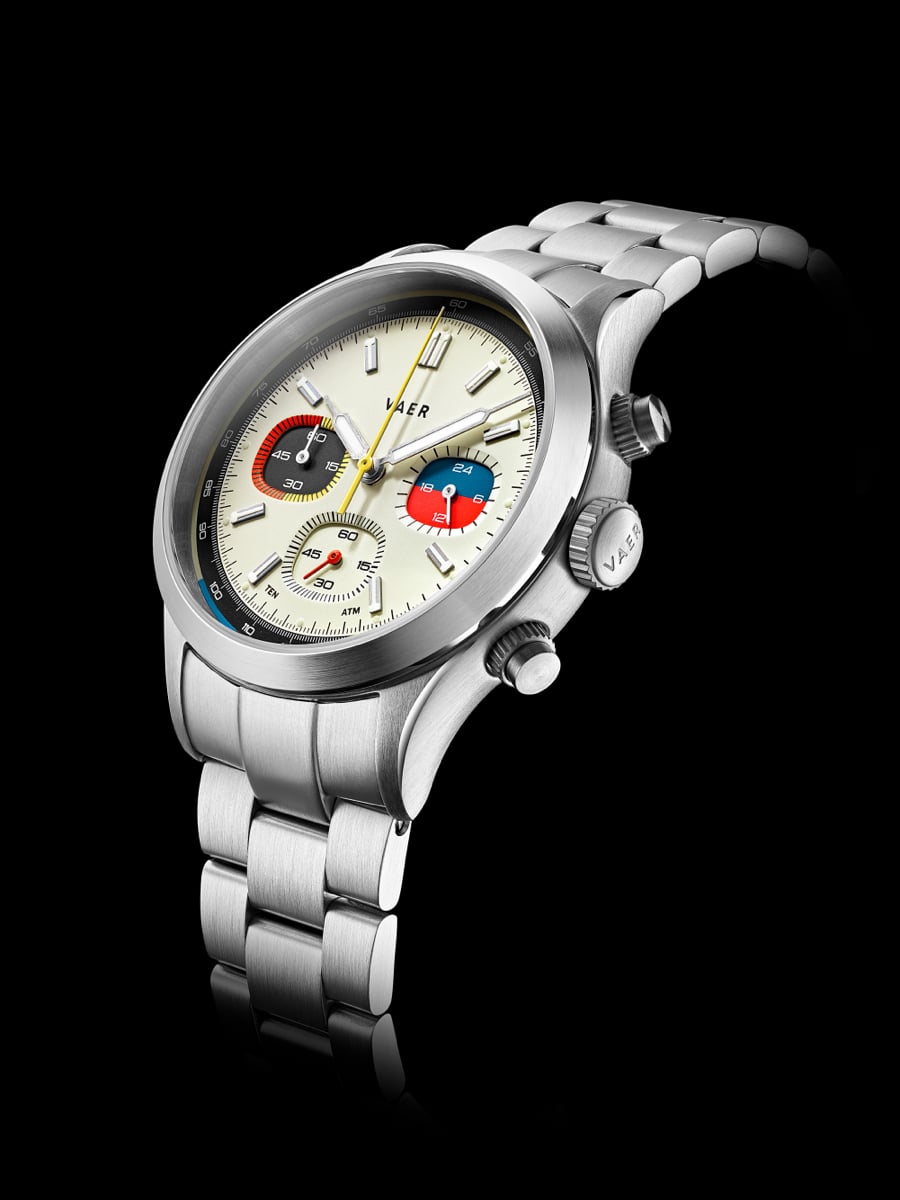 Retro Racing Character, Built for Everyday WearDrawing on the colorful racing chronographs of the 1960s and '70s, the RS1 Rally pairs vintage motorsport style with the durability expected from a Vaer. Its 40mm case houses a Japanese VK63 meca-quartz chronograph movement, complete with stopwatch functionality and an integrated tachymeter scale, while contrasting subdials give the watch its distinctive retro character. Sapphire crystal, 100 meters of water resistance, a screwdown crown, and strong BGW9 lume make it far more than a style piece. At under $300, it's an easy pick for the car enthusiast or chronograph fan.
 © Beartooth Media Group Inc.
 Loading...