Topic

MYOG Active Apex Vest version 2.0, at a whopping 2.8 oz.

  • This topic is empty.
Viewing 15 posts - 1 through 15 (of 15 total)
PostedFeb 2, 2014 at 10:08 pm

I didn't use a pattern for this vest, half sort of eyeballed/half traced a fleece vest i had (wasn't the best idea to use that). It was a bit more complicated since it has a full zip. 2.5 Apex insulation only in the front, with very breathable, non calendared and non DWR 1.1 oz ripstop nylon.

Back is a combo of the above ripstop nylon with no see um mesh for the back. It's designed to be an active piece for colder weather, replacing much heavier fleece, or non breathable puffy type pieces (though not meant to replace camp insulation by any means). Along that line, it weighs only 2.8 oz for a medium size, and could have weighed less had i used a smaller zipper. The idea is that using very breathble fabric, combined with Apex, results is an insulation piece that dries faster and is comfortable in a wider range of temps. Meant to be used in conjunction with a windjacket/shirt, which most of us carry anyways.

Here are some pics. Once i've worked out the kinks (which i largely did from making some mistakes on this project, but still need a bit more practice), i may start selling them for about 40 dollars or so.
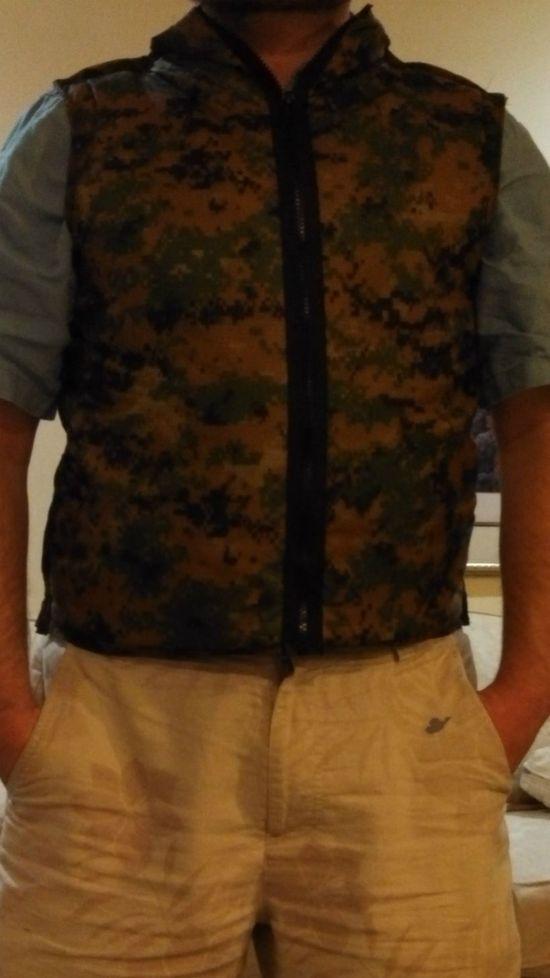
front

Not sure what's going on with the back here (pic below), as it looks fairly symmetrical when off, but i also had my underneath shirt tucked in hastily, and so maybe it was pulling it around a bit.
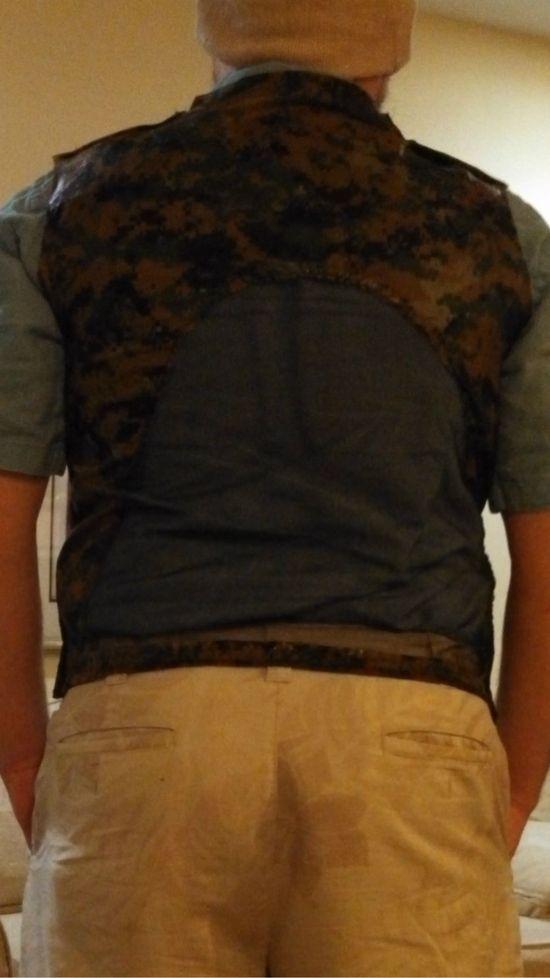
back

Weight and scale. Also packs down quite small, though i didn't take a pic fully showing this.
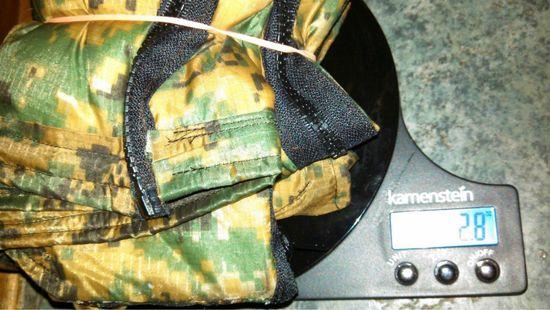
scale

PostedFeb 2, 2014 at 10:38 pm

Well, yes, but that's mostly because uncalendared and non DWR nylon ripstop is a bit rare and there aren't a lot of color/pattern options.

I got it from DIY gear supply and i think they were having a sale on this particular "color/pattern" awhile back and since it fit the above criteria, i said oh what the heck, so i look like a red neck.

Justin Baker BPL Member
PostedFeb 2, 2014 at 11:12 pm

I actually really like camo. I've always wished more backpacking companies would make gear in camo. It gets my inner 10 year old excited (i dressed up as a soldier/commando for halloween several years in a row).

Jerry Adams BPL Member
PostedFeb 3, 2014 at 7:48 am

Nice! A lot of warmth for that weight.

Could be a little longer? For more warmth.

You could have the fabric closer to the zipper, so there's less air flow.

Nice that you didn't use a pattern. It's more fun to figure out and you still end up with a good product.

But most people probably use patterns : )

PostedFeb 3, 2014 at 8:44 am

Thanks Jerry. Yeah, it could definitely be longer, especially since i'm having someone with a longer torso than myself test it out some (and who lives in a much colder climate than myself).

It's hard to tell from the pics, but most of the fabric is less than a quarter inch from the zipper on the inside. I didn't want to get it too close because i dislike nothing more than having fabric get caught in zippers, which i've have had happen with a number of my store bought garments.

Yeah, it's definitely more challenging figuring things out without a pattern, but i may look into trying that as well, especially if do start selling them–want to give people good quality. Speaking of which, don't think this was good quality, more like decent or functional.

Once i get the quality down better, do you think that 35 to 40 would be a fair price?

Thanks for the feedback and encouragement.

Jerry Adams BPL Member
PostedFeb 3, 2014 at 9:13 am

ha, ha,… you didn't ask for my unsolicited advice before : )

I put zipper between shell fabric and liner fabric, although it's more for aesthetic reasons.

Or have the zipper tape inside where you don't see it, but again, aesthetic.

I try to get fabric exactly lined up with edge of zipper teeth. It won't snag unless it overlaps a bit. Aesthetic, and air/water resistance.

I think when fabric snags, its the fabric that's in a bit from the zipper. Sometimes they put some stiff tape that goes an inch or so from the zipper. I never bother, I am careful not to snag fabric, and occasionally when I do, I just back up.

Now, if this was for a pre-adult male, for example, they are incapable of doing this, so you need the snag prevention stiffener.

rei.com – first synthetic vest I saw was $109, $76 in a couple odd colors for some reason. That's what I would consider a fair price. If you want to run a business, you have to charge enough or you'll go out of business. You need mark-up to cover all your hidden expenses.

The problem with running a business, is like Roger's experience with stoves and tents. Hard to mass produce. When you have a lot of customers you have problems – either because there are variations in manufacturing or customers treat things differently or have unreasonable expectations.

PostedFeb 3, 2014 at 9:48 am

Great tips, thanks! Think i will put the zipper inside like you mentioned, etc.

I understand about the markup thing, but there is no way i could charge even 76 dollars (and feel ok with myself doing so). Maybe 55 at most. It's why i have a part time job also, so i don't have to rely solely on profit.

I'm also wondering about the practicality of doing no see um mesh for the back. It might be that very breathable, thin ripstop nylon in one layer is cool and dries fast enough without doing the mesh, since this is a colder weather piece anyhow. I imagine that the mesh won't hold up near as long as the ripstop (and one would definitely have to wash and dry it in a pillow case with the mesh).

PostedFeb 3, 2014 at 12:43 pm

That's an awesomely light vest! I really like the way you made the back very breathable, since a pack will be there and "insulating" you anyways.

PostedFeb 3, 2014 at 3:05 pm

Thanks Andy. "I really like the way you made the back very breathable, since a pack will be there and "insulating" you anyways." Yep, that's the idea exactly. I find that pretty much no matter what i wear while hiking, or the time of year, and temps, that if i'm wearing an internal pack, my back sweats quite a bit. Cutting down on that can only be a good thing.

Tim Marshall BPL Member
PostedFeb 3, 2014 at 5:51 pm

What if you skip the zipper and replace the noseeum with some Lycra so it'll stretch as you pull it on. Simpler to build , better than mesh on the back and dropping zippers seems smart to me. Gotta find the right stretch fabric though.

-Tim

PostedFeb 3, 2014 at 11:43 pm

They do make stretch mesh, I believe. Can probably find some at Seattle fabrics.

PostedFeb 4, 2014 at 10:20 am

Hi Tim,

Funny enough the previous version, was a simple pull over vest that instead of a combo of 1.1 rs nylon and no see um mesh on the back, had a somewhat stretchy polartec power dry high efficiency "base layer" fabric.

The latter was a moderate or in between mid and light weight fabric, but it still almost doubled the weight–weighs 5.5 oz if i remember correctly. Also more costly. I still use it on those really cold days, which lately have been less rare than norm for here.

Since it's sort of a niche piece of gear, would like to keep the weight and price down. But i think using just the ripstop nylon on the back should be fine too.

Also, the zipper helps A LOT with thermal regulation (based on my experience with windjackets), which i think for this kind of gear is pretty important. Might be comfortable going down a hill or walking flat, but when you start pushing up the hill, then it's nice to have that option of unzipping i think. Makes it more comfortable for a wider range of activity and temps.

Thank you for the reply and feedback.

Allen C BPL Member
PostedMay 14, 2015 at 10:09 pm

Justin, are you still making/selling these vests?
I may be interested in one. Thanks!
Allen

Viewing 15 posts - 1 through 15 (of 15 total)
Loading...