Topic

Compensating for Loss in Dimensions after Stuffing the Down

  • This topic is empty.
Viewing 14 posts - 1 through 14 (of 14 total)
M W BPL Member
PostedJan 20, 2014 at 4:29 pm

Hello all!

I've gathered from the numerous posts, that one loses about 4-7" of length once a quilt is stuffed with down. This seems to be the case with horizontal baffling. Add to that another 3" or so in width. This appears to be the figure when one stuffs their quilt to a thickness of 2.5" or thereabouts, with a baffle height of 2-2.25."

Is there an actual formula out there to account for the loss in dimensions?

I would like the completed post-stuffing dimensions of my quilt to be 74" x 66" with a baffle height of 1.75", chambers stuffed to about 2.25" maximum…

Any guidance?

Materials are slowly being collected, now I have to find the nerve to start cutting….

Marko Botsaris BPL Member
PostedJan 20, 2014 at 4:53 pm

There is probably some physics variational problem there where the energy over a surface is being minimized subject to constraints – but probably you should just sew a model of a single chamber, stuff it the way you plan, and then measure the final dimension to get the change in shape. That probably would give you a good idea.

If the baffles are sewn through then the answer should be easy to estimate since by stuffing you in effect turn the to parallel lines on either side of the chamber into an oval and eventually a cricle. If this oval was diamond shaped (to first approximation) which will slightly *underestimate* the actual shrinkage in length, then I make the shrinkage percentage to be

squareroot( 1-(W/L)^2 )

where W it the thickness you stuff the baffle, and L is the original distance between the sewn through lines. The actual shrinkage should be a bit more, but this should be pretty good as a first estimate.

If you really stuff the baffle (not a great idea) itshould roughly circular when you get done, which sounds about right (though probably a bit extreme) then

r = 2/pi = 0.64

So is r is the shrinkage percentage perpendicular to the sewn-through baffles then

0.64 < r < squareroot( 1-(W/L)^2 )

Multiply either of these two number (real result probably somewhere in the middle) by the original length of the bag to get the final length.

If the baffles are really wide with respect to the thickness then you could use a rectangular approximation (where the down is mostly the same thickness through the whole chamber and then suddenly shrink to zero at the seams) and then you would have:

r = 1- W/L

Proofs left as a homework problem, but I can write them up if you need them.

Marko Botsaris BPL Member
PostedJan 20, 2014 at 5:45 pm

Yeah, going back and re-reading sounds like he might mean box – so wasted my time. LOL

Anyway, the way to do it is draw a cross-section of the before and after chambers as you describe, then do the geometry. The pieces of fabric can't change length, so it is all about the target shape. You can probably divide it up into rectangles and triangles to get a pretty accurate estimate.

Ryan Smith BPL Member
PostedJan 20, 2014 at 6:22 pm

All I took from this thread was that we should all PM Mark with our future quilt shrinkage questions.

Ryan

Anthony Huhn BPL Member
PostedJan 20, 2014 at 6:44 pm

Yeah, and questions on homework….

What kind of foot box are you using? If you are using a cinch you will need to probably add ~6" just for the foot box

Additionally what baffle separation are you using? Most people use ~6-8"

I would probably err on the side of 8" for your project as you seem to be over-stuffing quite a bit if you are thinking of using 1.75" tall baffles and filling them to 2.25"
This would both reduce the shrinkage and make sewing it a little easier. Tighter spaced baffles tend to be necessary to stabilize the down, but extra fill should do the job too.

My rough estimate is
8" baffle seperation, gathered footbox
+12"

Someone call me out if I'm crazy, I've never done the gathered end before

Anthony

Anthony Huhn BPL Member
PostedJan 20, 2014 at 6:58 pm

Wow, just took another look at those dimensions
This sounds kind of like a the Jacks R' Better Mt. Rogers Quilt

http://www.jacksrbetter.com/shop/the-mt-rogers-large-quilt/

The one review says the guy measure the actual width and it was 58" instead of the listed 61"
What I'm assuming is Jacks lists the fabric dimensions so 3" width seems to be on the money.

I was also going to add that I expect the quilt to shrink around 6" in length… allow another 6" if you are sinching the footbox. Jacks has a length which is 74" with a gathered footbox and they say to size up if you are taller than 5'10"

Anthony

PostedJan 20, 2014 at 7:55 pm

ok. take a stuffed quilt, measure the length at rest, now pull the material reasonably tight in length, and the difference is how much it "shrank".
so then, when you make your own quilt, make it that much longer to get where you want to.
actually, maybe since it's just a quilt, make it one baffle too long on the head end, and if that is found annoying or floppy, open it up and rework the material to be the new head end of the thing.

cheers,
v.

Marko Botsaris BPL Member
PostedJan 20, 2014 at 9:19 pm

Peter's is a good idea! Easier than my suggestion of building a test baffle. Especially useful if you are modeling your bag on another with similar dimensions. One thing for sure, keep track of the before and after measurement THIS time, and your SECOND quilt will be just right. ;-)

I know, right now you want to punch me, don't you? You are a braver person than I for doing such a project. I'm plenty satisfied if I can get a stuff sack to come out even looking.

M W BPL Member
PostedJan 21, 2014 at 8:44 pm

Well, I wouldnt want to punch anyone…

Seriously however, I understood from a post by Jaime Shortt that he had a forumla to approximate the loss in dimensions. I emailed him, hopefully will still get a respnse.

Otherwise I will simply add 9" to the length and I suppose 6" to the width, and see what happens.

As for the footbox, I will sew in a baffled footbox panel of about 40" x 10".

As this is already a larger quilt, and intended for mostly summer Algonquin type weather, I'd like to measure things as precisely as possible to keep the weight down.

Marko Botsaris BPL Member
PostedJan 21, 2014 at 9:27 pm

Anyway, if you can DRAW a cross section through on of the baffles, the way you you plan to fill it – at least close – then you can figure out the shrinkage. Its that simple. You don't need math – that just makes is more fun. ;-)

Alternately, cut 4 pieces of string – 2 the length of the the "box" baffle pieces and 2 for the top and bottom sections with the length of the fabric between stitches. Make a little figure out of these pieces on the table with the side pieces straight up and down, but with the top and bottom pieces bowed out how you plan to stuff the chamber. Make sure the ends touch so you get a little rounded rectangle, exactly the cross sectional shape you think you will get. Now measure the NEW, shorter length of the the "chamber" with a ruler. Divide that length by the length of the of the upper/lower strings – that is your ratio.

As someone said, make sure you compensate for the foot box too.

Jerry Adams BPL Member
PostedJan 22, 2014 at 8:42 am

If baffle height is 1.75" and chamber expands to 2.25" I don't think there will be much expansion.

I made a vest with similar dimensions. Same baffle height and chamber height. 5" wide baffles. 4 baffles (20") expands to maybe 20.5" but some of that is just the nylon fabric stretching a bit. So, maybe make your quilt a couple inches longer than you want.

Although that's not a bad idea to make it one baffle longer and then cut it off if not needed.

I made a mistake on the bottom of the bottom baffle. I sewed the face fabric to the liner fabric (sewn through baffle?). I forgot to make the fabric wider to make up for the missing 1.75" of inside baffle fabric. So the bottom baffle is 7/8" narrower than I intended. And the vest is that much shorter than I intended. With a quilt it would be at the top, but maybe the same sort of error is possible at the foot box.

I don't see why there would be any sideways shrinkage, except that the outer circumference is bigger than inner because of the loft thickness. If the quilt went all the way around you, and you were a cylinder, the outer circumference would be 2 * pi * radius – radius = 2.25" in your case. Outer fabric needs to be about 14" wider than inside.

This is called differential cut in sleeping bags. Or just make the outer fabric 14" wider, and let the inner fabric wrinkle to use up excess – that would sort of be losing 14" of width.

Anthony Huhn BPL Member
PostedJan 22, 2014 at 5:06 pm

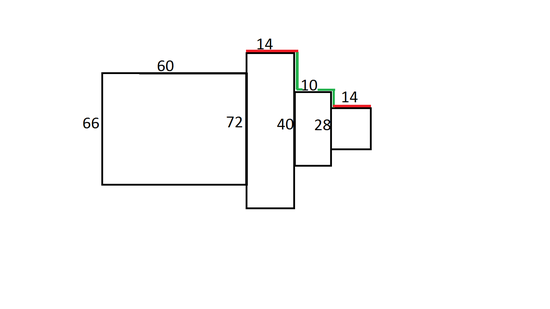
You said a 40X10 footbox? If you sewed a footbox that size on you 66" width quilt the fabric isnt going to be any where near wide enough to fully close up that footbox….

I think you should make the quilt (after shrinkage)

Flat Dimensions

1 : 66" wide 60" long
2 : 72" wide 14" long
3 : 40" wide 10" long
4 : 28" wide 14" long

Green sewed to green
Red sewn to red

Quilt

Anthony

Edit: Keep in mind that this doesn't take into account your shrinkage question

M W BPL Member
PostedJan 23, 2014 at 2:37 pm

Thanks for the advice everyone! I guess I'll have to do the old fashioned string-model-on-the-table approach – I initially thought of this, but then thought, there must an easier, more accurate way…and since I can scarcely calculate a 15% gratuity in my heard, I wanted to see check here first

Let you know how it works…

Viewing 14 posts - 1 through 14 (of 14 total)
Loading...