Topic

First sewing attempts and questions

  • This topic is empty.
Viewing 24 posts - 1 through 24 (of 24 total)
Jim H BPL Member
PostedJan 6, 2014 at 7:48 am

I’m new to sewing, but this weekend I dove in. I was gifted a Singer Heavy Duty 5532 and picked up some supplies around town and read through every BPL sewing article and lots of forum threads. I attempted a couple stuff sacks using some unknown coated nylon fabric from the thrift store, and then a simple zippered bag using some pack cloth remnants I picked up. (Pics below).

Still, I’ve got a few beginner questions related to sewing outdoor fabrics.

A. Does anyone ever use a glue stick or Scotch double-sided tape to help secure folds on these fabrics? Just messing around with scraps, the double-sided tape worked well, but I’m not sure if it’d hurt the seam integrity on a tarp or pack. I’m guessing one practical answer would be “practice until you don’t need tape.” Hopefully I’ll get there.

B. One issue for me was getting a nice straight line of stitching. One the green zippered bag, I was practicing a top stitch, and as you can see in the third pic, I was all over the road. Any tips for getting that line nice and straight? Googled turned up reference to an “edging foot,” but it also seems like lots of people don’t bother with one. Again just practice?

C. Is there a reference for the various types of fabrics and coatings? I’ve spent a bit of time on various retailer sites and I think I understand the uncoated, sil, and poly coated nylons in different weights, but then I keep seeing shorthand references to M50, M90, and Argon, etc., but I’m not sure whether these are different fabrics entirely or alternate names?

I think I’ve got the bug, and a tarp, summer sewn-thru quilt, and UL daypack are on my list before spring.

1

2

3

PostedJan 6, 2014 at 7:56 am

The fabrics are different.

I believe M50 is a 10D fabric that's .67oz yd2, so very thin, and m90 is 20D and 1.1oz yd2. Argon I think is 10D as well, probably as light as m50.

There's also Impetus 1.0, which I'll be using for my first sewing project (without help from my mom) and that's 15D at 1oz yd2.

There's this double sided fabric tape that can be sewn through without gumming up the needle then the tape completely washes out in the washing machine, apparently.
I'm going to try using that stuff so I won't have to pin everything.

I've only seen it at Seattle fabrics. Can't remember the name of the product and can't find it online. It's different from the iron/instant seam stuff.

Jim H BPL Member
PostedJan 6, 2014 at 8:53 am

Wow it's amazing those are lighter fabrics. I'll have to look into them. Seattle Fabrics is where I picked up some remnants. I'll look for that tape as well.

Also your info on the fabrics helped turn up this fabrics page on BorahGear: http://borahgear.com/fabrics.html

I'll have to find myself some of that Argon to play with.

Jerry Adams BPL Member
PostedJan 6, 2014 at 8:56 am

thru-hiker.com – limited selection, just state of the art stuff, more expensive

owfinc.com, questoutfitters.com – more selection, cheaper, most of the stuff is too heavy

titaniumgoat.com – nobul – which is light and cheap but nobul1 leaks down

seattlefabrics – more expensive but no better stuff. I hear their store in Seattle is worth seeing.

wildernesslogistics.com has cheap 850 down

Those are just the places I've bought from

Your seam is straight enough – don't worry about it – gets better with time – don't screw with those crutches like glue or tape : ) Don't waste time with "edgeing foot" (whatever that is). Sometimes pins are useful, or I just do some hand stitches and then maybe pull them out afterwords.

Jim H BPL Member
PostedJan 6, 2014 at 9:11 am

I like your style, Jerry. Thanks for the tips.

Looks like the Argon fabric is available via http://dutchwaregear.com/. $10/yard, various colors. Still more reading to do, but this sounds like a great material for my sewn-thru summer quilt.

PostedJan 6, 2014 at 10:09 am

Look for my link in Gear Deals for super cheap down.

From Allied Feather/Down Linens.

You can get 1 pound (minimum order amount) of 800FP for 82.80 shipped. or 1 pound 850FP for 103.5 and have plenty left over to make other things, or even make two summer quilts.

Ryan Smith BPL Member
PostedJan 6, 2014 at 10:23 am

A. I use pins usually. Some don't and that is fine. Small price to pay for your stuff staying put IMO.

B. Practice helps a ton. Start slow until you can get straight stitches every time, then speed up your machine a little. Repeat. My machine has some lines on the arm that you can follow as the fabric runs through which helps.

C. You've already got some good responses on this one. Keep in mind that Google can literally find anything you want also.

Ryan

Jerry Adams BPL Member
PostedJan 6, 2014 at 10:42 am

The most amusing thing about sewing is when you find a piece of fabric you didn't intend finds it's way into a seam

After mandatory curses : )

Elliott Wolin BPL Member
PostedJan 6, 2014 at 11:45 am

And the worst is when it's a fold of the waterproof garment you're making, and after you remove the stitching there are lots of tiny holes in your previously pristine fabric! So out comes the seam sealer (along with all the curses…).

PostedJan 6, 2014 at 12:29 pm

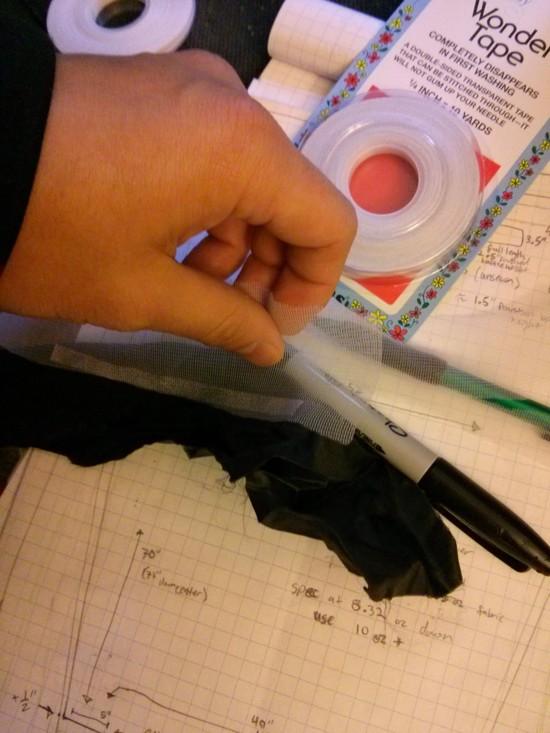
Just got back from Seattle Fabrics and picked up a couple rolls of the Wonder Tape that i was talking about. Should hold just fine while sewing!

Also snagged a yard of Polartec Power Grid remnant for cheap to play around with!

wonder tape

I bought 2 of the 3 rolls that were left, but they probably have more in the back.

Jim H BPL Member
PostedJan 6, 2014 at 12:40 pm

Thanks for the tip on the tape. Let me know how it works. There's a few similar looking items on Amazon, one by Dritz, and one by Collins, with reviews for each stating it's better than the other.

Roger Caffin BPL Member
PostedJan 6, 2014 at 4:24 pm

> One issue for me was getting a nice straight line of stitching.
Practice helps, but so does 'sewing under tension'. I was sure I had published a photo of this somewhere, but I can't find it.

When sewing, hold the fabric behind the machine with your left hand and in front of the machine with your right hand. Stretch the fabric a bit. Then sew, while allowing the fabric to feed through the machine. This does two things:

It keeps the fabric aligned as you sew. layers of silnylon and other light fabrics have this terrible habit of skewing with respect to each other due to the action of the moving dogs underneath and the drag of the foot above.

By controlling the fabric with two hands you also prevent it from skewing sideways if a bit gets caught somewhere else. Your hands look after external forces.

And using guide marks on the plate, or even the edge of the presser foot as a guide, also helps a lot.

Cheers

Bob Gross BPL Member
PostedJan 6, 2014 at 4:34 pm

"And using guide marks on the plate, or even the edge of the presser foot as a guide, also helps a lot."

That works a lot for me.

–B.G.–

Jim H BPL Member
PostedJan 6, 2014 at 6:05 pm

Thanks for the tips. I just spent a few minutes playing with scraps, and holding the fabric in tension really helps. I spent a considerable amount of time messing with the feed dog tension this weekend, and adding more tension by hand seems to make perfecting the feed dog tension less important. I did a bit better using the guide lines on the machine, but it'd be nice if they were painted a contrasting color. I've got some high-viz sight paint I may try and use to make the guide lines pop out a bit more.

Jerry Adams BPL Member
PostedJan 6, 2014 at 6:34 pm

I never adjust the tension above or below

Once you get it set, you don't need to change it

Of course, this depends on machine and stuff, just my experience

Sometimes, when pulling it through from the rear, especially with weird "fabric" like velcro or 1/8 inch foam, it will form rats nest underneath – the race doesn't catch the loop of thead and pull it around bobbin

Bob Gross BPL Member
PostedJan 6, 2014 at 6:41 pm

Try sewing with super thin silk. You will be tearing your hair out.

Even worse is 0.74 cuben fiber.

–B.G.–

Laurie Gibson BPL Member
PostedJan 6, 2014 at 6:44 pm

@Jim H.
"I did a bit better using the guide lines on the machine, but it'd be nice if they were painted a contrasting color. I've got some high-viz sight paint I may try and use to make the guide lines pop out a bit more."

or you could place a couple of inches of colored tape along the guide line of choice

Jim H BPL Member
PostedJan 7, 2014 at 12:26 pm

I'd like to make my first project a couple of tarps. I'd like to start with a big 10x10ft tarp which I plan on using late this summer hiking around Yosemite with my dad/brother. We're all a few inches over 6 foot, but I think this should be a good size for a simple pitch if we get any rain? I saw some recommendations for 10×12. What does the extra length get you in terms of pitches? Lastly, could I get away with just 4 tieouts per side, or are some interior tieouts necessary on a tarp of this size?

Elliott Wolin BPL Member
PostedJan 7, 2014 at 1:12 pm

You can purchase a walking foot accessory for many sewing machine models (not to be confused with a walking-foot sewing machine, which is something else). This helps move the fabric along from the top via a feed dog. I found it especially useful on bulky fabrics.

Ian BPL Member
PostedJan 7, 2014 at 4:17 pm

Thanks for the motivation Jim. I have some fabric and a pattern that I've been staring at for a few weeks. Time to send the kids out of earshot and dive in.

PostedJan 12, 2014 at 11:23 am

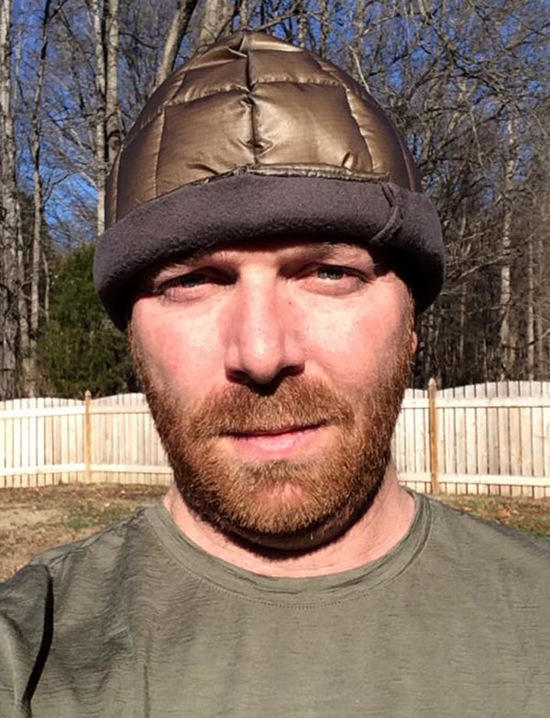
I just got my first thread injector for Christmas. Wife got me a higher end machine with a lot more features than I need but the best part is the "walking foot" that makes feeding light materials much easier. I think mine will live on the machine.
I've taken a few classes, practiced a lot on stuff sacks, and just made my first project, a Black Rock inspired down beanie that worked out OK.
I learned that 80% of the battle is in the prep work. I dug out the iron and ironing board and press everything before sewing. This helps keep fabric from bunching and allows me to make guide lines or creases that I can use as reference while trying to sew a straight line. I've had trouble getting the double sided tape I bought to stick to light nylon, but pins or women's hair barret clips work well to keep the ends together. Good luck and keep practicing.Down Beanie

Jim H BPL Member
PostedJan 12, 2014 at 3:29 pm

I found these two youtube videos on sewing a box stitch with webbing. The first video has a nice explanation of thread tension, and the second a nice explanation of the box stitch. They're filmed well with nice closeups of the stitching.

https://www.youtube.com/watch?v=l-OphRrTgUo

Bob Gross BPL Member
PostedJan 12, 2014 at 4:15 pm

Jim, I found those two short videos to be good. I wish I had seen the second one back a few years ago when I first got my sewing machine.

–B.G.–

Viewing 24 posts - 1 through 24 (of 24 total)
Loading...