After a 1 1/2 month adventure trip I returned yesterday to find the WPB Cuben I ordered from Zpacks in my mail. Out of curiosity, I tested it even before even unpacking.
The executive summary is that my lab tests show air permeability is poor (on par with low cost micro-porous PU coatings averaging .17 CFM) versus 3 layer eVent (averaging .53 CFM for UL 3 layer jackets). See http://www.prolitegear.com/site/nw-alpine-eyebright-jacket-overview.html for a bubbler test comparison.
The WPB Cuben abrasion resistance is projected to be lower than 3 layer eVent because there is not a tricot layer on either side. See my eVent and 2011 version WPB Cuben micrographs in submission 45 – 47 shown at http://www.backpackinglight.com/cgi-bin/backpackinglight/forums/thread_display.html?forum_thread_id=45026&disable_pagination=1 .
My tests and micrographs suggest to me (not proves) that the 2013 dotted WPB Cuben uses MP PU forced through one side of the Dyneema fibers and then scraped (mechanically abraded) into a square pattern on the forcing side, rather than eVent membranes on two sides. An alternative explanation is that after lamination, they mechanically abraded the eVent membranes to have a checkerboard pattern with the double thickness membranes only remaining on the perimeters of the abraded areas. In either case, the fabrication methodology looks very similar to 2011 submission 47 using non-MP PU.
The areal density of the sample I tested was 58.14 g/m2 (1.71 oz/yd2). The areal density spec is (48.3 g/m²) 1.42 oz/yd2. The HH tested greater than 3,515 mm H2O.
The following micrographs list the field of view (horizontal distance) and illumination source (top of sample or bottom of sample).
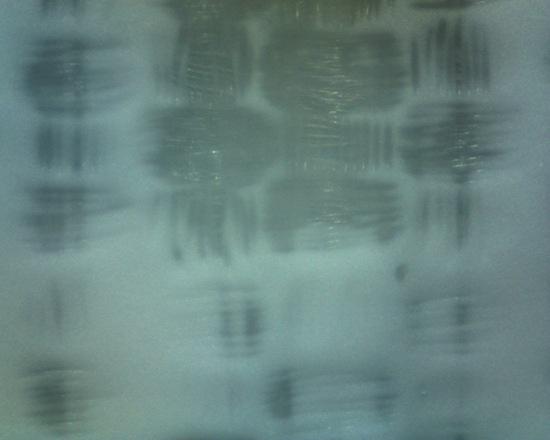
1 – 20mm Bottom
This micrograph best illustrates the fabrication sandwich which is made up of two WPB layers each with a thickness of .027 mm sandwiched on either side of a Dyneema matrix-like-pattern with a thickness of .021mm. I measured the thickness of each layer in my lab. The major grids are formed from a thicker WPB material rather than thicker Dyneema fibers.
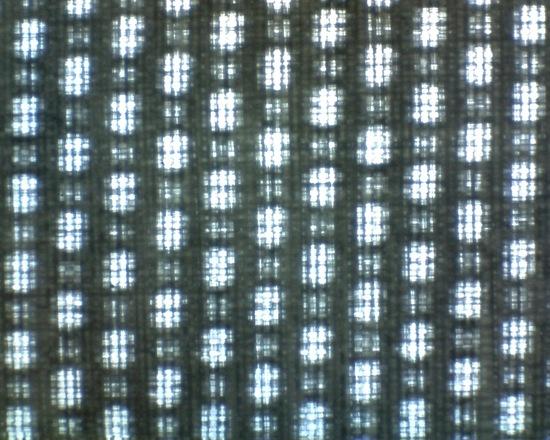
1 – 20mm Top.1
This view looks very similar to the 2011 submission 47 micrograph clearly showing mechanical abrasion after lamination.
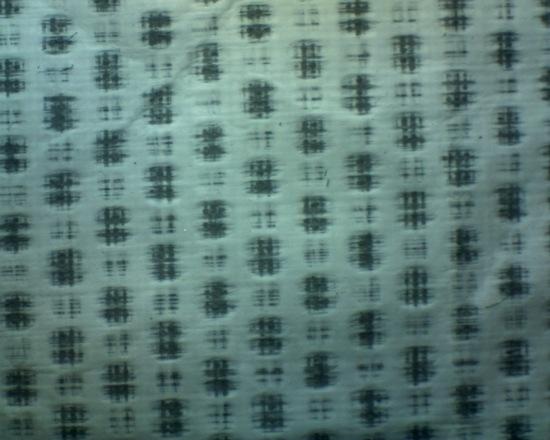
1 – 20mm Top
The manufacturing abrasion patterns are not the same on both sides of the fabric. This is the side opposite of what is shown in the prior micrograph. Note there is no tricot layer to protect the WPB layer on either side from field use abrasion as is commonly provided with conventional eVent fabrications.

2 -5.0mm Bottom
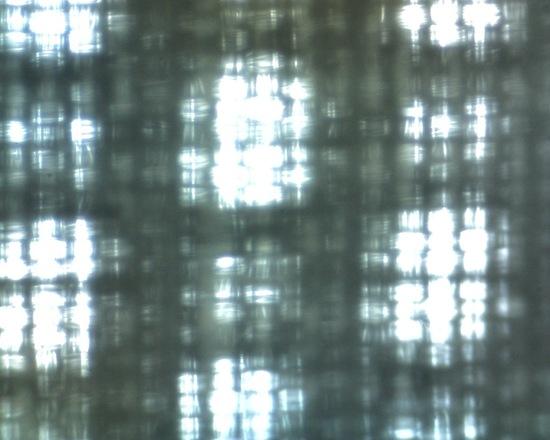
2 -5.0mm Top

3- 1.4mm Bottom

3- 1.4mm Top