


Exactly why I love, love, love theory threads. When we actually walk ourselves through the accepted logic and generalities, eyes get opened.
Topic
Become a member to post in the forums.
Exactly why I love, love, love theory threads. When we actually walk ourselves through the accepted logic and generalities, eyes get opened.
nm
This would make for a great BPL article. Hint Hint.
Ryan
Here's what I heard back from MH:
"Hi Max,
Thank you for contacting Mountain Hardwear today, great questions. Compressing your Ultralamina 15 during the day while traveling won't affect the useable life or loss of warmth of the bag. The Ultralamina 15 is meant to be compressed in the compression stuff sack while traveling. As long as you are storing it in the storage bag, or better yet, hanging in the closet when you are home it will uphold quite nicely. For the average use, it's meant for a lifespan of upwards of a decade with good maintenance. If you plan on using it everyday and compressing it all the time it may only last a few years, though this doesn't sound like your intended use.
I hope this answers your questions, if you have any further questions please let me know.
Best Regards,
Amanda
Mountain Hardwear
Customer Care"
I responded asking what their testing process is like, so hopefully they'll have even more information for me in a little bit. This response is a bit generic and vague, so I don't know how much it contributes to the discussion, but hey, it's something!
When I think of something worthy, I'll probably submit an article to BPL at some point but I won't be doing it on this (not enough expertise). I definitely think sleeping bag compression could be an amazing article, though.
I have some left over syn insulation (whatever Ray Jarnine uses). I was thinking of pressing it flat overnight and letting it re-loft each day. Measure the loft at the start and then measure again after 30 (or some amount) of days. Pressing it flat (using say a book) might be over compressing it. Maybe us carpet so something else under it? What does "everyone" think? Any better ideas for a simple test?
i think using modern climashield APEX would be best
synthetics have improved from years ago IMO …
the thing is all these big companies to compression cycle testing … im sure someone has the data somewhere
;)

I doubt if you would get much more of a response from a manufacturer's representative. We're very spoiled here with the wealth of talent. If DuPont or other fiber manufacturer's have the real test info, they wouldn't publish it unless they found the Holy Grail of Insulating Fibers— accompanied by a long line of patent attorneys.
On the consumer side, there are so many variables that it would be impossible to give a truly accurate number of compressions or uses per life of the product. Or I could lie to you ;)
I like the decade idea in that the rest of the bag will be trashed by the time the loft goes dead if you are using it a lot. I'm sure 90% of the sleeping bags sold get less than 14 days use per year. Through hikers and UL Arctic explorers don't even put a dent in the market.
The other consideration is that there will be a whole new whiz bang replacement before the service life of your current bag has expired. I remember stuff like Hollofil, Quallofil and 14 zillion other variations over the years. People will be arguing the attributes of three new ones plus two more treatments for goose down before you trash that bag.
Bottom line? If you wear that bag out it means you were having a lot more fun than the desk-bound stiffs on the other side of this screen :)
"If you wear that bag out it means you were having a lot more fun than the desk-bound stiffs on the other side of this screen :)"
You don't have to rub it in! ;^)
I've been recovering from a back sprain and got out today for a 3 mile stroll. IT FELT SO GOOD! It is *sunny* in *November* in *Seattle.* My dog just about took the front door off the hinges when I grabbed the leash.
Reading about Max's adventures makes me want to travel. I think Maui would be just about right :) No way I'm biking in the Midwest in November. {{{{{{{BRRRRRRRR}}}}}}
"I have some left over syn insulation (whatever Ray Jarnine uses). I was thinking of pressing it flat overnight and letting it re-loft each day. Measure the loft at the start and then measure again after 30 (or some amount) of days. Pressing it flat (using say a book) might be over compressing it. Maybe us carpet so something else under it? What does "everyone" think? Any better ideas for a simple test?"
Do the real thing: pack it randomly into a bag, or a small sample into a pill bottle or similar. The folding and bending of the fibers is a big part of it. A tall graduated cylinder with a weighted piston would allow compression and then measuring the rebound. I would expect to see a curve with less desired values increasing over time.
Or buy a nice bag and use it a lot. Much more fun. I'm a fan of through field testing :) I've sent emails to nearly every distiller in Scotland, but no takers. Darn!

I don't think that synthetic bags are bad, they have their purpose and in some situations they are better than down. My only issue is the cost of replacing them. I'm too poor to buy cheap gear ;)
The idea that they necessitate replacement is the question of the hour, Justin ;)
MH got back to me with no relevant information at all, as you predicted Dale. Oh well. Guess I'll have to find out the hard way!
I won't be babying my bag quite as much as I was given the info in this thread.
Look on the bright side, Max: if the performance of your bag isn't in conformity with MH's response to you, you can use that letter to make them give you a replacement! Free replacements every 2-3 years should provide you with warm nights for a very long time. :~)
I like to view ALL gear as disposeable.
Whether it wears out, deteriorates, or just plain goes out of fashion, it all begins to depreciate the day you buy it. Some faster than others.
Thinking otherwise is somewhat foolish.
I can guarantee that cheap synthetic bags die fast from hard compression. Note that the really cheap ones are shipped compressed. I bought an Alps on an REI outlet sale for $26 just to have as a spare and I got just I paid for. Like any junk, it doesn't get better with age!
I wonder if the impressions of synthetic bags are weighted by the experiences with cheap stuff?
well there are enough people out there with mr. marshalls and mr. bells quilts …
any BPLers willing to come out and say that the prodigy and spirit quilts die a quick death?
if they do i would VERY much like to know … as one or the other is likely on my bucket list for next year
or how about the DIYs who make their own with APEX?
hmmmmm
;)
Max,
Look at Buck's post on using down bags for thru hikes. They held up well after what would be hundreds of compressions.
Down is the champ for:
1. retaining loft longest
2. lightest fill
3. best compressability
And with the new DWR treated down I think it will continue for many years as the best fill with even more people using it.
The Army gear lab at Nautick tests a LOT of gear, among them sleeping bag and cold weather garment fills. They need moderate cost and performance, pretty much in that order. Since they currently like Climashield and have found it very resliiant I'd say they likely know it's the best synthetic available – so far.
Not to say that Special Operations forces don't use down bags and clothes but they are small in numbers compared to the "Big Army" and Marine Corps.
Spec. Ops forces have their own budgets and very often get the best civilian gear. I've seen this when skiing with Army Special Forces troops. Believe me, if they want it they usually get it, cost be damned.
Become a member to post in the forums.
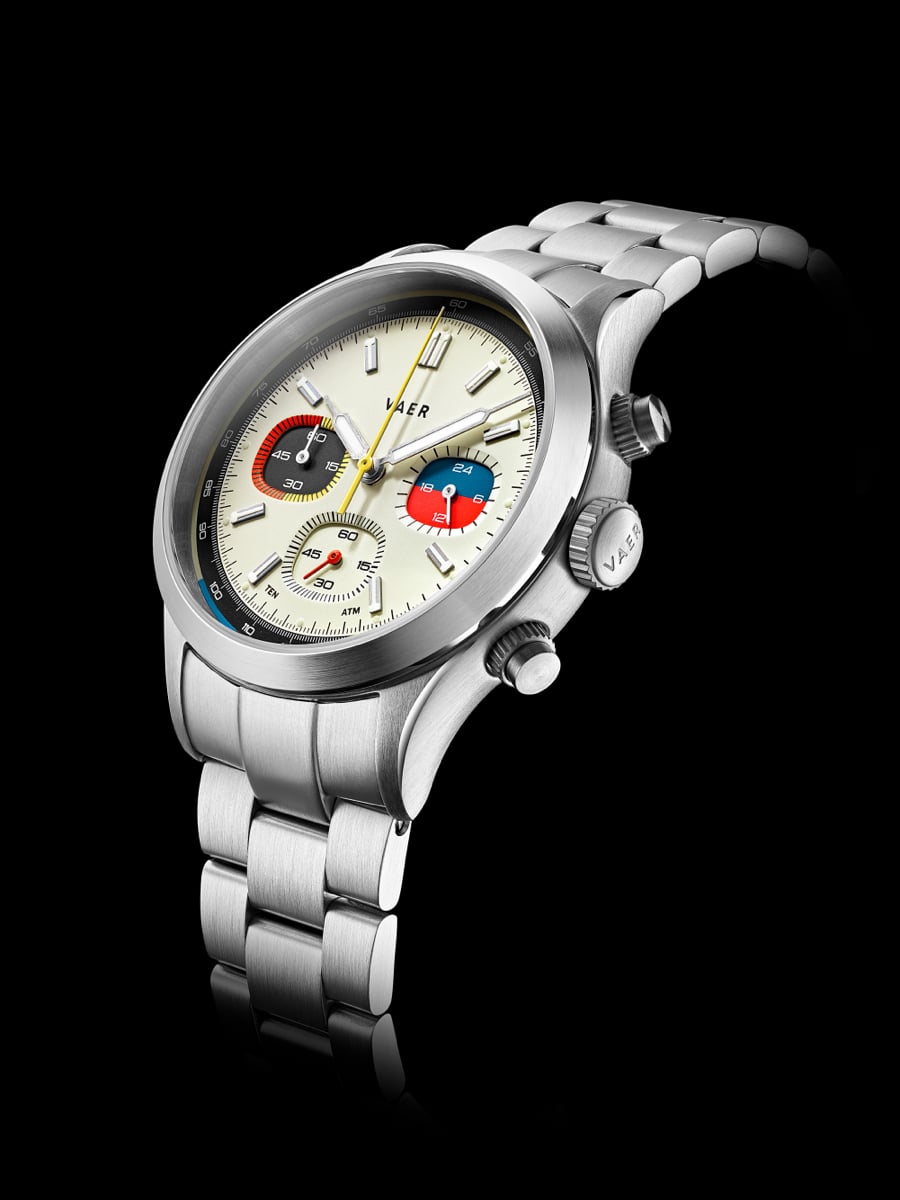 Retro Racing Character, Built for Everyday WearDrawing on the colorful racing chronographs of the 1960s and '70s, the RS1 Rally pairs vintage motorsport style with the durability expected from a Vaer. Its 40mm case houses a Japanese VK63 meca-quartz chronograph movement, complete with stopwatch functionality and an integrated tachymeter scale, while contrasting subdials give the watch its distinctive retro character. Sapphire crystal, 100 meters of water resistance, a screwdown crown, and strong BGW9 lume make it far more than a style piece. At under $300, it's an easy pick for the car enthusiast or chronograph fan.
 © Beartooth Media Group Inc.
 Loading...