


Lets say you had two 10 oz fleece sweaters layered on top of each other, and then you had one 20 oz fleece sweater.
Which would be warmer, the two light fleece sweaters or the one heavy fleece?
Topic
Become a member to post in the forums.
Lets say you had two 10 oz fleece sweaters layered on top of each other, and then you had one 20 oz fleece sweater.
Which would be warmer, the two light fleece sweaters or the one heavy fleece?

I would think the two, because you are bound to trap some air in between the two and create a little more insulation that way. Something else to consider is that with two, you might be adding bulk and fabric in places that will not help with warmth like in the armpit area. One heavier fleece might be lighter in that area and thicker where it's needed?
Just a couple of thoughts.
BTW, not your question but just in case…
If you do indeed intend to layer you would have two items of different warmth/loft/weight.
That is because doing that it gives you 3 different option.
So say
1) 7 oz layer
2) 13 oz layer
3) 20 oz ((7+13) layer

what Kat said – two layers trap air between so it's warmer, but not enough to be noticeable
if you have two layers of down or synthetic, then the one layer is warmer for the weight, because with two layers you have an extra layer of fabric on top and bottom of that second layer which adds little warmth, but it's not a huge weight penalty, a few ounces
Not only for the air-trapping effect other have mentioned, but with two layers you'll be able to shed one when you're working harder and not sweat as much, which will make you warmer later when you need both layers.
I am going with less warm. A 10 oz fleece might have 3 oz of elastic, pockets, zippers etc. even if it is just the collar of the shirt I suspect that the advantage given by the air gap is offset by garmet construction.
Two layers will dry faster than one thicker layer generally
Something to consider ;)
Thinking of what it takes for me to comfortable at 0F or at -20F and Greg is right, one big layer is more weight efficient than two garments at that one, lowest temperature. The colder-rated garment is just more fill, whereas two garments adds inner and outer shells plus zippers, storm flaps, etc.
And I do that (one big garment) AROUND TOWN or while driving because I'm either outdoors (big, thick layer) or indoors (t-shirt) and shedding one layer at the door is convenient.
But ON THE TRAIL, I'm in and out of the sun, exercising and then not, and the temperature swings each day. So variable layers is helpful. As the Inuit practice: Never sweat. Stay a little on the cool side whenever you exercise.
And I very much agree with Franco's thoughts about 1/3, 2/3 being a versatile combination.
If you go with one primary garment, it should have a lot of ways to open up – side and pit zips. There are times when I'm dog mushing in insulated coveralls, but the side zips are open from ankles to hip. Then I zip up as soon as we stop, get a cross wind or the temps drop.
I do understand that puffy layers are lighter for the warmth when you add a bunch of fill because of the shell material (kinda the reason why I don't care for really light puffy jackets) but I was more referring to non puffy layers like fleece and wool sweaters.
I do agree that light layers are better, on the other hand too many layers can become cumbersome.
Speaking of layers, I think I broke the record for most layers when I wore 10 layers out of desperation one mildly hypothermic night (borrowed a couple from my friend).
>"Speaking of layers, I think I broke the record for most layers when I wore 10 layers out of desperation one mildly hypothermic night (borrowed a couple from my friend)."
I've long remembered a college party at my house late at night when a Dutch exchange student had to bicycle home. He asked to have an old newspaper, separated the sheets, crumbled them up, stuffed them under his wind breaker, and rode home. Instant puffy! For free. When you need it. There are often natural materials (pine needles, leaves, etc) or things with us (ground sheet, tarp, pack bag, etc) that could be fashioned into some additional insulation. Like emergency driving maneuvers, I practice those scenarios in my head so when I need them (a little panicked and hypothermic), I'll be recalling rather than creating something anew.
On one of those faux survival shows they put leaves and needles inside their shirt to stay warm
As previously mentioned, the zips/pockets, etc will add weight.
But as you're looking at fleeces, the shell weight wouldn't be applicable.
Going with Franco's 1/3 and 2/3 weight division would give you the most versatility.
Maybe you could find a lighter fleece for the inner layer with no pockets/misc features or cut then out yourself, and the outer one have pockets, etc if you need them.
Or, fleece vest inner and fleece jacket outer.
Become a member to post in the forums.
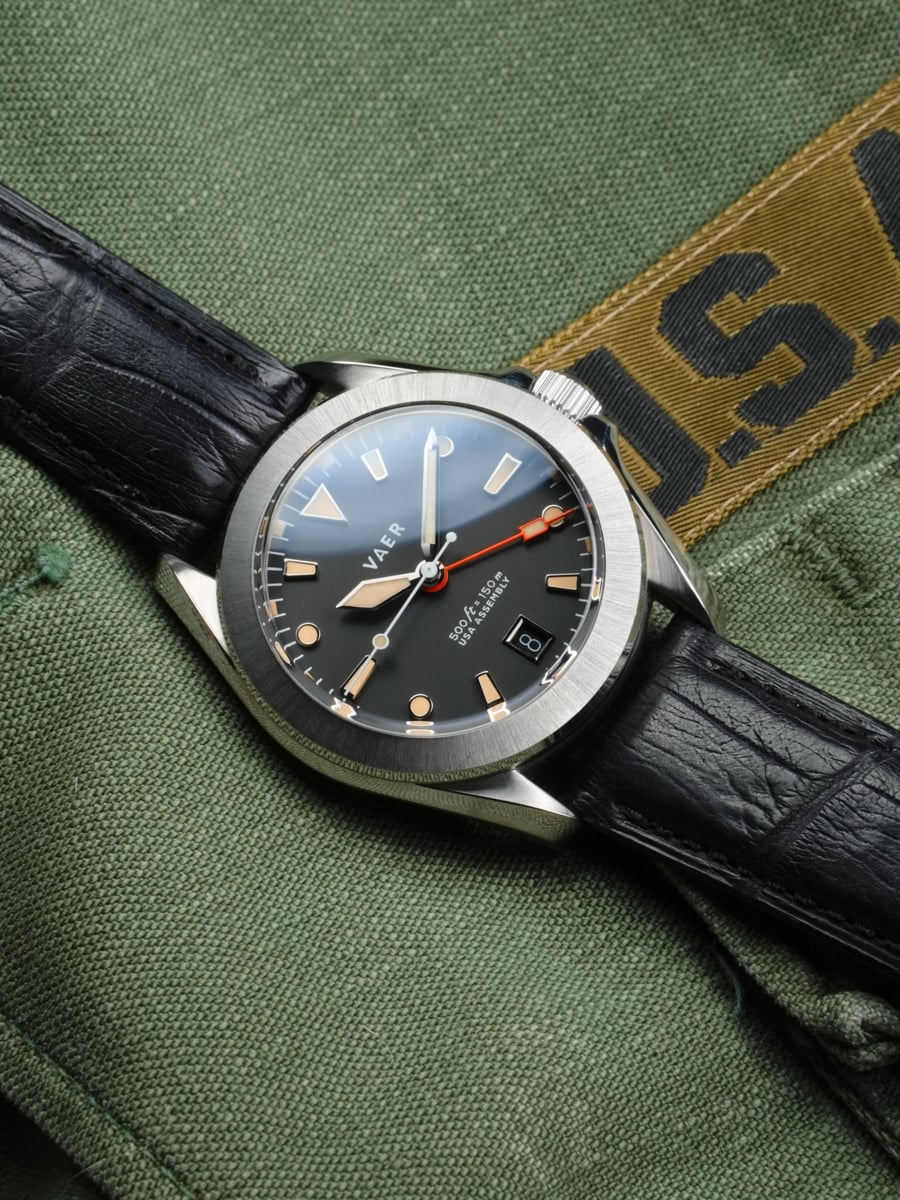 A Cult-Classic GMT Reimagined for Everyday WearInspired by the famously bezel-stripped Rolex GMT-Master worn by Marlon Brando in Apocalypse Now, the G2 Apocalypse turns a piece of 1970s film and watch history into a practical everyday GMT. Its restrained 39mm design pairs a Swiss Ronda quartz GMT movement with sapphire crystal, 150 meters of water resistance, strong BGW9 lume, and USA assembly. The result is an accurate, low-maintenance travel watch with a story collectors will immediately recognize.
 © Beartooth Media Group Inc.
 Loading...