


…
Topic
Become a member to post in the forums.
…

Once you take it out, give it some time to fluff up, and try to measure it's loft. That measurement could go a long way toward helping better understand what it's realistic "R-value" might now be.
Down, in general, has been proven over the years to be quite resilient.
Matt

Roger,
I know a sleeping bag designer that stored some bags compressed as test for a couple of years, and when removed they lofted up to about 70-80% to that of the same model that was stored uncompressed. I think I recall they where 800+ Fp.
From the few studies I've seen, compression doesn't minimal long term damage, it does drastically increase loft time.
Basically down is like velcro on a microscopic level. So heavy compression keeps it stuck to itself pretty good. For the down to actually be damaged, you'd have to move the bag around a lot for the down barbules and plumes to break (think about rubbing velcro around to make it fuzzier).
Once the bag is unpacked it may take a few days to full loft, shaking it out after a few hours should help with this. Also know that any Costco bag (especially from 2009) won't be a "true" -20 bag. That may be a limit where you won't die at those temps, but you aren't going to be remotely warm either.
Loft isn't the most accurate measure for warmth, but it is a decent starting place for guesstimating. Based on Western Mountaineering 6-7 inches double layered will bring you down to just above 0F (they are a bit conservative, but will be using better down and design so work as comparison).
http://westernmountaineering.com/index.cfm?section=products&page=Sleeping%20Bags&ContentId=27
Give it to him for the temperature rating listed. He won't die if it's at 70% of it's original performance. If he's cold and can't sleep, it'll be just punishment for storing a bag compressed, and he'll never forget the lesson again.
-Max Dilthey's School of Hard Knocks

Fluff it up and measure the loft. Then compare the loft to charts showing temperature rating by inch of loft. Method isn't perfect but you should have a rough idea by doing this.
Edit:Matt already mentioned this. I should have read the responses before responding.
Here is a chart from a BPL article in 2004 :
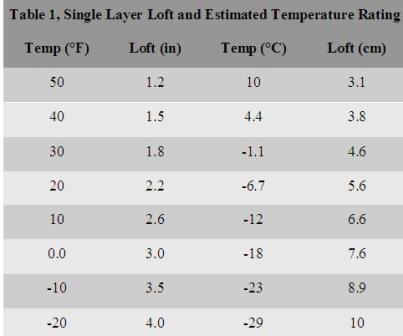
Western Mountaineering have a more conservative temperature range but close to it :
http://www.westernmountaineering.com/index.cfm?section=products&page=Sleeping%20Bags&ContentId=27
you need to divide the WM figures by 2 (7" =3.5" top and 3.5" bottom)
Give the bag plenty of time to fluff up and vigorous shakes, no wimpy stuff.
Become a member to post in the forums.
 New Gear with Aluula FabricsLighter, stronger, more abrasion-resistant, and highly water-resistant - explore ultralight backpacking gear made with ALUULA Graflyte fabrics. Engineered for exceptional strength, durability, and lightweight performance, ALUULA Graflyte helps reduce pack weight without sacrificing reliability, making it ideal for demanding backcountry adventures.
 © Beartooth Media Group Inc.
 Loading...