Topic

Brightest Red LED Headlamp in 2xAAA or 1xAA

  • This topic is empty.
Viewing 9 posts - 1 through 9 (of 9 total)
PostedOct 29, 2013 at 12:59 pm

I spent 10 hours hiking in the dark on a technical trail (intentionally) with a PTec Byte mounted at my waist. The Low mode white was more than enough to illuminate the trail ahead and had a wide enough spill to highlight the sides of the trail, which was important, as the frequent switchbacks required the ability to see “up or down the corner”.

The Red LED, though, was not sufficient to get the job done. It is about as bright as a fresh Petzl e+lite, has a wide flood with about 10 feet of usefullness, but no appreciable side spill, and the illumination from a waning half moon is enough to wash it out. I couldn’t find a spec on the PTec site.

I like preserving my night vision with a red LED, and I like the low power consumption.

So, does anyone make a small headlamp with a Bright Red LED? What are the specs to look for?

I’m looking for a solid 12 hours of runtime on 2xAAA or 1xAA, at least 10′ of throw, and a “rotating mount” for easy aiming. (Hinges on the waist tend to move down bit by bit.)

Or do “bright red” and “low power consumption” not fit in the same sentence?

Thanks.

Edit: Anyone got insights on the Underwater Kinetics Vizion ?
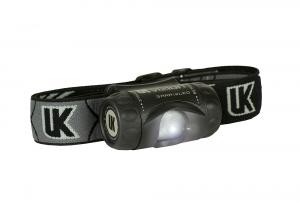
Vizion

Bob Gross BPL Member
PostedOct 29, 2013 at 1:07 pm

I realize that this is not exactly what you are looking for. Would it do any good to put a simple piece of red cellophane over a good AA headlamp? There are plenty of good AA headlamps with multiple intensity levels, so all you need is the red factor.

–B.G.–

Barry Cuthbert BPL Member
PostedOct 29, 2013 at 2:10 pm

Zebralight H51r

http://www.zebralight.com/H51r-Red-LED-AA-Headlamp-ship-to-US-customers-only_p_63.html

Main Features and Specifications

LED: Cree XP-E Red (Dominant Wavelength 620-630nm)
User Selectable Levels: 3 main level (High, Medium and Low). Each main level can be configured to one of its two sub-levels. The second sub-level of the High can be further configured to different brightness levels or strobes.
Light Output
High: H1 100 Lm (0.9 hrs) or H2 60 Lm (2.4 hrs) / 80 Lm (1.7 hrs) / 4Hz Strobe
Medium: M1 20 Lm (8 hrs) or M2 10 Lm (30 hrs)
Low: L1 2 Lm (3 days) or L2 0.2 Lm (16 days)
Light output are out the front (OTF) values. Runtime tests are done using Sanyo 2000mAh Eneloop AA batteries.
Operating Voltage Range: 0.7V – 2.5V
Battery: One 1.5V AA (NiMH, lithium or alkaline). 14500 Li-ion batteries are not supported. Batteries are not included in the package.
Parasitic Drain: Negligible (equivalent to 16 years)
Beam Type
80 degree spill beam spread
9 degree hot spot
Dimensions
Diameter: 0.90 inch (23 mm)
Length: 3.2 inch (81 mm)
Weight
1.2 oz (35.8 gram)
2.2 oz (61.9 gram) with an Eneloop AA
3.0 oz (84.9 gram) with an Eneloop AA and headband
Features
Electronic soft-touch switch, with a 200,000 cycle operating life
Smart user interface provides fast and easy access to all brightness levels
Precision machined unibody casing from premium grade aluminum bar stock
Proprietary heat sinking design bonds the LED board directly to the unibody aluminum casing, providing unblocked thermal paths to over 94% of the surface area.
Durable natural hard anodized finish (Type III Class I)
SCHOTT ultra clear lens with anti-reflection coatings on both sides
Orange peel textured reflector
Battery power can be locked out by slightly unscrewing the tailcap to prevent unwanted activations or parasitic drain
Waterproof to IPX7 (2 meters, 30 minutes)
Operations

This light has 3 main levels (High, Medium, and Low). Each main level can be configured to one of its two sub-levels. The second sub-level of the High can be further configured to different brightness levels or strobes.

Basic Operation
Short click turns on the light to High or turns off the light.
Long click (press and hold for about 0.6 seconds) turns on the light to Low.
Advanced Operation and Configuration
Short click turns on the light to High. Short click again quickly to cycle from High to Medium, and Low.
Press and hold to cycle from Low to High, release to set. When press and hold, the light always cycle from Low to High regardless which level you are currently in.
Double click to toggle and select between the two sub-levels for that main level. Sub-level selections (except the strobe) for the 3 main levels are memorized after the light is turned off and through battery changes.
The second sub-level of the High can be configured after 6 double clicks. Double click (startng with the 7th) to cycle and select different brightness levels or strobes. Short click to turn off the light when finishing configurations. The selections for the second sub-level of the High are memorized after the light is turned off and through battery changes.

Accessories in the package

Pocket clip
One black silicone holder with headband
One GITD silicone holder
Two o-rings

PostedOct 29, 2013 at 2:15 pm

"ZebraLight H51r-Red"

Exactly what I want.

To bad it is Discontinued.

Anyone got one needing some love?

Mark BPL Member
PostedOct 30, 2013 at 4:19 pm

Red light in itself does not preserve night vision.

If you go for a brighter light it does not matter if it's red green or blue it will still affect your night vision.

For civilian use i don't really see any gain for preserving night vision.
If the night is bright enough to safely do your work without a torch then no red light is needed.
If the night is not bright enough to do your work safely then use a torch.

Personally i use a torch for 99% of my night hikes and i use my torches on their brightest settings.
I always make sure i have more than enough batteries, so i don't see any point in messing about with lower settings.

15 years ago it made sense as torch outputs tended to be extremely low, so it was actually safer to preserve some night vision as often it was better than the output of the torch.

These days there are many extremely small and light weight torches that will illuminate your path for as far as a human eye can pick out details, they also offer great battery life and are extremely reliable.

Just doesn't make sense to me for people to stumble about in the dark risking injury under some strange pretence of preserving night vision.

Embrace the light :)

PostedOct 30, 2013 at 6:13 pm

"Red light in itself does not preserve night vision." [especially at high intensities]

Interesting. Good to know.

Thanks.

Steve M BPL Member
PostedOct 30, 2013 at 7:13 pm

Come up to the PNW and try a night hike in thick fog/mist. A bright red LED headlamp is far superior to a white one in this situation.

PostedOct 30, 2013 at 7:50 pm

Mark S is on the correct track. There's a lot of misunderstanding about what a red lamp will do. I actually own the rare and sought-after Zebra H51r, and now I'm going to tell you why you don't need one. I have a friend who is a professor of perceptual physiology, and he explained this to me in great depth (much of which I could not follow) but the upshot is this:

If you are using red light at high enough intensity that you can see red, then it's not conferring any particular protection of night vision. Same with NVG, Night Vision Green. But if you turn deep red down low enough that you're only "seeing in black and white," (ie, your rods are functioning but your cones are shut down) then deep red DOES confer additional protection of your night vision, beyond what white light could do. If you turn your white light down to a sublumen level, you'll be able to preserve quite a bit of NV, but not as much as you could with deep red or NVG.

As Mark S correctly points out, this is not a good level of light for night hiking.

According to the gurus at CPF, most of the red LEDs available on the market are orange-red, which doesn't confer more protection than any other color. The red has to be a very, very deep red. Alternately, you can try NVG, which has the same effect.

One reason red light IS prized, is that it doesn't attract the bugs like white light does. Which frankly has become the main use I put my H51r to.

The odd effect is: you'll get more preservation of your vision with a white light turned down to a sublumen mode, than you will with a bright red light. So if you can't spring for a dim red light, get a white light that goes very dim, and enjoy most (if not all) of the benefits of red. But, there's really no NV advantage to a bright red light at all.

I agree with Mark. Embrace the light.

Save your night vision for star parties and such.

Viewing 9 posts - 1 through 9 (of 9 total)
Loading...