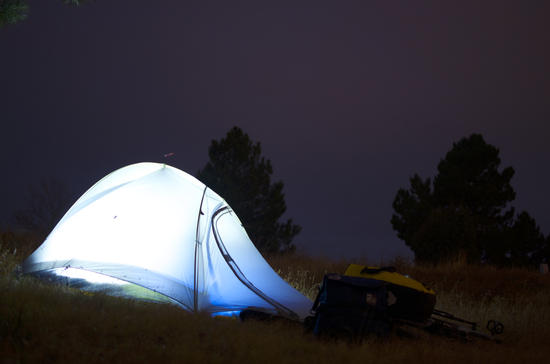
I picked up the Fly Creek UL1 Platinum and was surprised that my experience was so different from what I expected from reading reviews.
I have experience with very few tents, so maybe there are other forum members out there who, like me, are aggressively searching for reviews and making a purchase based off them, rather than personal experience. I have about 8 nights in the tent, two in rain and one near freezing.
Size:
I am 6'2", and I use a 6'6" sleeping bag. I can lay completely flat in the tent and not touch the netting on either my head or my feet. If I shake my feet around in the foot of my sleeping bag, the bag can touch the netting, but it wasn't an issue. I was very comfortable from side to side. I also had enough room on either side of me for my camera, my jackets, and my extra clothing. My pack went under my legs and overall, all my gear was in the tent and didn't inhibit sleep.
I can sit up in the tent, but it's an awkward hunch when I'm sitting on my NeoAir. Often, my head touches the netting while sitting up. I can, however, maneuver into a position where I'm not uncomfortable, so I wouldn't mind being stuck in the tent for a rainy morning. I don't think I could work (type) in the tent, but I can definitely read.
Durability/Construction:
Obviously I can't speak to long term durability. However, the tent feels very stable. I was surprised when I set it up; it actually looks like the pictures in Backpacker Magazine. The fabric is not wispy like spinnaker cloth, and the footprint feels substantial without being heavy.
The included stakes were surprisingly nice. At one point, I'll tie rope pulls on them. The way I'm using them, I have a loop tied into the end of each of the guylines and I just loop that on the notch in each stake.
The guy-lines on either side of the door didn't look very useful to me, so I took them off. I didn't have to cut them, and I can always re-tie them. For the life of me, I couldn't figure out how to use the included tensioners, but I haven't found them necessary; I just stick my stakes out far enough that the line is taut. I usually use the two guylines at the base of the fly on either side of the tent, and I left the middle-of-the-fly guylines on for bad weather.
Set-up:
I expected a tent that was much harder to set up than a fully free-standing tent. I also expected the longest middle pole to be relatively insecure. However, the middle pole was completely secure and didn't flop around or wiggle at all. I can get by with 6 stakes, but I don't particularly like it; 9 stakes is preferable because I can stabilize all 3 poles plus the 2 stake-outs near my feet, the vestibule, and most importantly, the sides of the fly. Without two stakes on either side of the fly, the fly rests very close to the bug netting and condensation is produced. If you guy the sides out tight, condensation isn't produced.
It sounds like a lot of stakes, but in practice, I found that putting in 3 more stakes than a "normal" tent has wasn't that big a time-sink, and the end result was a tent that felt more like a tarp than a movable shelter. It has performed just fine in the rain, with no obvious fail points.
I hope this is helpful in the sea of other Fly Creek reviews. I know the platinum is newer, so maybe my reflections on the fly material are useful to veteran tenters.
Now go! Camp!