


Is there an accepted formula for finding a an estimate of surface area needed to support a given weight in various kinds of snow? Seems like this would be a useful thing for cross-comparing skis of different shapes, and snowshoes too.
Topic
Become a member to post in the forums.
Is there an accepted formula for finding a an estimate of surface area needed to support a given weight in various kinds of snow? Seems like this would be a useful thing for cross-comparing skis of different shapes, and snowshoes too.
To determine surface area you can either use Manufacturers specs or divide up what ever product you have into simple geometric shapes and add up all of the total parts.
Once you have your area divide weight in pounds by Square inches to get PSI.
Now comes the difficult part. How much Pressure can snow support. And as the snow conditions change how much can it support. You can get a rough idea buy looking at the weight ranges for snow shoes. But that tends to be optimistic. For a conservativ value take the low end weight for the snow shoe and divide it by the area of that snow shoe. If you look between manufactures of snow shoes this value is always pretty close. I am thinking it was 6-7psi but I can't remember.
Here's one spec for shoe shoes for unpredictable conditions: (10+ days of dog mushing the 1,049 miles to Nome):
Rule 16 — Mandatory Items: A musher must have with him/her at all times the following items:
Proper cold weather sleeping bag weighing a minimum of 5 lbs.
Ax, head to weigh a minimum of 1-3/4 lbs., handle to be at least 22” long.
One operational pair of snowshoes with bindings, each snowshoe to be at least 252 square inches
in size.
Any promotional material provided by the ITC.
Eight booties for each dog in the sled or in use.
One operational cooker and pot capable of boiling at least three (3) gallons of water at one time.
Veterinarian notebook, to be presented to the veterinarian at each checkpoint.
An adequate amount of fuel to bring three (3) gallons of water to a boil.
Cable gang line or cable tie out capable of securing dog team.
Functional non-chafing harness for each dog in team and a functional neckline
The problem working it out is the type of snow you come across, so you need to allow for the softest type you have there.
To illustrate take a look at a mate of mine carring the same load a day apart :
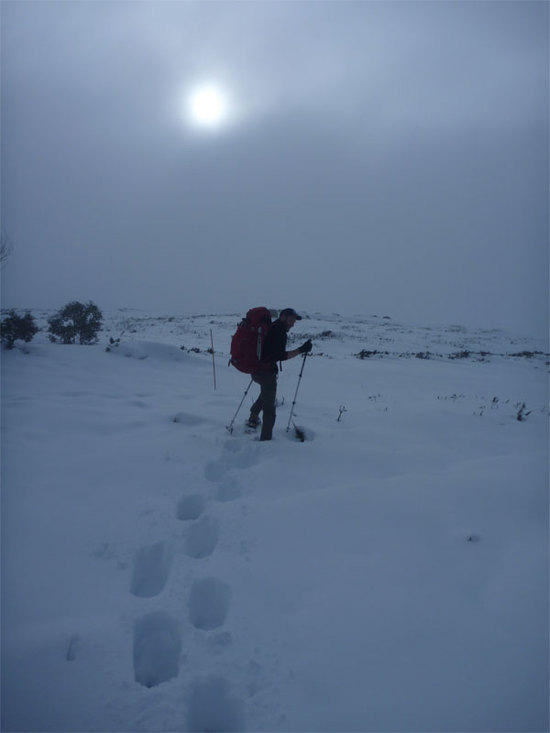
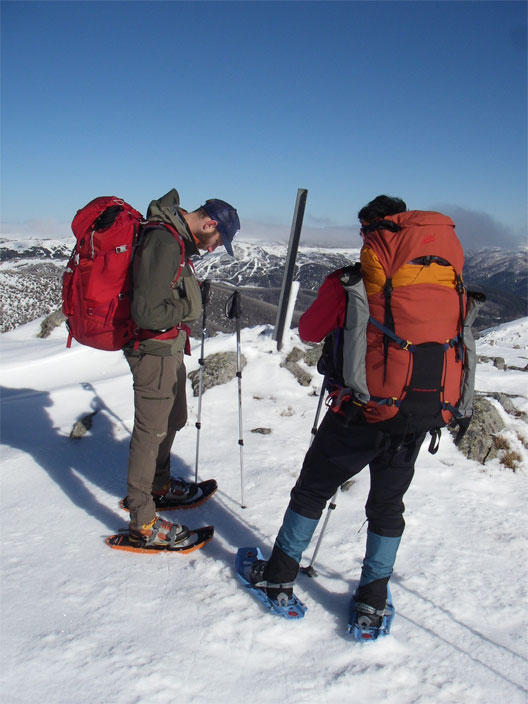
what you don't see there is that at times the first day he was sinking well past his knees and so was I, that somehow putting me off taking photos…
why bother…
what you are going to find out after days of calculations is that you need a 'quiver' of skis and snow shoes in order to have the optimal equipment for the various conditions… unless you plan to get one set and only go out when the snow meets the optimal conditions for the skis and snowshoes you own…
or… you just get one set in the middle and learn to adapt your technique to the various conditions… this is often the best strategy since you will encounter various conditions on any one given ski/snowshoe trip anyway…
Bill D

del
Become a member to post in the forums.
 DS2 Meridian: Vintage Dive Style, Everyday ReliabilityInspired by the streamlined "skin diver" watches of the 1960s, the DS2 Meridian combines vintage proportions with the durability of a modern everyday tool watch. A reliable Japanese Miyota quartz movement delivers set-it-and-forget-it accuracy, while 150 meters of water resistance, a locking screwdown crown, sapphire crystal, and strong Super-LumiNova make it ocean-ready. Available in multiple case sizes and starting under $250, it's an approachable way to get classic dive-watch styling without sacrificing everyday practicality.
 © Beartooth Media Group Inc.
 Loading...